
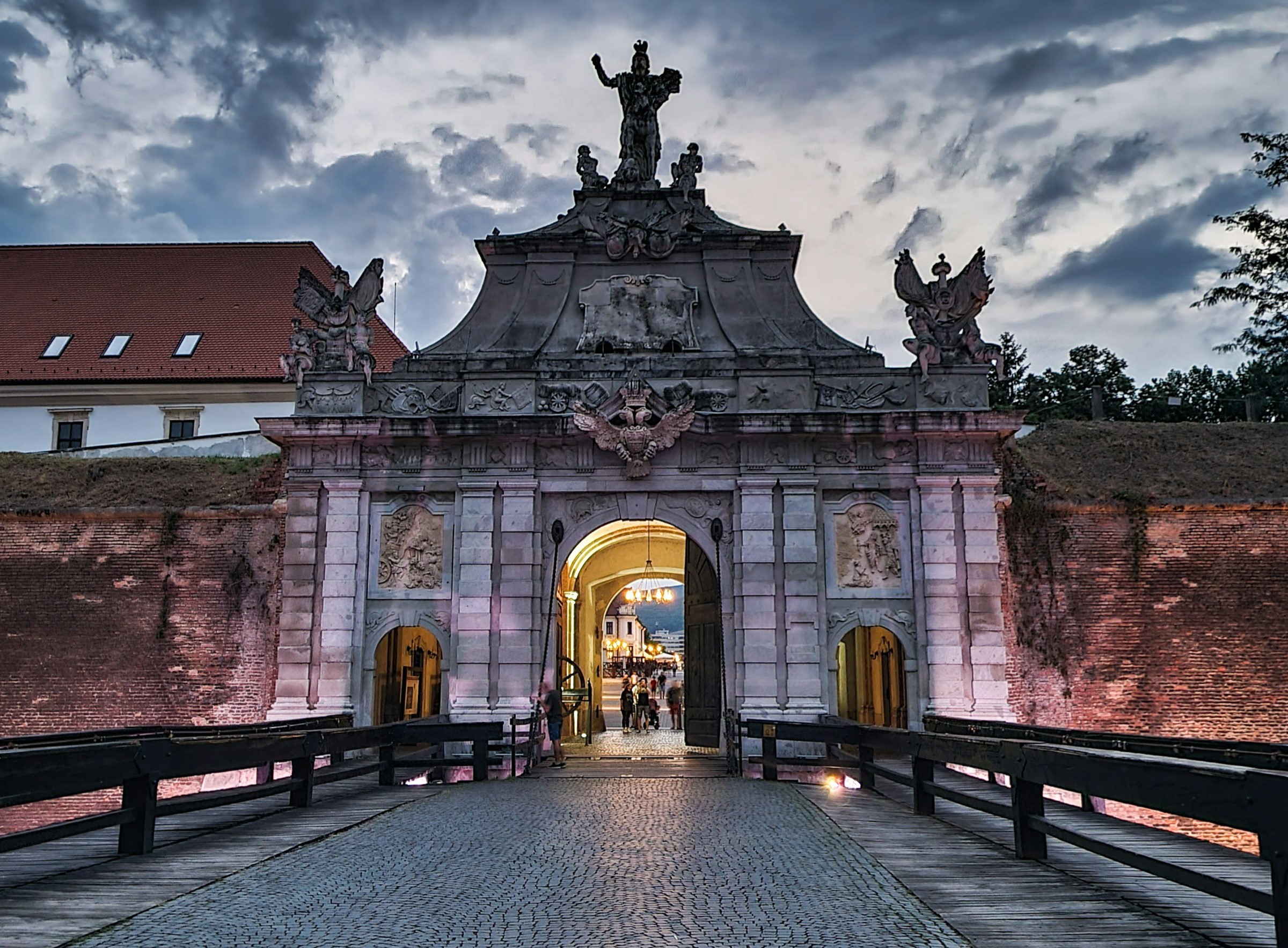
City view of Alba Iulia, Romania

Alba Iulia

Alba Iulia draws a perfect star on the map, its Vauban citadel folding bastions, ravelins, and ceremonial gates into a lesson you can stroll. The Coronation Cathedral and the Roman Catholic Cathedral stand a few minutes apart, quietly narrating unity and difference. Museums tackle Roman forts, medieval chapters, and the modern moment when union with Transylvania was proclaimed in 1918. Cyclists move along ramparts while guards in period uniforms change shifts with theatrical precision. Lunch leans toward pork, polenta, and cabbage, but bakeries insist on apple strudel as well. Families roam, counting statues of wolves and emperors, and kids test the echo under archways. A pleasing quirk: a section of the old Roman road is left exposed like a timeline under glass, humble stones doing more history than speeches. Evenings flatten into long shadows that trace geometry across the lawns, making math feel almost sentimental.

Top attractions & things to do in Alba Iulia

If you’re searching for the best things to do in Alba Iulia, this guide brings together the top attractions and must-see places to visit in Alba Iulia. The top picks below highlight the most visited sights for first-time visitors, plus a few local favorites worth adding.

Alba Carolina Fortress in Alba Iulia, Romania

Alba Carolina Fortress

Stone bastions carve a star into the plain, a design perfected in the 18th century when Prince Eugene of Savoy and imperial engineers reshaped Transylvania’s defenses in the Vauban style. The Alba Carolina Fortress holds layers older than its walls, for within its perimeter stand traces of the Roman camp Apulum and medieval towers that watched crusaders and merchants pass. Walking the gates is like browsing centuries, from sculpted baroque reliefs honoring Charles VI to trenches that once commanded artillery lines. The fortress also became the symbolic stage of December 1, 1918, when the Great Union was proclaimed and Romania’s modern identity declared. Today, ceremonial guards in Habsburg uniforms march at noon, while families stroll along the bastions. Cafes and exhibitions inhabit casemates that once stored powder, making history taste like coffee. The scale is generous yet the atmosphere personal, a reminder that power, art, and politics often meet on the same ground.
Ads place
Ads place
Ads place
Ads place
Ads place
Batthyaneum Library in Alba Iulia, Romania

Batthyaneum Library

An unassuming facade conceals a treasury of manuscripts and books that place Alba Iulia on the map of European scholarship. Founded in 1798 by Ignac Batthyany, the library holds over 60,000 volumes, including incunabula and rare astronomical works. The jewel of the collection is the Codex Aureus of Lorsch, an illuminated gospel from the 9th century, alongside medieval chronicles that recorded battles and councils. The reading rooms, with their high shelves and careful order, feel almost monastic, though the library was once part of a Franciscan monastery. Researchers arrive from distant universities, but ordinary visitors are welcome to glimpse treasures that survived wars, censorship, and the hazards of time. The Batthyaneum is more than a library; it is an argument that culture requires guardianship as meticulous as fortifications. Leaving the hall, you carry the sense that Alba Iulia’s greatest fortress may be made of words rather than walls.
Ads place
Ads place
Ads place
Ads place
Ads place
Coronation Cathedral in Alba Iulia, Romania

Coronation Cathedral

Beneath arches painted in quiet tones lies the church where kings and queens began their rule in ritual splendor. The Coronation Cathedral was built in 1921–1922 to host the crowning of King Ferdinand and Queen Marie after the Great Union of 1918. Architects used a Neo-Romanian style, blending Byzantine echoes with local motifs, so the building itself argued for continuity and identity. Inside, frescoes narrate biblical scenes while also weaving national symbols into halos and garments. Pilgrims and tourists alike pause before the royal chairs, still preserved as witnesses to a pivotal moment in Romania’s modern story. The bells ring across the fortress grounds, reminding visitors that Alba Iulia was chosen as more than a city, it was chosen as a capital of memory. Today weddings, processions, and quiet prayers continue beneath the same dome, proving that ceremony remains alive when architecture gives it a fitting stage.
Ads place
Ads place
Ads place
Ads place
Ads place
Roman Catholic Cathedral of St Michael in Alba Iulia, Romania

Roman Catholic Cathedral of St Michael

This cathedral speaks Latin in stone, its spire one of the oldest to rise in Transylvania. Construction began in the 11th century, weaving Romanesque foundations with Gothic revisions and later Baroque flourishes. Within its walls rest John Hunyadi and other voivodes whose names anchor Moldavian and Hungarian chronicles. The nave is austere but luminous, and the carved portal folds pilgrims into centuries of worship. Inscriptions on tombs tell of noble families and long alliances, while chapels reveal fresco fragments that once instructed illiterate congregations in color and gesture. Choir music expands easily beneath the vault, reminding visitors that acoustics can be as faithful as prayer. Even after restorations in the 20th century, the cathedral carries the fragrance of age, a patience that accepts every generation as temporary tenants. Step outside and the fortress square spreads open, yet the spire insists on drawing your gaze back upward, a silent sermon about endurance.
Ads place
Ads place
Ads place
Ads place
Ads place
Union Hall in Alba Iulia, Romania

Union Hall

Inside a modest building with whitewashed walls lies the chamber where modern Romania was declared whole. On December 1, 1918, delegates assembled here to proclaim the Great Union, an act that resonates beyond politics as a cultural covenant. The hall still preserves the original documents and the table around which more than a thousand representatives debated and signed. Murals later added in the 20th century dramatize the event with portraits of peasants, soldiers, and intellectuals, so the walls themselves argue that history is collective. Visitors pause before the framed resolution as if words could still warm, and in a sense they do. The Union Hall proves that symbolism needs no grandeur, only conviction. Outside, statues of Ferdinand and Queen Marie complete the tableau, reminding travelers that individuals and institutions sometimes align with history’s clock. The air feels charged, not theatrical but deeply persuasive, a space where the past still negotiates with the present.
Ads place
Ads place
Ads place
Ads place
Ads place