
City view of Banska Stiavnica, Slovakia

Banska Stiavnica

Banska Stiavnica is a mountain town that wrote its fortune in silver veins and then rewrote itself as a stage for creativity. Once the seat of a famous mining academy in the 18th century, it pioneered geology and metallurgy when Europe still treated such studies as alchemy. Today its steep lanes host galleries, cafes, and bookstores that lean confidently into their layered past. Churches crown the ridges, castles oversee the valley, and a calvary complex stages devotion in baroque steps. Lunch might mean garlic soup in a bread bowl, followed by trout from nearby streams. Locals still enjoy mining traditions during annual festivals, turning technical history into performance and song. A quirky delight, a love bank museum lets couples deposit their vows in a vault, repurposing heritage as romance. The result is a town that knows how to turn ore into culture and history into hospitality without losing authenticity.

Top attractions & things to do in Banska Stiavnica

If you’re searching for the best things to do in Banska Stiavnica, this guide brings together the top attractions and must-see places to visit in Banska Stiavnica. The top picks below highlight the most visited sights for first-time visitors, plus a few local favorites worth adding.

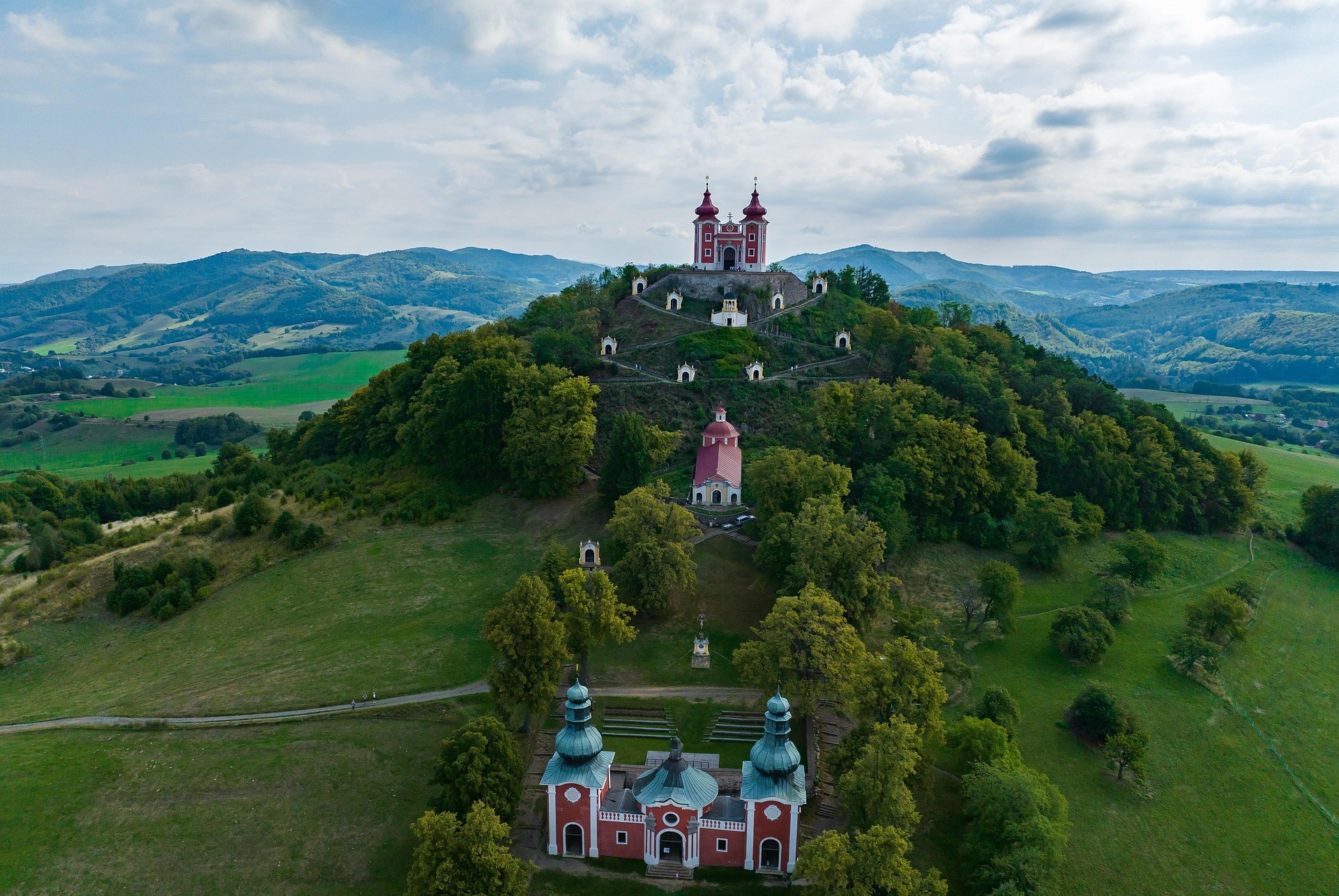
Calvary Banska Stiavnica in Banska Stiavnica, Slovakia

Calvary Banska Stiavnica

The hillside north of town carries a sequence of chapels like beads, leading to a twin-tower church that holds the view and the breath. Built in the 1740s–1750s, the Baroque Calvary staged devotion outdoors with a theatrical savvy that never loses sincerity. Stations climb through orchards and meadows, their facades painted in confident reds and creams; inside, scenes mix local donors with universal stories. After storm damage in the 2000s, careful restoration returned roofs, frescos, and paths with an eye for authentic materials—lime, timber, and pigments that weather honestly. Wayfinding boards explain topography as liturgy: gradients arranged so stamina and contemplation meet in fair compromise. On feast days processions fold the route into one moving sentence; on quiet mornings skylarks do the reading. The final terrace offers a measured panorama of the mining amphitheatre, a reminder that this UNESCO landscape was engineered as much as it was painted by nature. Come with good shoes and unhurried company; the hill will do the rest.
Ads place
Ads place
Ads place
Ads place
Ads place
New Castle in Banska Stiavnica, Slovakia

New Castle

Climb the lane and a white, six-storey tower resolves from trees like a lookout that never clocks off. The New Castle rose between 1564–1571 as a sentinel for the mining town, part of a regional warning system against Ottoman raids that used fire and bells to pass messages along ridges. Its plan is compact but clever: a central core ringed by galleries, embrasures, and sloped faces that feed musket and cannon without ego. Inside, displays sketch frontier life in the late 16th century—weapons, letters, and the logistics that keep vigilance fed and paid. From the platform you read the volcanic hills and the chessboard of streets below; on clear days, shafts and spoil heaps underline how extraction shaped settlement. Notes on fortification basics make the geometry friendly, and a small model shows how signals hopped valley to valley. The tower is less about battle than agreement, a practical architecture of lines of sight, clock discipline, and shared alarms that still feels modern.
Ads place
Ads place
Ads place
Ads place
Ads place
Old Castle in Banska Stiavnica, Slovakia

Old Castle

From the square the complex looks like a small town within walls, which is almost true: the Old Castle grew from a Romanesque basilica into a layered fortress as threats and habits changed. Foundations reach to the 13th century, when worship set the plan; the 16th century brought bastions, gunports, and a sober gatehouse tuned to anti-Ottoman strategy. Courtyards hold a lapidarium where weathered portals and coats of arms still teach stone literacy, while the former nave shelters exhibitions that explain guilds, bells, and the arithmetic of maintenance. You will notice Renaissance arcades stitched into older masonry, a polite conversation between styles. A small clockwork exhibit nods to regional mining punctuality, and the view back toward the town reads like a catalog of roofs. Conservation favors lime and restraint, leaving tool marks legible so repairs do not masquerade as originals. The site anchors the city’s UNESCO story with evidence rather than slogans—faith, defense, and work sharing one address and learning to get along.
Ads place
Ads place
Ads place
Ads place
Ads place
Open-Air Mining Museum in Banska Stiavnica, Slovakia

Open-Air Mining Museum

Down in the valley a helmet, lamp, and jacket are your ticket from romance to reality. The Open-Air Mining Museum lowers visitors into an educational adit where damp air, timber sets, and the click of dripping water make the 18th century suddenly legible. Guides explain how veins were chased with hand tools, how gunpowder changed planning, and why ventilation and drainage were the difference between wages and headlines. Above ground, hoists, ore carts, and stampers show the choreography of a shift; a small hall decodes assay samples into numbers that paid bills. Panels relate the wider hydrological system of tajchy—artificial lakes and channels that banked energy for pumps—central to the site’s UNESCO inscription. Expect clear talk about hazards, maintenance, and the quiet heroism of routine. When you step back into daylight, the town’s steeples and slag tell a cleaner story: that prosperity here was engineered with water, math, and patience, long before electricity arrived to take over the night shift.
Ads place
Ads place
Ads place
Ads place
Ads place
Pocuvadlo Lake (Tajch Pocuvadlo) in Banska Stiavnica, Slovakia

Pocuvadlo Lake (Tajch Pocuvadlo)

Follow the road through birch and pine and a bright mirror opens among hills: Pocuvadlo is both a swim spot and a chapter of hydraulic ingenuity. The reservoir belongs to the historic system of tajchy engineered for mines, a network refined in the 18th century by figures such as Jozef Karol Hell and cartographer-planner Samuel Mikoviny. Dams, ditches, and tunnels banked water uphill to power pumps and mills when the ore demanded deeper work. Today the lake is ringed by an easy trail with views to the Sitno massif; in summer, piers, boats, and kiosks turn engineering into leisure. Shoreline panels explain spillways, clay cores, and maintenance cycles so hydrology becomes friendly rather than abstract. The wider system underwrites the town’s UNESCO status, proof that landscape here was calculated with slide rules and seasons. Arrive early for glassy reflections; stay late for silhouettes and calm air. It is civic infrastructure that learned a second career as a park—efficient, beautiful, and shared.
Ads place
Ads place
Ads place
Ads place
Ads place