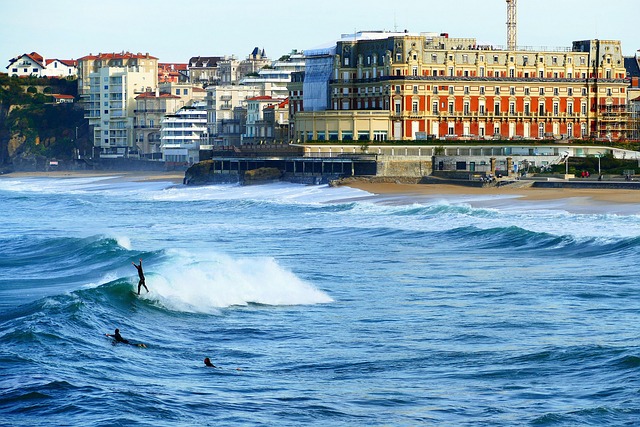

City view of Biarritz, France

Biarritz

Biarritz, a luxurious seaside town on France's Basque coast, is renowned for its beautiful beaches and surf culture. The town has a rich history as a popular destination for European royalty in the 19th century, which is reflected in its elegant architecture. The iconic Hôtel du Palais, once the summer residence of Empress Eugénie, stands as a symbol of Biarritz's opulence. The town's Grand Plage is a favorite spot for sunbathers and surfers alike, while the Rocher de la Vierge offers a stunning view of the coastline. Biarritz is also known for its Thalassotherapy centers, which attract visitors seeking relaxation and wellness treatments. The town's culinary scene blends French and Basque influences, offering dishes like pintxos and seafood delicacies. With its chic atmosphere, stunning scenery, and vibrant surf culture, Biarritz is a top destination on the Atlantic coast.

Top attractions & things to do in Biarritz

If you’re searching for the best things to do in Biarritz, this guide brings together the top attractions and must-see places to visit in Biarritz. The top picks below highlight the most visited sights for first-time visitors, plus a few local favorites worth adding.

Grand Plage in Biarritz, France

Grand Plage

The Grand Plage is Biarritz's iconic golden-sand beach, framed by elegant Belle Époque architecture and the landmark Hôtel du Palais. Once favored by Empress Eugénie and European royalty, this crescent-shaped beach became the birthplace of European surfing when Hollywood star Peter Viertel brought his board in 1957. The 450-meter shoreline hosts the annual Biarritz Surf Festival, while the Art Deco Casino Municipal (1929) overlooks the waves. Don't miss the Rocher du Basta rock formation - its underground tunnels were used by Napoléon III's engineers to study wave patterns. At low tide, exposed WWII German bunkers reveal the beach's strategic wartime role. Sunset brings surfers catching final waves as the Miremont Tea Room (1880) serves its famous macarons to beachgoers. The beach’s distinctive golden hue comes from Pyrenees quartz washed down the Adour River over millennia. In 2023, archaeologists discovered 18th-century whale oil jars in the cliffs, remnants of Biarritz’s first industry before tourism.
Ads place
Ads place
Ads place
Ads place
Ads place
Hôtel du Palais in Biarritz, France

Hôtel du Palais

The Hôtel du Palais began life as Empress Eugénie's summer villa in 1854, designed by Paris Opera architect Charles Garnier. After burning down in 1903, it was rebuilt as Europe's first palace-style seaside hotel, hosting F. Scott Fitzgerald and Frank Sinatra. The 154-room masterpiece blends Neo-Renaissance and Art Deco styles, with the original imperial gold-leaf chapel preserved intact. During WWII, it became a Nazi naval hospital - bullet pockmarks still visible on marble columns. The 3-Michelin-starred Hélène Darroze restaurant serves seafood from Eugénie's private fishing grounds. Don't miss the underground Impératrice Spa, where seawater is still drawn through 19th-century bronze pipes. King Edward VII’s 1905 suite contains hidden doors for discreet romantic assignations. The hotel’s beehives produce 200kg/year of “Imperial Honey” from Eugénie’s original lavender gardens.
Ads place
Ads place
Ads place
Ads place
Ads place
Musée de la Mer in Biarritz, France

Musée de la Mer

The Musée de la Mer (1933) inhabits an Art Deco former casino, its shark tank visible through original stained-glass windows. Home to 1500 marine species, highlights include grey seals trained using Basque commands and a 1.5-ton sunfish caught locally in 2019. The Aquarium des Tropiques replicates Amazonian waters so accurately that piranhas breed here annually. Don't miss the 10m squid specimen - its 2012 capture inspired local legends of a "Kraken." Upstairs, the Whaling History Gallery displays harpoons used until the 1970s, when Biarritz banned the practice. The rooftop terrace offers seal-feeding demonstrations with panoramic ocean views. Night visits reveal bioluminescent plankton glowing electric blue in special tanks. The museum’s newest exhibit uses AI to translate dolphin echolocation clicks into musical patterns. During restoration work, builders uncovered 1930s gambling chips beneath floorboards – now displayed in the lobby.
Ads place
Ads place
Ads place
Ads place
Ads place
Phare de Biarritz in Biarritz, France

Phare de Biarritz

The Phare de Biarritz lighthouse has guided ships since 1834, its 73-meter granite tower offering dizzying views across the Bay of Biscay. The 248-step climb reveals Fresnel lens technology that projects light 48km out to sea. Unique in Europe, its red-and-white stripes were added in 1937 to distinguish it from Spain's similar Hondarribia lighthouse. During WWII, keepers transmitted secret codes to Allied submarines using light sequences. The adjacent Atalaye plateau hosts Europe's largest migratory bird count each autumn. Engineering buffs will appreciate the original 4-ton mercury float rotation system, replaced by LEDs in 2010. On clear days, you can spot Spanish Pyrenees peaks 150km south. Lighthouse keeper Marcel Duhau’s 1940-1963 logbooks detail rescues of 127 sailors. The foghorn’s low C note vibrates at 130Hz – the same frequency as a humpback whale’s song.
Ads place
Ads place
Ads place
Ads place
Ads place
Rocher de la Vierge in Biarritz, France

Rocher de la Vierge

The Rocher de la Vierge ("Virgin's Rock") is Biarritz's most photographed landmark, accessed via Gustave Eiffel's 1887 iron footbridge. Crowned by a white Virgin Mary statue installed by whalers in 1865, this dramatic offshore rock offers panoramic views of the Basque Coast. Beneath your feet lie Napoleon III's drainage tunnels (1859) that prevented coastal erosion. The site was originally called "Rocher de l'Hôpital" after a 12th-century leper colony. During WWII, German forces stored torpedoes in the rock's hollow chambers. Today, interpretive panels explain how the Pointe de Atalaye served as a whale-spotting station until 1900. At spring tides, waves crash through blowholes with thunderous force. Local legend claims the Virgin’s outstretched arms protect fishermen – her statue survived a direct lightning strike in 1962 unscathed. Marine biologists recently tagged 300kg bluefin tuna from this vantage point during migration studies.
Ads place
Ads place
Ads place
Ads place
Ads place