
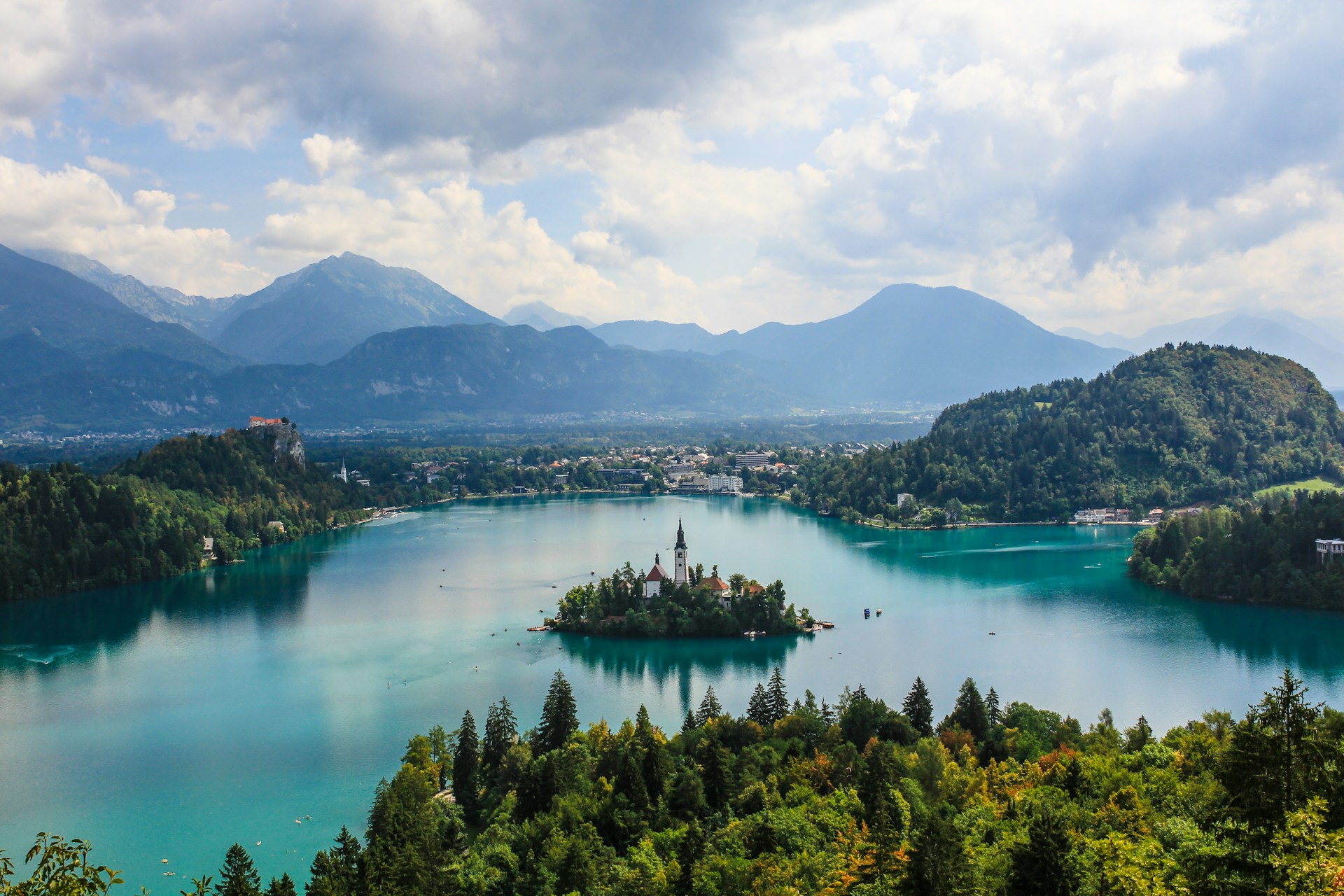
City view of Bled, Slovenia

Bled

Bled is a compact lesson in staging: a lake, a cliff with a castle, and an island that turns a bell into a small ambition. Rowers practice before breakfast while bakers assemble kremna rezina, the cream slice that ruins willpower in two bites. You can ring the island bell after climbing a measured set of steps; legend promises luck, but the view already feels like enough. Records from the 11th century place a chapel here; later, spa doctors in the 19th century marketed fresh air with persuasive data. Less expected: a traditional wooden pletna boat is steered with a single oar fixed on a unique fork, a technique taught within families. Walk the six kilometer path for changing angles or hike to Ojstrica for a quick postcard lesson without the cliches. End with trout from Sava Bohinjka waters and a glass of local white that tastes like clean weather.

Top attractions & things to do in Bled

If you’re searching for the best things to do in Bled, this guide brings together the top attractions and must-see places to visit in Bled. The top picks below highlight the most visited sights for first-time visitors, plus a few local favorites worth adding.

Bled Castle in Bled, Slovenia

Bled Castle

Perched on a sheer cliff above the water, Bled Castle mixes romance with practicality: ramparts face the wind, roofs hunker against winter, and the courtyard frames the lake like a camera. Charters cite the site as early as 1011, when the bishops of Brixen received it, though today's look blends Romanesque walls, a small Gothic chapel, and later defensive tweaks. In the print studio, staff demonstrate a replica 19th-century press that turns woodblock motifs into keepsakes; the smithy across the yard shows how hinges swallowed rust. A modest exhibition pairs coins and shards with measured captions, noting rooflines altered after fires in the 16th century. Stand on the upper terrace to read the lake: the pletnas draw commas across the surface, while the island church aligns neatly with the saddle of the Karawanks. If you arrive near closing, the cliff's edge goes quiet, and the castle's angled windows catch the last sun like signal mirrors to the town below. Inside the chapel, fragments of paint suggest careful restoration rather than glossy reinvention.
Ads place
Ads place
Ads place
Ads place
Ads place
Bled Island and Church of the Assumption in Bled, Slovenia

Bled Island and Church of the Assumption

A short boat ride delivers you to Bled Island, where a compact baroque church crowns a patch of limestone and trees in the lake's calm center. Guides often note foundations from the 9th century, while the present Church of the Assumption reflects late baroque rebuilding after the 1690 earthquake. Climb the 99 stone steps and listen for the "wishing bell," a tradition linked to a foundry record from the 1530s. Look closely at the separate bell tower's restrained silhouette, which some sources describe as a pragmatic 18th-century solution to lightning and fire. Out on the water, pletna boats—wide wooden craft said to date to 1590—arrive under oar, not engine, preserving quiet and views back to cliffs and the Karawanks. Many visitors linger for the tiny museum displays about the island's pilgrimage role and the traces of earlier ritual found beneath the pavement, before circling the chapel to catch a final angle on the lake's pale-green skin. On clear days, the ripple of reflections turns the nave's white walls into a light meter, quietly registering weather as worshippers pass.
Ads place
Ads place
Ads place
Ads place
Ads place
Lake Bled Promenade and Park Cafe in Bled, Slovenia

Lake Bled Promenade and Park Cafe

Skirting the water's edge, the Lake Bled promenade offers a slow loop past boathouses, reed beds, and hotel lawns where strollers compare shades of green. Benches carry brass plaques, and information boards mention early spa tourism around 1906, when sanatorium culture and cold-air cures overlapped with alpine walking. Halfway along, the Park Cafe serves the town's emblematic cream slice, locally said to have been introduced in 1953; bakers still aim for a custard layer near 7 centimeters, a crisp puff top, and an audible fork break. Rowers from Bled's club, founded in the 19th century, move in sets along lanes marked by discreet buoys, while swans patrol like unbothered marshals. Near sunset, the parish church bell folds into the low hum of traffic and the soft click of bicycle freewheels, a mechanical chorus shaped by the promenade's 6-kilometer circuit. It is a democratic route: locals walking dogs, wedding parties in tuxedos, retirees timing laps, and visitors learning that the lake rewards unhurried repetition.
Ads place
Ads place
Ads place
Ads place
Ads place
Ojstrica Viewpoint in Bled, Slovenia

Ojstrica Viewpoint

Hikers aiming for sunrise pick the short, steep path to Ojstrica, a wooded knoll above the lake where a rough bench frames the classic postcard view. Maps show a climb of roughly 20-30 minutes depending on footing, with roots and damp leaves advising slower steps after rain. At the top, the lake, island, and castle arrange themselves along a tidy axis, while the Julian Alps set a jagged horizon beyond. Photographers talk about golden-hour angles around 7 degrees above the ridge, which soften the castle's cliff and pull detail from the island's nave. In winter, crampons are recommended; a small sign warns against cutting switchbacks, a rule local guides say dates informally to the 1970s when erosion lines first alarmed foresters. Carry a headlamp and pack out your breakfast; the bench is not a cafe, and the viewpoint's charm lies in how little has been built since the path was flagged in the 20th century. On the descent, glimpses through spruce briefly turn the water into moving panes of glass.
Ads place
Ads place
Ads place
Ads place
Ads place
Vintgar Gorge in Bled, Slovenia

Vintgar Gorge

Northwest of town, the Vintgar Gorge channels the Radovna River through a narrow limestone cut where boardwalks cling to rock like careful handwriting. Engineers first laid wooden galleries in the 1890s, turning a once-remote slot into an accessible walk that still feels elemental after spring melt. Water speeds through chutes, then slackens into pools said to reach several meters deep, their color a glacial mix of turquoise and milk. Look for drill holes and iron anchors, pragmatic remains of early Austro-Hungarian route-making, and keep an ear out for the thud of logs that locals recall from interwar timber drives. At the end, the Sum waterfall drops around 13 meters beside a power-station intake dating to the early 20th century, a reminder that scenery and infrastructure have long negotiated here. Arrive early on bright days; the gorge narrows, and passing takes patience as people wait on widened bays to let others step by. In overcast light the rock reads like graphite, and the river's white noise edits conversation to whispers.
Ads place
Ads place
Ads place
Ads place
Ads place