
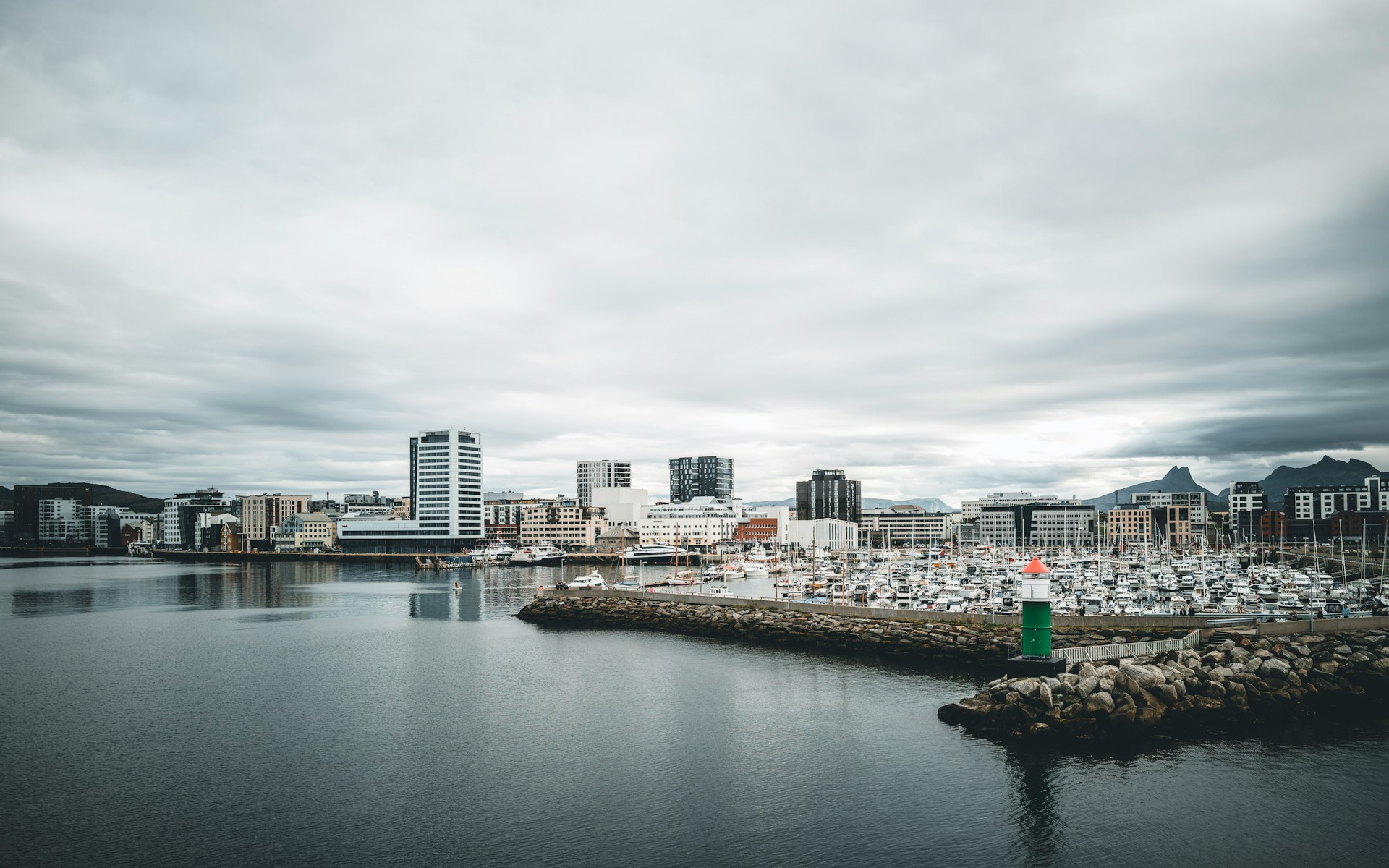
City view of Bodo, Norway

Bodo

Bodo sits just north of the Arctic Circle, acting as a gateway to the Lofoten Islands and the wild landscapes of Nordland. The city’s modern center reflects its post–World War II rebuilding, but its cultural life is anything but plain. The Norwegian Aviation Museum showcases daring feats in the air, while the nearby Saltstraumen maelstrom offers a mesmerizing natural spectacle, with some of the world’s strongest tidal currents. Seafood is a given, but Bodo’s bakeries are equally worth seeking out for traditional pastries. In summer, midnight sun hikes are part of the local rhythm, while winter brings a quieter, snow-covered charm. One delightful surprise: the city’s street art scene, growing steadily as blank walls transform into vivid murals. Bodo’s appeal lies in its ability to serve both as a transit point and as a destination where raw nature meets understated urban life.

Top attractions & things to do in Bodo

If you’re searching for the best things to do in Bodo, this guide brings together the top attractions and must-see places to visit in Bodo. The top picks below highlight the most visited sights for first-time visitors, plus a few local favorites worth adding.

Bodo Cathedral in Bodo, Norway

Bodo Cathedral

Bodo Cathedral was consecrated in 1956, built after the devastation of World War II when German bombers destroyed much of the town. Architect Gudolf Blakstad designed it in a modernist style, with a tall rectangular tower that rises like a beacon above the rebuilt city. The cathedral’s concrete walls contrast with its luminous stained-glass windows, which depict biblical themes in strikingly contemporary colors. Inside, the organ, one of the largest in Norway, reverberates with deep resonance during services and concerts alike. A fascinating detail is that the cathedral’s free-standing bell tower, containing 12 bells, stands apart from the main building, creating a visual rhythm across the square. More than a religious site, it symbolizes resilience and renewal, representing a city that endured destruction and embraced modernity in its reconstruction. Visitors often pause in its serene interior, reflecting on how faith, architecture, and history intersected at a critical moment in Bodo’s past.
Ads place
Ads place
Ads place
Ads place
Ads place
Kjerringoy Trading Post in Bodo, Norway

Kjerringoy Trading Post

Kjerringoy Trading Post, preserved as an open-air museum, offers a vivid glimpse into northern Norway’s mercantile golden age of the 19th century. Situated by a sheltered fjord, the white wooden buildings once housed merchants who dominated trade in stockfish, butter, and other local produce. At its height, the post was run by Christian Holmboe and his descendants, whose wealth made Kjerringoy one of the richest trading centers in the north. Today, interiors remain frozen in time: ledgers, furniture, and even wallpaper whisper stories of prosperity built on seafaring and barter. Visitors learn how fortunes rose and fell with the fisheries, and how the community intertwined with Sami traders and coastal farmers. A fascinating fact is that this site inspired several novels by Knut Hamsun, who captured its atmosphere of ambition and fragility. Walking among the boathouses, one senses a blend of nostalgia and realism, a place where commerce once shaped destinies.
Ads place
Ads place
Ads place
Ads place
Ads place
Mjelle Beach in Bodo, Norway

Mjelle Beach

Mjelle Beach, located just north of Bodo, is celebrated for its rare red-and-white sand, a geological curiosity caused by the mineral garnet blending with pale quartz. The beach stretches along a secluded bay, where Arctic light paints the waves in shifting hues depending on the season. On clear summer nights, the midnight sun sets the shoreline aglow, while in winter, the northern lights dance above, making Mjelle a year-round canvas of natural spectacle. Local stories say the unusual sand was once used for good luck charms, treasured for its shimmering quality. A hike through coastal trails leads to the beach, rewarding visitors with views of rugged cliffs and seabirds circling overhead. Scientists still study the unique deposits, which are rarely found in such abundance elsewhere. To stand barefoot on Mjelle’s sand is to feel geology and myth intertwine, a reminder of how landscapes can both surprise and enchant.
Ads place
Ads place
Ads place
Ads place
Ads place
Norwegian Aviation Museum in Bodo, Norway

Norwegian Aviation Museum

The Norwegian Aviation Museum in Bodo is the largest of its kind in Scandinavia, a striking circular building symbolizing both a propeller and a control tower. Inside, visitors encounter over 100 aircraft, ranging from fragile biplanes to supersonic jets, each telling a chapter of Norway’s aviation history. One highlight is the Cold War section, where a Soviet MiG-21 stands opposite a NATO F-104 Starfighter, a stark reminder of the tense years when Bodo served as a strategic airbase. The museum also preserves Norway’s first civilian aircraft, linking wartime urgency with the peacetime pursuit of connection across fjords and mountains. A remarkable feature is the air traffic control simulator, which allows guests to step into the shoes of those who once guided pilots through unpredictable Arctic skies. Opened in 1994, the museum continues to grow as a cultural landmark, offering a rare chance to see how aviation reshaped both defense and everyday life in the north.
Ads place
Ads place
Ads place
Ads place
Ads place
Saltstraumen Maelstrom in Bodo, Norway

Saltstraumen Maelstrom

Just outside Bodo lies Saltstraumen, home to the world’s strongest tidal current, where 400 million cubic meters of seawater surge through a narrow strait every six hours. The current can reach speeds of up to 37 kilometers per hour, creating whirlpools over 10 meters wide that have fascinated travelers and scientists alike. Fishing here is legendary, as the nutrient-rich waters support cod, halibut, and coalfish in abundance, a tradition locals have followed for centuries. The phenomenon has inspired folklore, with tales describing giants stirring the ocean to create the maelstrom. Today, visitors can observe the spectacle from the bridge, or join boat safaris that skim perilously close to the churning water. What makes Saltstraumen especially remarkable is its reliability; the tidal flows have repeated with clockwork precision since the last Ice Age, shaping the marine ecosystem of northern Norway. It is both a scientific wonder and a reminder of nature’s raw power.
Ads place
Ads place
Ads place
Ads place
Ads place