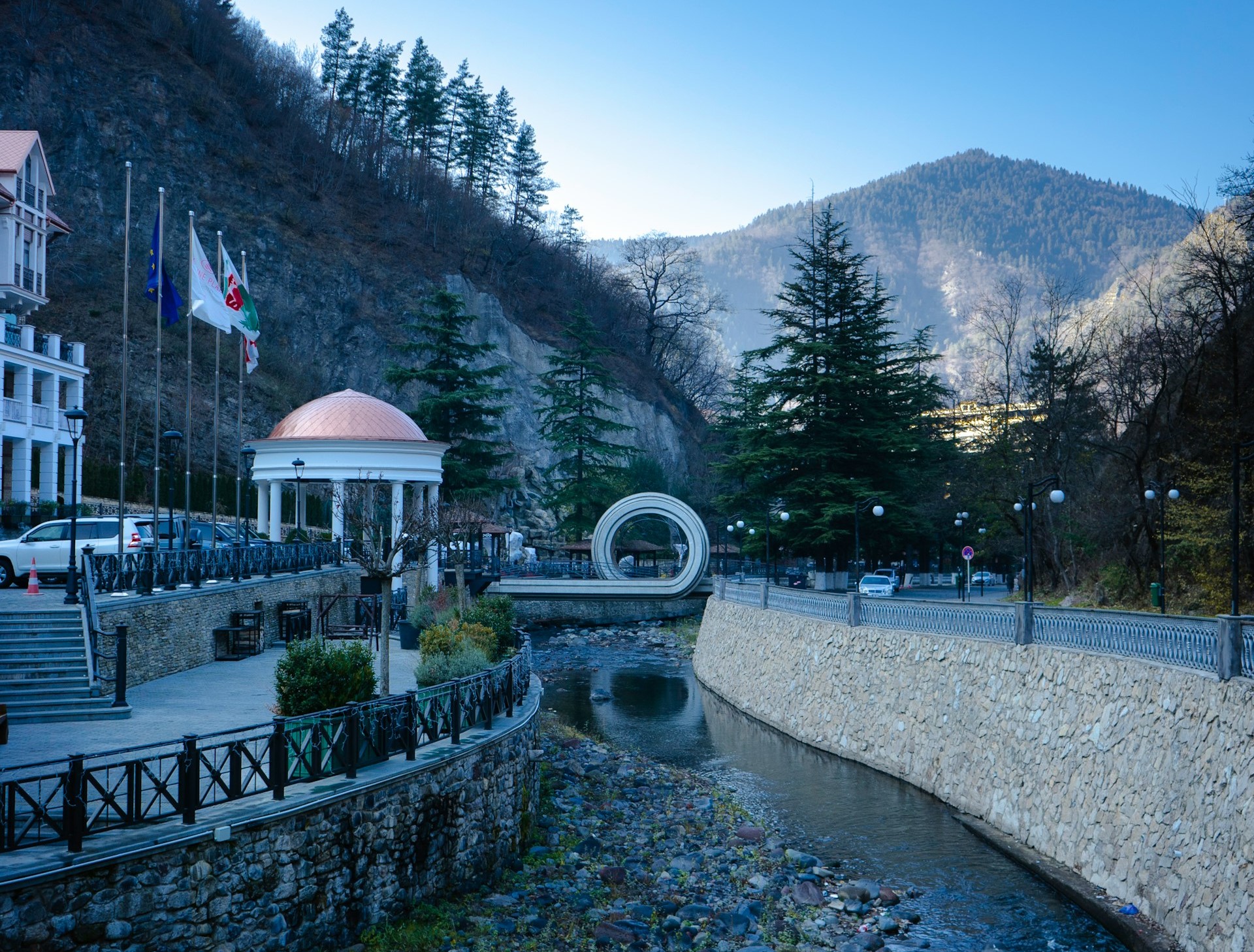

City view of Borjomi, Georgia

Borjomi

Nestled in a lush valley at the foot of the Lesser Caucasus, Borjomi has drawn health seekers for two centuries with its naturally carbonated mineral springs. The town’s centerpiece—Borjomi Central Park—spreads across forested slopes lined with centuries-old pine and beech trees. Visitors sip the effervescent mineral water straight from ornate fountains along the shaded Wandelweg. Beyond wellness tourism, Borjomi serves as a gateway to the sprawling Borjomi-Kharagauli National Park—one of Europe’s largest protected areas—where marked trails lead through spruce forests, alpine meadows, and past turquoise glacial lakes. Local chalets offer restorative spa treatments, while guesthouses serve hearty regional dishes: mushroom soup, grilled trout, and honey-sweetened churchkhela. In every season, from snow-laden pines in winter to vibrant wildflowers in summer, Borjomi’s blend of therapeutic heritage and dynamic outdoor recreation revitalizes both body and spirit.

Top attractions & things to do in Borjomi

If you’re searching for the best things to do in Borjomi, this guide brings together the top attractions and must-see places to visit in Borjomi. The top picks below highlight the most visited sights for first-time visitors, plus a few local favorites worth adding.

Borjomi Central Park in Borjomi, Georgia

Borjomi Central Park

Established in 1850 by Russian settlers, Borjomi Central Park spans over 70 hectares of mixed pine and beech forest. The park’s centerpiece is the historic Prospect Baths Pavilion, where naturally carbonated mineral springs—first bottled in 1890—flow through ornate fountains into public drinking cups. Hidden among the trees are 19th-century promenades lined with wrought-iron benches and lanterns, once frequented by Georgian nobility seeking wellness retreats. Beneath the forest canopy, wooden boardwalks guide visitors to a waterfall fed by the mineral-rich river, whose water is credited with therapeutic benefits for digestive and musculoskeletal ailments. A 2016 restoration uncovered remnants of an old sanatorium wing, now displayed as ruins entwined with ivy. In winter, snow-dusted pines transform the park into a fairy-tale landscape, while summer brings a chorus of songbirds and wildflower blooms. Seasonal guided “mineral trail” walks educate on the park’s unique volcanic geology and its role in Borjomi’s enduring spa culture.
Ads place
Ads place
Ads place
Ads place
Ads place
Borjomi-Kharagauli National Park in Borjomi, Georgia

Borjomi-Kharagauli National Park

One of Europe’s largest protected areas, Borjomi-Kharagauli National Park covers over 85,000 hectares of the Lesser Caucasus. Established in 1995, the park preserves ancient mixed forests, alpine meadows, and glacial lakes. Visitors traverse the famed Green Path, a 100-km trail network that connects remote ranger stations and crosses six distinct eco-zones. Along the route, hikers encounter endemic species such as the East Caucasian tur and wild rhododendron blooms in May. Archaeologists in 2012 documented Bronze Age obsidian workshops near the Adzhi-Bogdo peak, indicating the park’s prehistoric importance. Seasonal horseback tours follow old shepherd trails, offering intimate views of the Borjomi Gorge and mineral springs hidden in limestone cliffs. In winter, snowshoe expeditions reveal lynx tracks and frozen cascades. The park’s visitor centers host workshops on sustainable forestry and traditional Svan hunting practices, making Borjomi-Kharagauli not only a natural haven but also a living classroom for Caucasian culture and conservation.
Ads place
Ads place
Ads place
Ads place
Ads place
Green Monastery (Likani) in Borjomi, Georgia

Green Monastery (Likani)

Hidden in the verdant foothills of Borjomi, the Green Monastery—also known as Likani Monastery—was founded in the 13th century by Queen Rusudan of Georgia. Its fortified walls and crenellated towers blend seamlessly with the surrounding pine forest, creating a jade-green camouflage that inspired its name. The central church houses 14th-century fresco fragments depicting the Annunciation, recently uncovered during a 2018 conservation project. Beneath the nave lies a crypt containing sarcophagi of early monastic leaders, marked by incised crosses in the ancient Georgian script. A narrow trail leads to a crystal-clear spring believed to have healing properties for skin ailments, still visited by pilgrims today. Within monastery grounds stands a stone lectern where King Erekle II is said to have declared autonomy from Persian rule in 1783. Though less frequented than Borjomi’s spa resorts, the Green Monastery offers a serene sanctuary steeped in medieval spirituality and royal politics.
Ads place
Ads place
Ads place
Ads place
Ads place
Lagodekhi Protected Areas in Borjomi, Georgia

Lagodekhi Protected Areas

Extending from Borjomi’s eastern border, the Lagodekhi Protected Areas encompass an elevation range from 450 to 3,000 m, protecting diverse habitats from lowland forests to alpine tundra. Established in 1912 by Imperial decree, it stands as one of the oldest reserves in the former USSR. Rare species such as the Caucasian black grouse and Lynx lynx thrive in its remote valleys. The park’s Green Corridor trail crosses suspension bridges over the Mashavera River and leads to the dramatic 30-m Ninoskhevi Waterfall. Birdwatchers track migratory raptors along thermal updrafts, while herpetologists catalog endemic salamanders beneath moss-covered logs. A series of restored shepherd huts offer basic overnight lodging for multi-day treks, preserving centuries-old transhumance routes. Conservation researchers in 2020 documented new lichen species on ancient beech trees, underscoring the area’s ecological significance. With permits available from the Borjomi office, Lagodekhi Protected Areas beckon adventurers seeking unspoiled wilderness and scientific discovery.
Ads place
Ads place
Ads place
Ads place
Ads place
Romanov Dacha in Borjomi, Georgia

Romanov Dacha

Built in 1892 for the Romanov imperial family, the Borjomi Romanov Dacha is a picturesque wooden retreat overlooking the mineral springs. The chalet-style building features carved verandas, stained-glass windows, and a central ballroom once lit by crystal chandeliers. During his 1893 visit, Tsar Alexander III reputedly conducted state meetings on the terrace, forging Russo-Georgian alliances. After 1917, the dacha served as a sanatorium before falling into disrepair—until a 2010 restoration uncovered hidden murals depicting the Romanov crest and Georgian motifs. Today, the dacha hosts a museum displaying original imperial furniture, hand-painted porcelain, and Tsar Nicholas II’s travel trunks. Surrounding gardens contain exotic plantings of rhododendron and cedar brought from Persia, reflecting 19th-century botanical interests. Guided tours recreate a day in the life of the Romanov elite, complete with samovar teas served in the antique drawing room. A boutique hotel now occupies adjacent annexes, offering guests a chance to experience the grandeur of Borjomi’s imperial past.
Ads place
Ads place
Ads place
Ads place
Ads place