
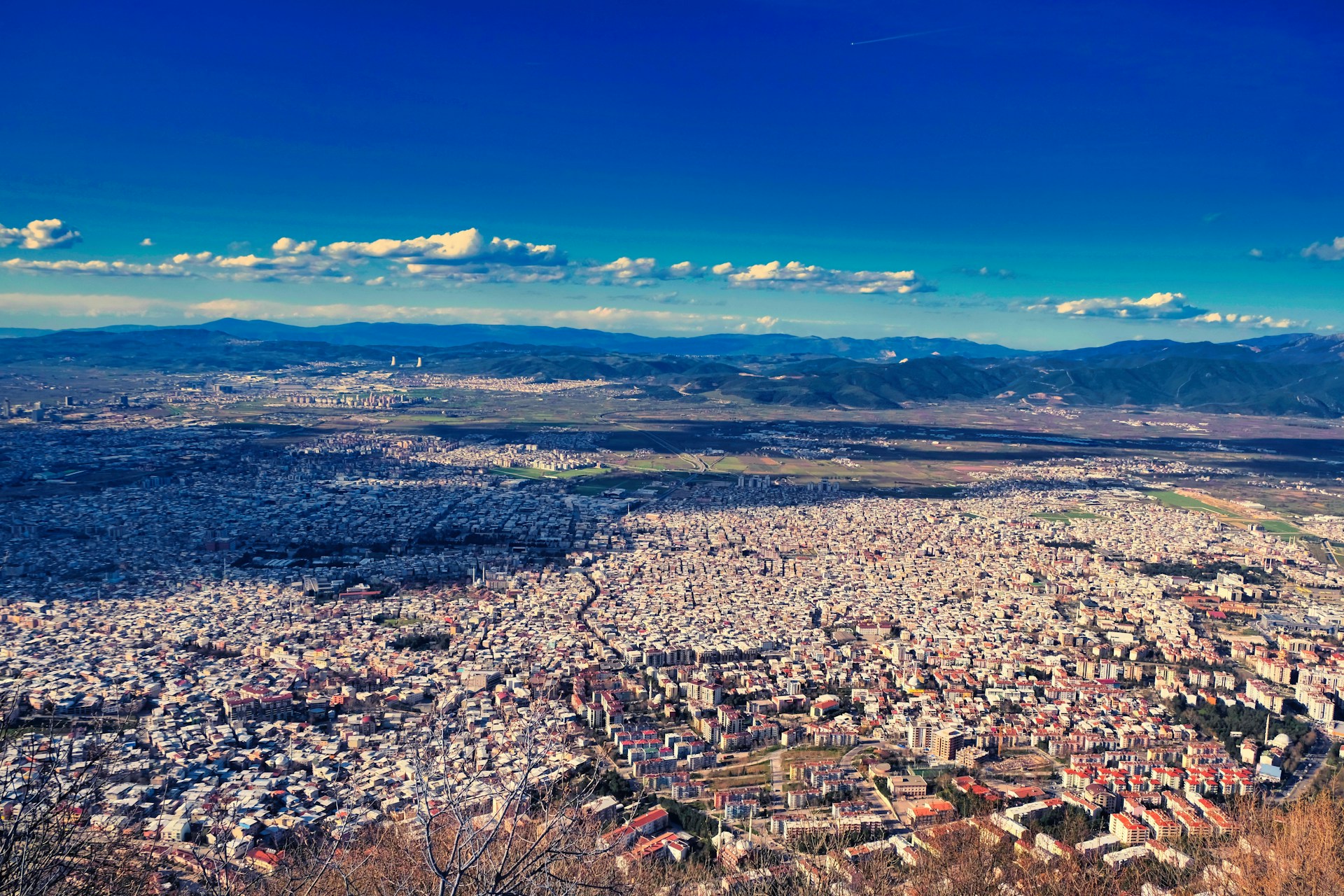
City view of Bursa, Turkey

Bursa

Bursa, nestled at the foot of the snow-capped Uludag mountain, flourished as the first major capital of the Ottoman Empire in the 14th century. The city’s green-tiled Yesil Mosque and adjacent Yesil Türbe mausoleum showcase intricate tilework and calligraphy, while the grand Ulu Cami, with its twenty domes and sprawling courtyard, remains a center of devotion. In the historic Koza Han, a former silk bazaar, merchants still trade hand-woven scarves and filigree jewelry beneath vaulted arcades. Thermal springs in the Çekirge district feed venerable Ottoman hamams where visitors soak in mineral-rich waters under ornate ceilings. A short cable car ascent up Uludag offers panoramic views over lush pine forests and the Marmara Sea beyond, while winter transforms the slopes into a ski resort favored by locals. Culinary pilgrims flock to taste Iskender kebap—thinly sliced lamb layered over pita bread, baked in tomato sauce and crowned with sizzling yogurt. As dusk falls, the shadow of the Ulu Cami looms over candlelit restaurants serving chestnut-purée desserts and locally produced peaches, underscoring Bursa’s timeless charm at the crossroads of nature and history.

Top attractions & things to do in Bursa

If you’re searching for the best things to do in Bursa, this guide brings together the top attractions and must-see places to visit in Bursa. The top picks below highlight the most visited sights for first-time visitors, plus a few local favorites worth adding.

Cumalikizik Village in Bursa, Turkey

Cumalikizik Village

Nestled at the foot of Mount Uludag, the historic village of Cumalikizik dates back to the early 14th century and remains one of the best-preserved examples of an Ottoman rural settlement. Its cobblestone alleys wind between timber-framed houses with stone bases and brightly colored facades, many of which are still inhabited by local families. The village played a key role during the foundation of the Ottoman Empire, serving as a waqf settlement supporting religious endowments. Cumalikizik has maintained its traditional layout and communal lifestyle, with homes arranged around shared courtyards and fountains. Visitors enjoy authentic Turkish breakfasts, handmade crafts, and seasonal festivals celebrating rural heritage. Declared a UNESCO World Heritage site in 2014 as part of the "Bursa and Cumalikizik: the Birth of the Ottoman Empire" listing, the village offers a living window into the social and architectural fabric of early Ottoman life.
Ads place
Ads place
Ads place
Ads place
Ads place
Grand Mosque of Bursa (Ulu Camii) in Bursa, Turkey

Grand Mosque of Bursa (Ulu Camii)

Commissioned by Ottoman Sultan Bayezid I after his victory at the Battle of Nicopolis in 1396, the Grand Mosque of Bursa stands as a defining monument of early Ottoman religious architecture. Designed by architect Ali Neccar, this sprawling mosque features a unique layout with twenty domes supported by twelve columns, symbolizing the twenty vows Sultan Bayezid made before the battle. The mosque is renowned for its calligraphic panels, created by some of the finest Ottoman masters, which adorn its vast interior. At its center is an elegant ablution fountain under an open skylight, blending functionality with spiritual serenity. Located in the city's bustling heart, the mosque has been a continuous place of worship for over six centuries. Visitors today admire its blend of Seljuk influence and emerging Ottoman style, making it not only a spiritual sanctuary but also a milestone in the evolution of Islamic architecture.
Ads place
Ads place
Ads place
Ads place
Ads place
Green Tomb (Yesil Turbe) in Bursa, Turkey

Green Tomb (Yesil Turbe)

The Green Tomb, completed in 1421, serves as the mausoleum of Mehmed I, the fifth Ottoman sultan and architect of the empire's reunification after the Interregnum. Perched atop a hill in the Yesil district, the tomb is famed for its striking green-blue Iznik tiles that cover both its exterior facade and richly ornamented interior. The octagonal structure reflects early Ottoman funerary aesthetics with its mihrab, marble sarcophagus, and intricate muqarnas. Designed by Haci Ivaz Pasha, the tomb forms part of a larger complex including the adjacent Yesil Mosque and a theological school. Restoration work in the 20th century preserved original tilework, allowing visitors a rare glimpse into the aesthetics of 15th-century Ottoman design. The tranquil garden surrounding the tomb offers panoramic views of Bursa and a reflective atmosphere befitting the resting place of a ruler who helped shape the course of Ottoman history.
Ads place
Ads place
Ads place
Ads place
Ads place
Koza Han in Bursa, Turkey

Koza Han

Built in 1491 under the patronage of Bayezid II, Koza Han was originally designed as a caravanserai to serve silk merchants traveling along the Silk Road. Situated between the Grand Mosque and the Orhan Mosque in Bursa's bustling bazaar district, the han has two levels arranged around a central courtyard that once hosted camels and pack animals. At its center lies a domed mescit (small mosque) and a fountain, reflecting Ottoman urban planning principles. The upper rooms, formerly used as lodgings, now host vibrant shops selling Bursa silk, textiles, and handcrafted goods. Koza Han remains the symbolic heart of Bursa’s historic silk trade, which thrived from the 15th through 19th centuries. The han’s weathered stone arches and lead-domed cupolas offer visitors a peaceful retreat amid the city's commercial bustle, while shaded cafes in the courtyard allow a moment of reflection surrounded by centuries of trade and culture.
Ads place
Ads place
Ads place
Ads place
Ads place
Mount Uludag National Park in Bursa, Turkey

Mount Uludag National Park

Towering above Bursa, Mount Uludag ("Great Mountain") has long held religious, strategic, and recreational significance. In antiquity known as Mount Olympus of Mysia, it served as a center for Christian monasticism during the Byzantine era. Today, Uludag National Park is Turkey’s premier winter sports destination, offering ski resorts, cable cars, and alpine hotels that attract visitors from around the world. The park also provides ample opportunities for hiking, birdwatching, and botanical exploration in its lower forests and alpine meadows. In summer, its trails reveal rare endemic flora, glacial lakes, and panoramic views across the Marmara plain. The Uludag Teleferik, one of the longest cable cars in the world, connects Bursa with the park’s summit, blending scenic travel with efficient access. As a year-round destination, Uludag offers a blend of historical legacy, natural beauty, and outdoor adventure unmatched in northwestern Anatolia.
Ads place
Ads place
Ads place
Ads place
Ads place