
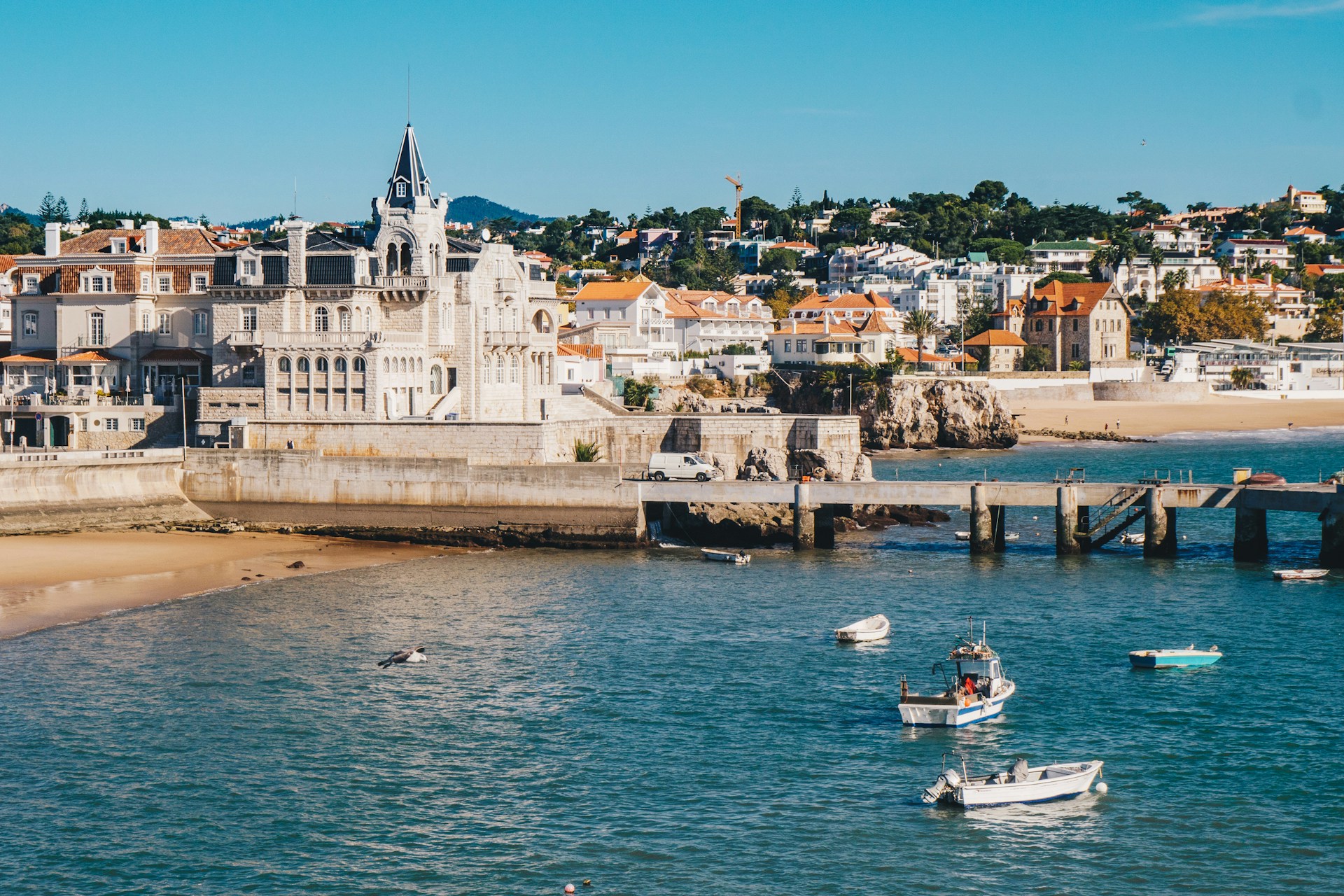
City view of Cascais, Portugal

Cascais

Cascais traded fishing nets for salons when exiled royals and spies washed up here during the 1940s. Today, mansions study the horizon while surfers test the wind along Guincho beach. The Condes de Castro Guimaraes Museum blends Gothic revival flourishes with a small but pointed art collection, and a lighthouse museum next door keeps radar company with history. Trains from Lisbon deliver cyclists who roll the ocean path to Boca do Inferno, a cliff mouth that thunders when swells have something to say. At lunch, try sea bream so fresh the plate needs only olive oil and a squeeze of lemon. Small surprises accumulate: a hidden cove behind the fortress, a bookshop that doubles as a wine bar, a street of tiled facades that throws back sunset like foil. The result is a place that edits itself well, never too loud, never too shy.

Top attractions & things to do in Cascais

If you’re searching for the best things to do in Cascais, this guide brings together the top attractions and must-see places to visit in Cascais. The top picks below highlight the most visited sights for first-time visitors, plus a few local favorites worth adding.

Boca do Inferno in Cascais, Portugal

Boca do Inferno

Waves muscle through a collapsed sea cave and exhale into daylight, turning rock into a breathing instrument that changes pitch with the tide. The cliff here is layered limestone, bored for ages by the Atlantic until a roof gave way and left a ragged amphitheater for storms. On calm days, you hear a low murmur; in winter, the blowhole thunders and mist salts every sleeve within reach. Locals trade stories about a notorious visit by Aleister Crowley, whose staged disappearance in 1930 briefly made this chasm a headline. From the path you can read the coast like a map—Cascais behind you, Guincho and Cabo da Roca ahead—while fishermen watch the swell with scholarly patience. Sunset stains the ledges copper and the spray turns to glitter, but the edge always keeps its warning. Come for drama, stay for the geology lesson, and leave with shoes dusted in salt that will not concede easily.
Ads place
Ads place
Ads place
Ads place
Ads place
Cascais Citadel and Art District in Cascais, Portugal

Cascais Citadel and Art District

Thick walls once faced cannons toward the mouth of the bay, part of a coastal defense web laid out in the 16th century. Later, the compound softened into a royal summer enclave when King Luis I discovered Cascais light in the 1870s, and the town’s calendar shifted to match court arrivals. Today, barracks and magazines host studios, galleries, and the resident-artist program known as the Residencia Artistica, so the old bastion now fires ideas instead of shot. You can wander ramparts for views of moored boats and tiled roofs, then step inside to find installations that treat stone as a collaborator. The palace quarters preserve quiet rooms and careful ceilings, a counterpoint to white cubes hung with experiments. Even the parade ground feels repurposed into a plaza for conversation and concerts. History here did not retire; it changed jobs, and the salary is measured in sketches and applause.
Ads place
Ads place
Ads place
Ads place
Ads place
Museu Condes de Castro Guimaraes in Cascais, Portugal

Museu Condes de Castro Guimaraes

A romantic seaside villa poses like a page from an illustrated novel, all turrets, verandas, and a tower that eavesdrops on the tide. Built around 1900 for Jorge O'Neil, the house blends neo-Gothic accents with Moorish filigree and rooms cooled by patterned azulejos. Today its museum leads you through carved furniture, Indo-Portuguese ivories, and a small library whose illuminated manuscripts once amused visiting royals, including King Carlos I. The music room keeps its piano ready, because the collection assumes art should be heard as well as seen. From the garden, the moat-like cove mirrors the tower, and gulls annotate the silence. Exhibits favor context over clutter, so each object holds a conversation with the Atlantic two windows away. It feels less like a museum than a cultured home that never quite stopped hosting, where time slows enough to register brushstrokes, book spines, and the formula of sun on tile.
Ads place
Ads place
Ads place
Ads place
Ads place
Praia do Guincho in Cascais, Portugal

Praia do Guincho

Wind draws calligraphy across a wide canvas of sand, and the sea replies with lines of surf that refuse repetition. Framed by the Serra de Sintra and protected within the Sintra-Cascais Natural Park, this beach is as famous for weather as for beauty. Sailboarders and kiters chase the reliable northerlies, continuing a tradition of windsurfing contests that peaked internationally in the 1990s. On quieter mornings, dunes stitched with hardy grasses shelter walkers tracing the boardwalk toward cliffs where the North Atlantic first finds Iberia. Restaurants tucked behind the ridge serve grilled fish that tastes of smoke and patience, and a late coffee becomes an alibi to stay longer. The light changes every ten minutes, and photographers learn humility quickly. Guincho is not a souvenir beach; it is a mood, and the wind edits everyone’s plans into a simpler, happier outline.
Ads place
Ads place
Ads place
Ads place
Ads place
Santa Marta Lighthouse Museum in Cascais, Portugal

Santa Marta Lighthouse Museum

Blue-and-white bands climb a slender tower at the harbor’s edge, guiding arrivals since 1868 and still throwing a measured blink across Cascais Bay. The museum inside unpacks navigation with lens assemblies, keepers’ tools, and a Fresnel optic that turns physics into sculpture. Housed partly in the restored Fort of Santa Marta, the site balances military memory with maritime craft, explaining how light, color, and timing build a language for ships at night. From the terrace you can follow storm paths in the scuffed paint of seawalls, then step back to read coastline and current like a chart. Exhibits reach beyond romance to the routine—logbooks, oil cans, and the stubborn choreography of maintenance in salt air. Outside, waves knock politely at the rocks, and the keeper’s house glows with domestic scale. The lesson is simple and enduring: a lighthouse is a promise kept one interval at a time.
Ads place
Ads place
Ads place
Ads place
Ads place