
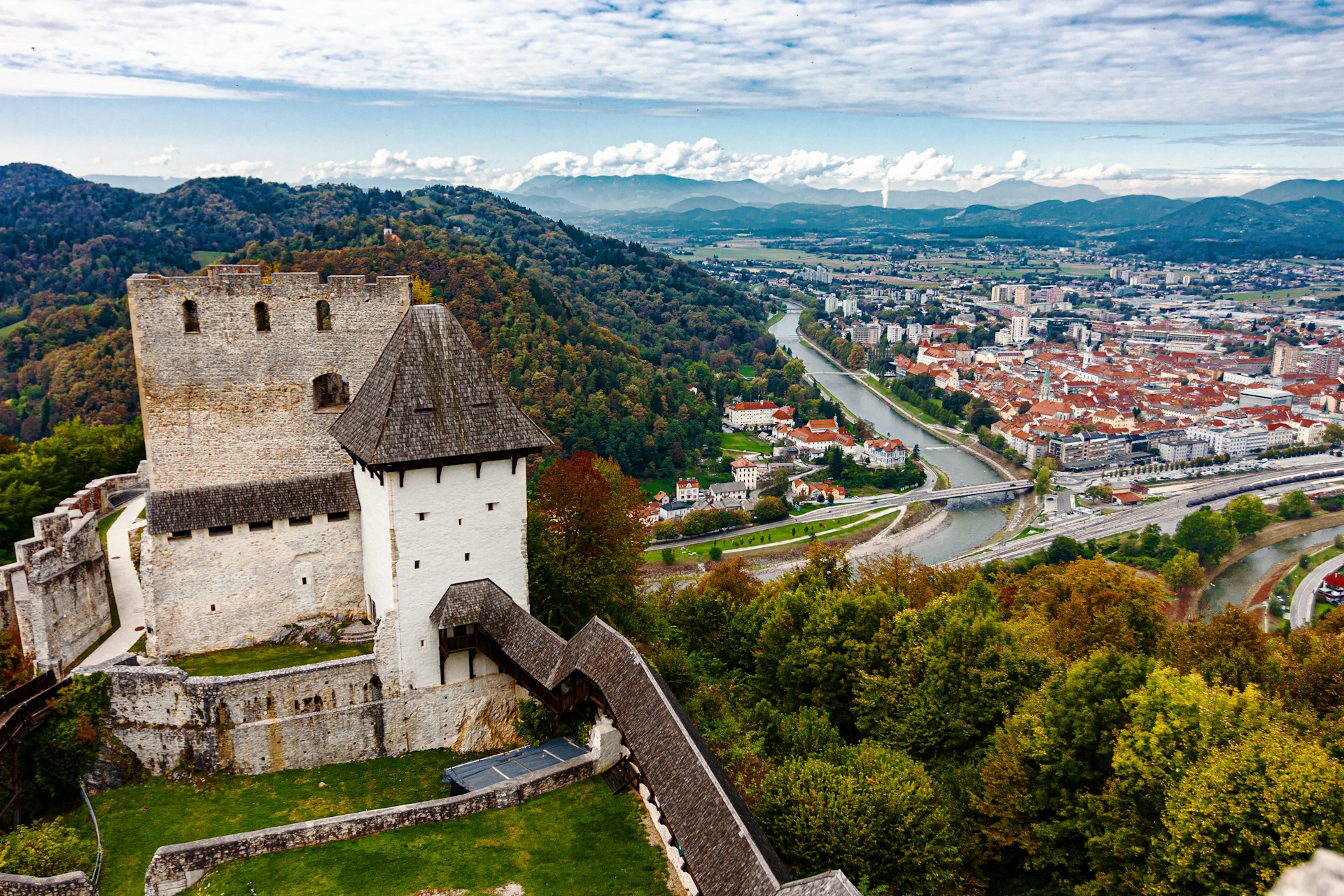
City view of Celje, Slovenia

Celje

Celje balances industry with old titles. Up on the hill, the Counts of Celje kept a fortress that still measures status in stone; down below, galleries and cafes file daily progress reports. The museum tells how the family rose in the 14th and 15th centuries, trading alliances with a skill equal to any sword. Eat zlikrofi style dumplings borrowed from Idrija's playbook or a bowl of ricet on cool days, and finish with honey cakes from a market stall. The Savinja river shapes the walkways and once powered mills that ran like careful clocks set by water. Quirky footnote: a former rail warehouse hosts a model train club whose layouts are more precise than some budgets and attract patient visitors on Saturdays. Stroll the river path at dusk when the castle walls color toward copper, and you can hear street musicians finding the right key for the evening crowd.

Top attractions & things to do in Celje

If you’re searching for the best things to do in Celje, this guide brings together the top attractions and must-see places to visit in Celje. The top picks below highlight the most visited sights for first-time visitors, plus a few local favorites worth adding.

Celje Castle in Celje, Slovenia

Celje Castle

Rising above the Savinja Valley, Celje Castle commands both history and horizon, its angular towers tracing a lineage that begins around the 14th century. Once seat of the Counts of Celje—rivals to the Habsburgs—the fortress shows the evolution of Gothic military architecture fused with later Renaissance touches. Excavations uncovered a gate tower foundation from about 1333, while the main palace bears masonry dating to at least the 15th century. Climb the Frederick Tower for panoramic views and the faint echo of medieval ambition; plaques recount duels, marriages, and betrayals that shaped Styria’s political map. Restoration campaigns in the 20th century secured parapets and revealed old mortar lines still holding against centuries of wind. On summer evenings, concerts and reenactments fill the courtyard where soldiers once drilled. Stand at dusk, and the castle’s silhouette merges with the hills—a geometry of survival that defines Celje’s skyline as much as its legend.
Ads place
Ads place
Ads place
Ads place
Ads place
Celje Regional Museum in Celje, Slovenia

Celje Regional Museum

Housed in the graceful former Count’s Palace, the Celje Regional Museum curates layers of memory spanning prehistory to modern industry. Founded officially in 1882, it remains one of Slovenia’s oldest cultural institutions. Its Roman lapidarium preserves tombstones unearthed from Celeia, while the Baroque halls upstairs display portraits of the Counts painted around 1600. Temporary exhibits explore local ironwork, early photography, and the city’s textile boom of the 19th century. The interior staircase—oak and iron—retains its creak from original boards, and an attic gallery holds a restored 17th-century globe. In the courtyard, lime trees offer shade over fragments of columns recovered during sewer works in the 1970s. Visitors often pause here, balancing curiosity with the quiet of a building that once negotiated both civic pride and private memory. Few museums manage to bridge centuries with such tact, where vitrines and walls together form a narrative more architectural than chronological.
Ads place
Ads place
Ads place
Ads place
Ads place
Old Town of Celje in Celje, Slovenia

Old Town of Celje

The Old Town of Celje unfolds along cobbled lanes that bend between facades layered from 15th to 19th century tastes. Here Baroque gables lean toward functionalist corners, and the rhythm of arcades once framed market stalls. Archaeological finds beneath the main square revealed fragments of Roman Celeia, earning the city its reputation as Slovenia’s “small Pompeii.” Café tables now sit above mosaics that date to around 170 AD. Look for the Town Hall’s restrained Neoclassical symmetry and the nearby St. Daniel’s Cathedral, whose bell tower anchors photographs like punctuation. The air carries traces of coffee and iron from workshops that operated until the 1930s. Modern galleries, boutiques, and street performers continue the tradition of civic performance once staged by guilds. As twilight falls, street lamps glow along the Savinja embankment, and the old paving stones catch the light as if retelling centuries of footsteps compressed into one continuing sentence.
Ads place
Ads place
Ads place
Ads place
Ads place
Savinja River Promenade in Celje, Slovenia

Savinja River Promenade

Running alongside the old embankment, the Savinja River promenade joins history with leisure as cyclists, joggers, and anglers trace a route that once guarded trade barges. Modern landscaping followed flood-control projects from 1972, integrating walking paths and stepped seating. Informational plaques mark the river’s highest crest in 1954 and the later ecological recovery of native trout. Willow trees planted in the 1980s now cast patterned shade across stone benches, while subtle lighting enables safe evening strolls. The pedestrian bridge—about 90 meters long—links the modern district to the medieval core, echoing Celje’s pragmatic adaptability. Street musicians occasionally set up near the central bend, their chords blending with the low rhythm of current against pylons. In spring, reflections double the skyline; in winter, mist reclaims it. This promenade demonstrates how a working river evolved into a civic living room, one that breathes with the same tempo as the town itself.
Ads place
Ads place
Ads place
Ads place
Ads place
St. Daniel's Cathedral in Celje, Slovenia

St. Daniel's Cathedral

Dedicated to the city’s patron, St. Daniel’s Cathedral blends Gothic arches with a calm Baroque sensibility added after renovations in the 18th century. The church’s earliest record appears in 1306, though excavations below the nave found crypt traces from perhaps the 12th century. Inside, ribbed vaults guide the eye toward an altar crafted by regional masters whose gilded panels still shimmer in filtered light. The organ—restored in 1996—fills the nave with tonal precision that matches the acoustics of stone and timber. Visitors note the modest tower height, limited by medieval regulations to remain below the castle’s watch line. Local legend says the bell rings an extra toll when river fog rolls in, marking invisible crossings. The surrounding square frames weddings, choirs, and markets, proving that sacred architecture here remains part of public life. When morning sun hits the facade, centuries of limewash reflect an optimism only faith and craftsmanship could maintain.
Ads place
Ads place
Ads place
Ads place
Ads place