
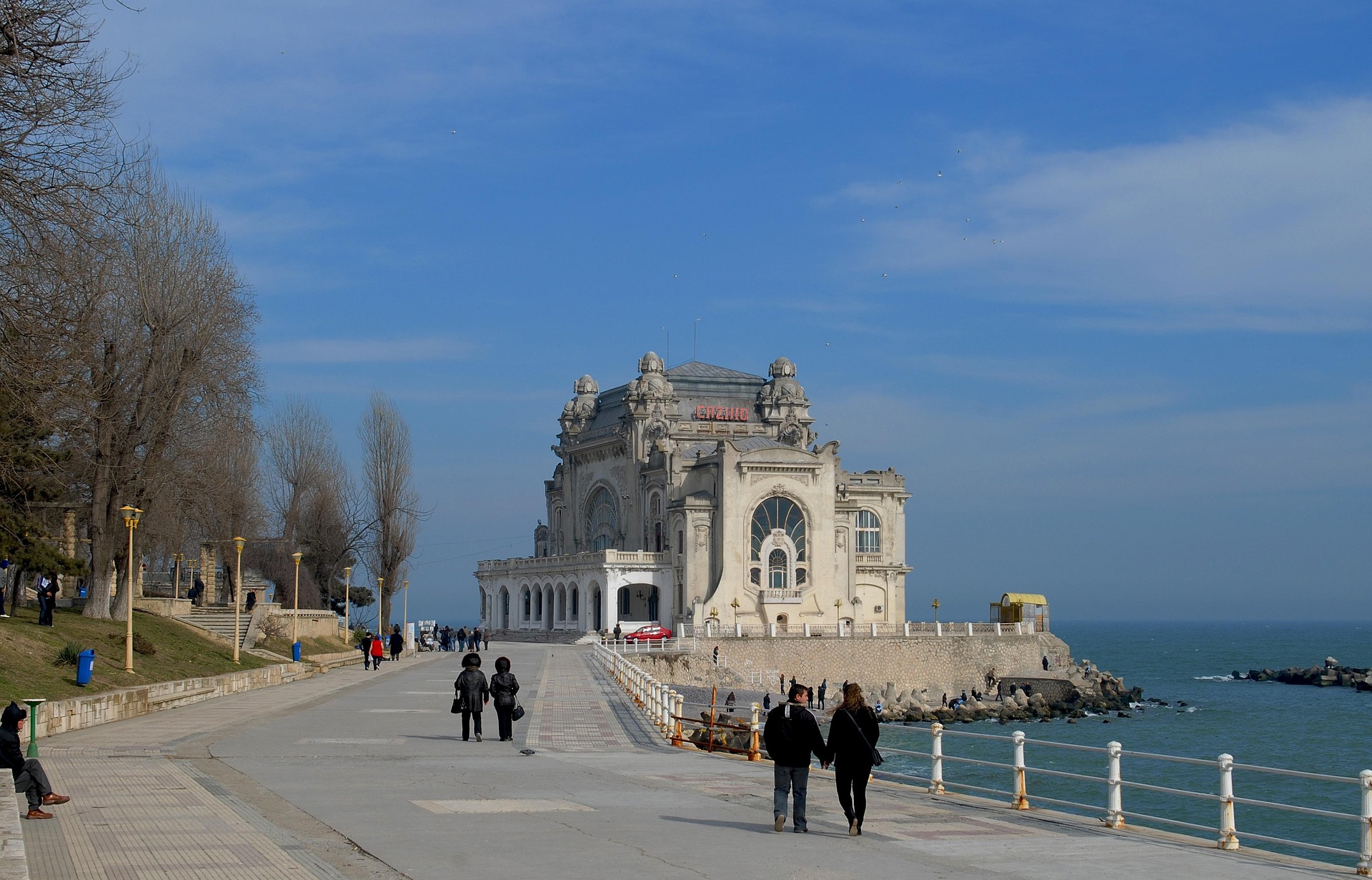
City view of Constanta, Romania

Constanta

Constanta looks the Black Sea in the eye and answers with a promenade, a casino shaped like a wave, and a museum that remembers when the city was Tomis. Roman mosaics, Greek inscriptions, and a statue of Ovid set the tone, while nearby beaches handle the modern habit of sunlit idling. Fish markets smell like proof, and restaurants treat sturgeon and mussels with simple respect. The old Ottoman quarter lingers in wooden balconies and a mosque with a view from its minaret that flatters the harbor. Summer nights pull music to the piers; winter reduces everything to gulls, wind, and strong coffee. A surprise hides under glass: one of the largest ancient floor mosaics in the region, its geometric calm surviving centuries of salt air. The city measures time in tides and timetables, and both lead inevitably to a plate of fried anchovies beside a very long horizon.

Top attractions & things to do in Constanta

If you’re searching for the best things to do in Constanta, this guide brings together the top attractions and must-see places to visit in Constanta. The top picks below highlight the most visited sights for first-time visitors, plus a few local favorites worth adding.

Constanta Casino in Constanta, Romania

Constanta Casino

Salt wind polishes the promenade as the Black Sea presses against an art nouveau palace built for leisure and bravado. Opened in 1910 under the patronage of King Carol I, the Casino hosted waltzes and roulette until wars and tides changed its luck. Architect Daniel Renard drew its curves in the language of Art Nouveau, then engineers reinforced them after storms that locals remember almost as characters in the story. During World War II the building served practical duties, and later decades layered repairs that tell their own history in plaster and glass. Stand at the rail and the sea performs to an audience of gulls while the facade plays both monument and memory. Photographs in nearby exhibits show fashionable crowds stepping from trams and into chandeliers, proof that Constanta once dressed for evening even on windy nights. Today restoration plans spark debate but the silhouette remains the city's calling card, a graceful survivor that invites you to imagine the orchestra tuning just behind the doors.
Ads place
Ads place
Ads place
Ads place
Ads place
Great Mosque of Constanta in Constanta, Romania

Great Mosque of Constanta

A slender minaret sketches the sky while the muezzin's balcony peers over rooftops and the edge of the harbor. Built between 1910 and 1913 by order of King Carol I, the Great Mosque of Constanta blends tradition with new materials. Architect Victor Stefanescu balanced Ottoman echoes with Romanian craft, and a carved door opens to a prayer hall lit by stained glass. The interior holds a fine Persian carpet gifted to the community, its patterns mapping devotion as surely as any compass. Climb the spiral stair and the minaret frames the port where fortunes have always arrived by water. The building also honors the deep history of Dobrogea, where Tatars and Turks left language and recipes alongside faith. Step back outside and the stone cools quickly in the sea breeze, a small miracle of engineering that keeps the monument calm even on bright afternoons. From the balcony the city arranges itself in neat bands of roofs, cranes, and sea.
Ads place
Ads place
Ads place
Ads place
Ads place
Museum of National History and Archaeology in Constanta, Romania

Museum of National History and Archaeology

In the square facing the ancient city gate stands a museum that treats evidence with affection. Founded in 1879 soon after the annexation of Dobrogea under King Carol I, the Museum of National History and Archaeology gathers anchors, statues, and coins into a brisk narrative. In one gallery the serene face of Glykon shares space with trade weights and amphorae marked with routes across the Black Sea. Another room displays the civic pride of Tomis in inscriptions that read like public tweets from two millennia ago. Collections from nearby Histria and Callatis widen the picture so the city becomes a chapter in a coastwide story. The building itself, once the city hall, stages light beautifully across marble and brick so that even small objects keep a stage presence. You exit onto the plaza feeling briefed rather than lectured, and the harbor wind finishes the tour with a salt signature. Step back inside for one more look at the lapidarium and you start to notice tool marks left by hands that worked quickly yet carefully.
Ads place
Ads place
Ads place
Ads place
Ads place
Roman Edifice with Mosaic in Constanta, Romania

Roman Edifice with Mosaic

Just inland from the waterfront, a floor of patience spreads under glass where merchants once sealed deals with a nod. The Roman Edifice with Mosaic dates to the 4th century, its geometric carpet laid when Tomis thrived under the Late Roman Empire. You read the site in layers, from warehouses to stairways to shards stamped with names that traveled faster than ships. Unearthed in 1959 during construction works, the hall revealed a mosaic of thousands of stones still holding the color of sea and grain. Interpretive panels trace trade links toward the Danube and Crimea while a cool hush settles over the excavated terraces. Some tiles were reset by careful hands yet sections remain worn by sandals, honest proof of traffic that once echoed here. Walk the perimeter and the modern city blurs a little as the map of ancient storefronts comes into focus, a reminder that selling and storytelling have always shared the same floor.
Ads place
Ads place
Ads place
Ads place
Ads place
Tomis Marina and Waterfront in Constanta, Romania

Tomis Marina and Waterfront

Where fishing skiffs once tied up at dawn, a boardwalk now threads cafes and sailboats into a single page you can read slowly. Tomis Marina spreads in a crescent below the cliff and keeps one eye on the Black Sea while the other watches the Casino's silhouette. Summer brings regattas and the patient choreography of mooring, a spectacle that pairs well with grilled mackerel and a glass of Dobrogea wine. The Roman poet Ovid would recognize the wind that still edits conversations, even if the harbor has traded triremes for catamarans. Down the quay stands the Genoese Lighthouse, a modest reminder of traders who stitched this shore to distant markets. Farther along, engineers salute Anghel Saligny, whose late nineteenth century work on the port turned ambition into infrastructure. Evenings end with a line of lights trembling on the water, and the city seems to breathe in time with halyards tapping the masts.
Ads place
Ads place
Ads place
Ads place
Ads place