
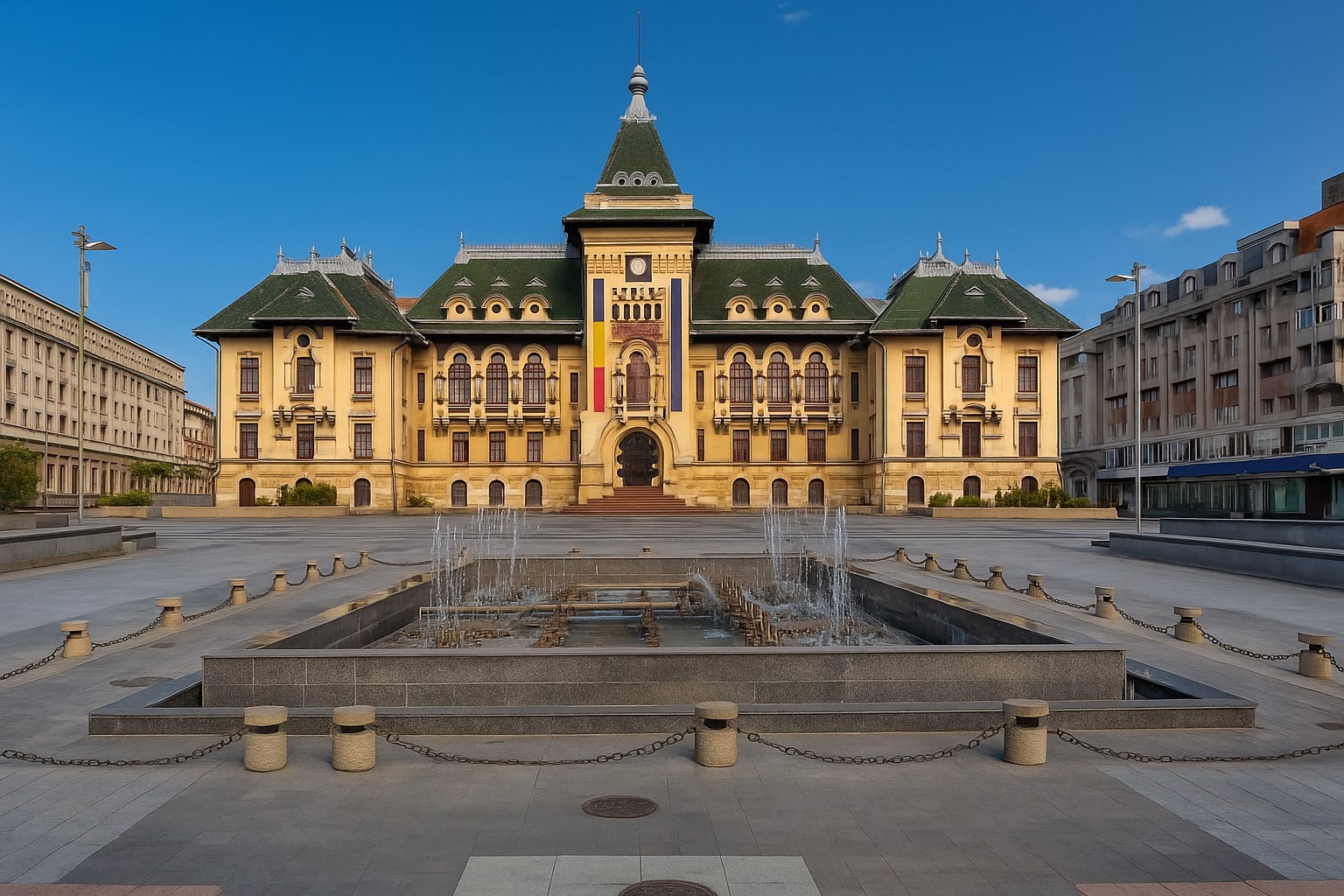
City view of Craiova, Romania

Craiova

Craiova greets you with parks generous in shade and a tidy old center where facades have learned to stand straighter after recent restorations. The Art Museum, housed in a neo-baroque palace, pulls you toward Constantin Brancusi's early sculptures, a prelude to the modernist legend he became. The botanical garden lays out a calm afternoon among palms and cacti, while students pour out of the university to claim benches and street corners. Menus deliver mititei, stews, and a regional obsession with baked peppers. Tramlines hum; football scarves appear on Saturdays. A small oddity charms collectors: a museum of coins and regional artifacts where tiny metal circles tell surprisingly large stories. Craiova feels practical and proud, ready to explain what it makes and why it matters, then happy to serve cake thicker than your resolve. Sunset paints the theater square and the city decides to take its time walking home.

Top attractions & things to do in Craiova

If you’re searching for the best things to do in Craiova, this guide brings together the top attractions and must-see places to visit in Craiova. The top picks below highlight the most visited sights for first-time visitors, plus a few local favorites worth adding.

Craiova Art Museum (Jean Mihail Palace) in Craiova, Romania

Craiova Art Museum (Jean Mihail Palace)

Marble staircases and gilded ceilings announce that this was once the residence of one of Romania’s wealthiest men. Built in 1907 by Constantin Mihail and designed by French architect Paul Gottereau, the palace now houses the Craiova Art Museum. Its most treasured works are by Constantin Brancusi, who began his artistic journey in this region before becoming a pioneer of modern sculpture. Paintings by Theodor Pallady and Nicolae Tonitza converse with European masters across salon walls where mirrors multiply color and light. Visitors often pause at Brancusi’s early pieces, recognizing hints of the abstraction that would later revolutionize art. During the interwar period, the palace also hosted dignitaries and royal receptions, its chandeliers glowing above diplomatic whispers. Today the museum balances heritage with modern exhibitions, proving that art and opulence can coexist gracefully. Standing in these rooms, you sense that wealth has been successfully converted into cultural capital.
Ads place
Ads place
Ads place
Ads place
Ads place
English Park (Gradina Englezeasca) in Craiova, Romania

English Park (Gradina Englezeasca)

Amid the busy avenues lies a green retreat whose name recalls 19th century fashions in landscaping. The English Park was arranged in 1853 at the initiative of Governor Barbu Stirbei, who wanted Craiova to mirror the elegance of Western Europe. Paths were laid with informal curves, trees grouped to suggest spontaneity rather than symmetry, and lawns left wide for leisure. Over time, the park became a favorite promenade for students, soldiers, and young couples who sought both shade and conversation. The interwar years brought kiosks for music and political speeches alike, reinforcing the idea that green space was also civic space. Though smaller than Romanescu Park, the garden continues to embody a style where nature appears carefully untamed. Benches still host readers and chess players, and the fountains provide a calm score beneath their games. The English Park is modest but eloquent, a living proof that urban refinement once meant designing silence into the city.
Ads place
Ads place
Ads place
Ads place
Ads place
Madona Dudu Church in Craiova, Romania

Madona Dudu Church

In the heart of Craiova rises a church with walls that seem modest until you step inside and encounter frescos alive with narrative. Founded in the 18th century and rebuilt after the earthquake of 1831, it holds the revered icon of the Virgin Mary said to be miraculous, attracting pilgrims especially during feast days. The interior frescoes, painted by Gheorghe Tattarescu in the 19th century, unfold biblical scenes with a vibrant palette that still commands attention. Stories circulate about how the church offered shelter during wars, its courtyards providing a quiet refuge when the city shook with turmoil. Restoration projects in the 20th century secured the structure, yet left the patina of time intact, so worshippers feel continuity rather than renovation. Candles burn steadily in front of the icon, and the air is heavy with incense and whispered prayers. The church feels less like a monument and more like a dialogue across centuries.
Ads place
Ads place
Ads place
Ads place
Ads place
Nicolae Romanescu Park in Craiova, Romania

Nicolae Romanescu Park

Paths curve beneath chestnut and oak trees while a lake gathers reflections of bridges that look as though they were drawn by a romantic hand. Opened in 1903 and designed by French architect Edouard Redont, the park was awarded a gold medal at the Paris Exposition, proof that landscape could be both civic duty and art. The suspension bridge still charms walkers who pause halfway for photos, and the artificial castle ruins provide a backdrop for children who insist on adventures. Locals rent boats, couples claim benches, and joggers measure their mornings in laps along shaded avenues. The small zoo adds another layer of family ritual, while the rose garden perfumes the summer air with persistence. Evenings often echo with concerts performed in the open-air theater, continuing a tradition of gathering under the trees. The park is not only Craiova’s lung but its memory, a daily rehearsal of leisure designed more than a century ago.
Ads place
Ads place
Ads place
Ads place
Ads place
Oltenia Museum Complex in Craiova, Romania

Oltenia Museum Complex

What began as a small scholarly collection has grown into a complex where archaeology, history, and natural science share corridors. Founded in 1915, the museum preserves treasures from the Dacian and Roman eras, including coins, ceramics, and carved stone that speak of ancient trade routes across the region. One highlight is a series of medieval manuscripts that survived both fire and shifting borders, their calligraphy still sharp after centuries. In the natural sciences wing, dioramas of the Carpathians explain ecosystems with patient accuracy, while ethnographic exhibits present costumes embroidered with ancestral codes. During the communist decades the museum expanded into neighboring buildings, a decision that gave it space but also a layered architectural style. Today visitors encounter both grand halls and intimate study rooms, a mixture that reflects the institution’s origins as a scholarly pursuit turned civic mission. The Oltenia Museum proves that curiosity, once properly housed, can outlast politics and fashion.
Ads place
Ads place
Ads place
Ads place
Ads place