
City view of Eindhoven, Netherlands

Eindhoven

Eindhoven is the brainy inventor in the Dutch family, a place where tech dreams get built and light festivals dazzle the night. The city’s Philips legacy glows in its museums and innovation hubs, but its personality is anything but corporate. Wander Strijp-S, a creative district of repurposed factories filled with street art, pop-up cafés, and designer shops. The Van Abbemuseum is a must for modern art lovers, while the annual GLOW festival transforms Eindhoven into a luminous wonderland. Football fan? The city’s red-and-white PSV jerseys are worn with pride. Fast-paced, futuristic, and always curious, Eindhoven is a spark that never fizzles out. It’s said that Einstein once delivered a lecture here, adding extra genius to its creative atmosphere.

Top attractions & things to do in Eindhoven

If you’re searching for the best things to do in Eindhoven, this guide brings together the top attractions and must-see places to visit in Eindhoven. The top picks below highlight the most visited sights for first-time visitors, plus a few local favorites worth adding.

DAF Museum in Eindhoven, Netherlands

DAF Museum

Close to the canal curve, an old brick complex shelters stories of engines, artisans, and a city that built vehicles for roads far beyond Brabant. The museum traces the company founded in 1928 by engineer Hub van Doorne, from trailers and lathes to streamlined trucks and city cars. Halls move through the 20th century with prototypes, race machines, and assembly-line tools arranged like a working orchestra. Panels address production during World War II and the hard choices faced by factories under occupation, then the boom years that followed, and 21st century restorations that keep the story running. Families linger at cutaway gearboxes and see how torque becomes motion, while retirees point out models they once drove. In a reconstructed street, neon signs and shopfronts set the vehicles back into everyday life, reminding visitors that innovation ends at someone's doorstep. Step outside and you can almost hear a diesel note rolling down the quay.
Ads place
Ads place
Ads place
Ads place
Ads place
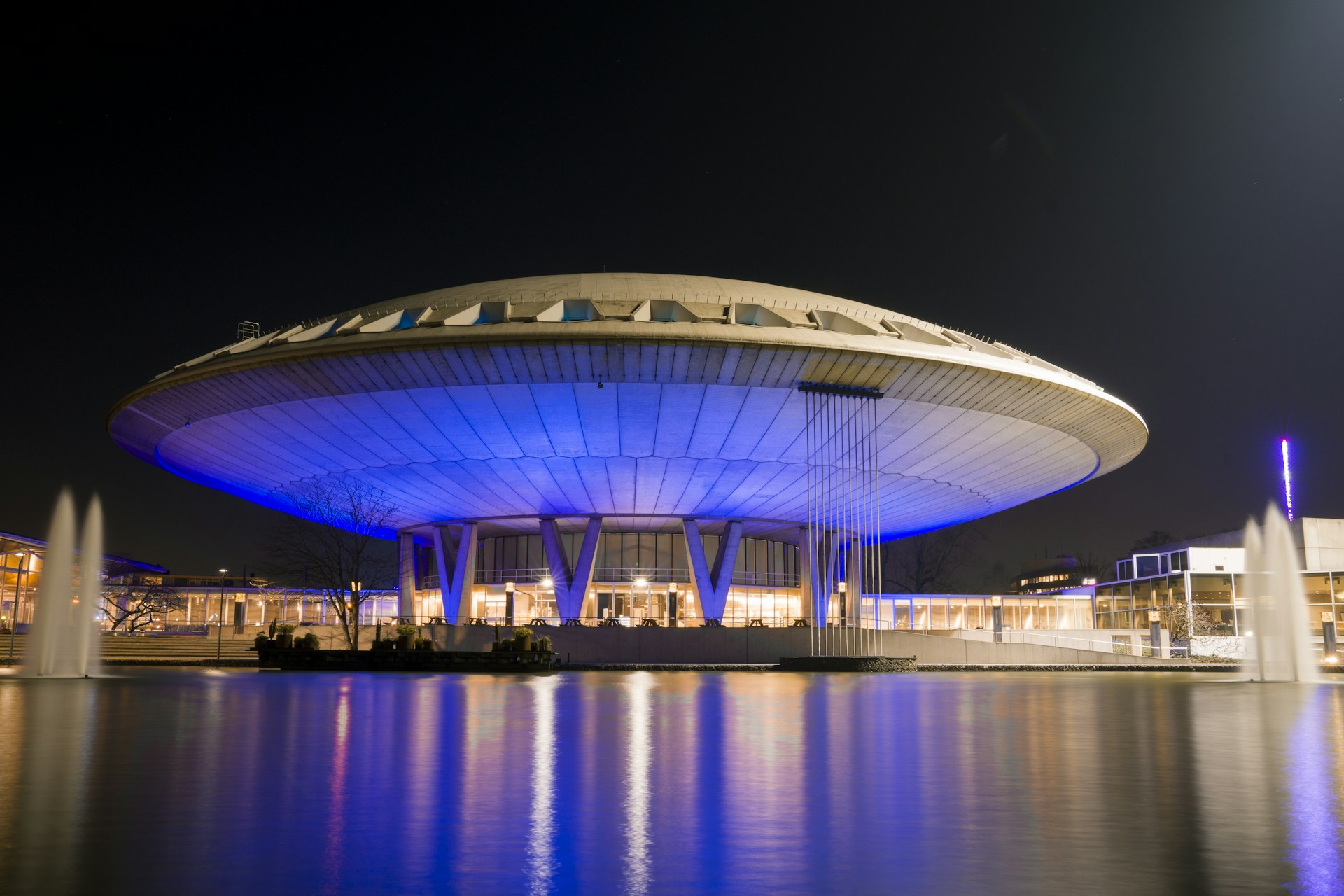
Evoluon in Eindhoven, Netherlands

Evoluon

Across a sweep of grass, a gleaming saucer rises as if it had taxied in from the future and decided to stay. Opened in 1966 under design director Louis Kalff, the Evoluon fused exhibition hall and icon to celebrate technology's promises in the optimistic postwar era. Its disc spans about 77 meters, lifted by tapered columns that make the mass appear to float, a bravura gesture of Modernist engineering in the late 20th century. Inside, changing programs play with light, sound, and interaction, returning to the building's roots in hands-on science. School groups test ideas at consoles while conferences turn the ring of galleries into a commons for invention. Walk the perimeter at dusk and the halo glows over lawns where families linger; look up from the pond and the saucer seems airborne again. Evoluon remains a local shorthand for daring, a reminder that form can persuade us to imagine tomorrow.
Ads place
Ads place
Ads place
Ads place
Ads place
Philips Museum in Eindhoven, Netherlands

Philips Museum

Steps from old factory halls, the Philips Museum threads the story of a workshop that grew into a global innovator through light, sound, and healthcare. It begins in 1891 with founders Gerard Philips and Anton Philips, whose first bulbs lit up a working town and a new ambition. Displays move through the 20th century with radios, shavers, and vacuum tubes that made modern life feel possible, and with stories of workers who built them. Interactive galleries explain research traditions, while exhibits on World War II face hard years and rebuilding with unblinking honesty. Design sketches and prototypes show how engineers turn problems into products, and how those products reshape daily routines. Finish in rooms where contemporary medical imaging stands beside historic glassblowing, proof that curiosity remains the company's most powerful current. Outside, the surrounding streets still echo with shift whistles and bicycles, and the museum makes their rhythm legible.
Ads place
Ads place
Ads place
Ads place
Ads place
Strijp-S District in Eindhoven, Netherlands

Strijp-S District

Former factories and power stations now frame a lively grid of studios, cafes, and lofts where the air still smells faintly of oil and coffee. Much of this quarter grew in the 20th century as a closed industrial campus under leaders like Anton Philips; today Strijp-S opens those volumes to residents and visitors with care. The vast Klokgebouw, completed in 1928, anchors the ensemble with its clock face and rugged concrete bays. In autumn, the city's showcase of creativity—Dutch Design Week—arrives, drawing makers and curious crowds since 2002. Courtyards host prototypes and debates while rooftops become viewing platforms for workshops below. Even on quiet weekdays, you'll see cyclists gliding between studios and kids playing under brick arcades, proof that reinvention can feel ordinary. By night, light installations stitch the blocks together, and the district hums like the factory it once was—only now the product is ideas.
Ads place
Ads place
Ads place
Ads place
Ads place
Van Abbemuseum in Eindhoven, Netherlands

Van Abbemuseum

Set beside the Dommel and the city's gentle quays, the Van Abbemuseum feels like a conversation between river light and bold ideas. Founded in 1936 with the gift of cigar magnate Henri van Abbe, it became a pioneer in collecting and exhibiting art that challenged habits of looking. Galleries trace the 20th century from avant-garde experiments to social questions, placing familiar names alongside provocations that still feel new. Works by Pablo Picasso converse with radical geometry by El Lissitzky, while temporary shows link Eindhoven's design culture to global movements. Architecture opens to the water, so reflections drift across concrete and glass. On quiet afternoons you may hear a guide explaining how artists responded to war, cities, and technology, and why that history matters in a town built on invention. The museum's library and cafe extend the visit into an easy study session; step back outside and the river carries the conversation on.
Ads place
Ads place
Ads place
Ads place
Ads place