
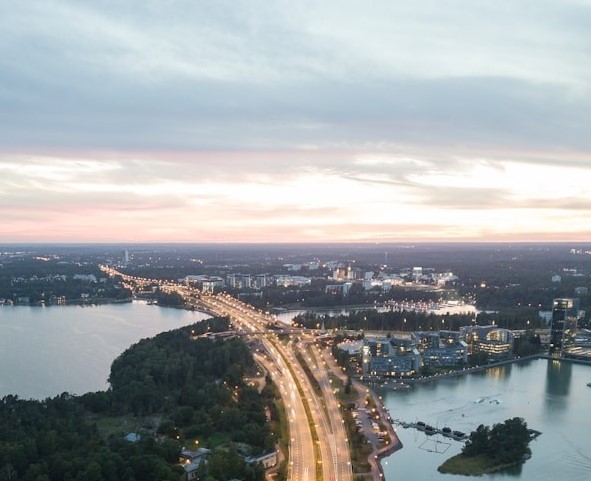
City view of Espoo, Finland

Espoo

Espoo sits beside Helsinki yet feels greener, shaped by postwar growth in the 1950s and a coastline of sheltered bays. Tapiola was planned as a garden city, and modernist blocks sit beside ponds and parks that invite slow walks. For culture, EMMA at WeeGee brings contemporary art into a former printing complex, while Otaniemi's campus adds student canteens and research buzz. Order creamy salmon pasta or a plate of fried vendace, then follow the shoreline path to Nuuksio National Park for spruce forests and clear lakes. In the Haukilahti marina, summer evenings smell of smoked fish and grilled sausages. A lesser known stop is the small Glims Farmstead Museum, which shows rural life that survived suburban expansion. Locals joke that Espoo has no single downtown because the best meeting point is whichever metro station has the least wind that day.

Top attractions & things to do in Espoo

If you’re searching for the best things to do in Espoo, this guide brings together the top attractions and must-see places to visit in Espoo. The top picks below highlight the most visited sights for first-time visitors, plus a few local favorites worth adding.

Espoo Cathedral in Espoo, Finland

Espoo Cathedral

In central Espoo, the atmosphere shifts as soon as you reach the old parish landscape around Espoo Cathedral. The church was built in 1485-1490 as a medieval stone church, and its modest exterior hides an interior that rewards slow looking. Lift your eyes to the ceiling and you will find vault paintings and details that feel handmade rather than polished, with murals from the 1510s adding color to the pale stone and wood. Outside, the churchyard and nearby paths create a calm pocket beside the river, making it easy to pair the visit with a short walk. Since it became a diocesan cathedral in 2004, the site has carried a broader role while still feeling local, like a building that knows the names of its neighbors. Go late afternoon when light drops low and the stone warms in tone, then listen for the quiet: footsteps, a few birds, and the soft sense that Espoo has deeper roots than its modern skyline suggests.
Ads place
Ads place
Ads place
Ads place
Ads place
Gallen-Kallela Museum in Espoo, Finland

Gallen-Kallela Museum

If you want Espoo with a dash of myth and artistry, head to the Gallen-Kallela Museum at Tarvaspaa. The building began as an atelier home for Akseli Gallen-Kallela in 1911-1913, and its National Romantic silhouette makes it feel more like a personal world than a neutral gallery. The museum has operated on site since 1961, presenting paintings, sketches, and design work that connect Finnish landscape to national storytelling, without losing the intimacy of a home studio. One of the pleasures is the setting: Tarvaspaa sits close to bays and shoreline paths, so the visit naturally expands into a walk among reeds and birch trees. Inside, rooms are compact and atmospheric, which makes you notice materials, window views, and the way the building frames light. Check the temporary exhibition if you can, then return to the permanent works to see how themes repeat across decades. Arrive with time to linger on the terrace or nearby paths; the art and the surrounding landscape feel like two chapters of the same story.
Ads place
Ads place
Ads place
Ads place
Ads place
Haltia The Finnish Nature Centre in Espoo, Finland

Haltia The Finnish Nature Centre

There is a moment at Haltia when you realize you can learn about Finnish nature and step into it almost immediately. Opened on 31 May 2013 beside Lake Pitkajarvi, the centre was designed by Rainer Mahlamaki to sit low against the forest edge, with warm timber tones that soften the modern lines. Inside, exhibits explain forests, bogs, and the coastal archipelago through sound, maps, and hands-on stations, so the information lands without feeling like a lecture. The building is roughly 3500 m2, which gives space for families, school groups, and quieter corners where you can slow down. Haltia also works as a practical base: trail maps, seasonal advice, and a cafe that makes it easy to plan a loop walk. Step outside and you are already on paths that lead toward Nuuksio, making the centre a true gateway to Nuuksio. Visit on a gray day if you can; the interior light feels especially calm, and the view over water turns the landscape into a moving backdrop.
Ads place
Ads place
Ads place
Ads place
Ads place
Nuuksio National Park in Espoo, Finland

Nuuksio National Park

A quick hop from Helsinki, Nuuksio National Park makes the capital region feel suddenly wild, with pine forests, dark lakes, and smooth bedrock underfoot. Established in 1994, the park covers about 53 km2 and still feels intimate, because trails weave between ridges and water rather than across open plains. Many visitors are surprised by over 100 lakes, from small ponds to long shorelines that catch low winter light. The area is managed by Metsahallitus, and well-marked routes plus fire-ring shelters make day hikes easy even for first-timers. Late summer brings blueberries and bright mushrooms, while October turns the forest floor into a russet carpet. On the rocks, the view opens suddenly and you can watch clouds slide over the treetops like slow waves. Follow a loop that crosses boardwalks over bogs, then pause at a lakeside lean-to for a thermos break. Public transport can get you close, but the last stretch feels like an intentional step away from the city. Go early on weekdays for quieter trails, and pack layers: the breeze off water can feel sharp even in July.
Ads place
Ads place
Ads place
Ads place
Ads place
WeeGee Exhibition Centre in Espoo, Finland

WeeGee Exhibition Centre

Espoo's best museum day can happen under one roof, and WeeGee Exhibition Centre is the reason. The complex was designed by Aarno Ruusuvuori as a printing house in 1964, expanded in 1967, and its concrete geometry still reads as confident Finnish modernism. Today it functions as a shared home for multiple museums, so you can move from contemporary art to local history without crossing town. A key detail is that it is a former printing house, and the industrial scale gives exhibitions breathing room, with wide corridors and high ceilings that make crowds feel smaller. The centre opened to the public in its current cultural role in 2006, and the vibe is more relaxed than monumental: lockers, cafes, and clear signage encourage spontaneous browsing. Take time to walk the exterior too; the facade lines up with the surrounding parkland and makes the building look almost like a sculpted piece of infrastructure. Come with one must-see museum in mind, then let the rest of the building surprise you.
Ads place
Ads place
Ads place
Ads place
Ads place