
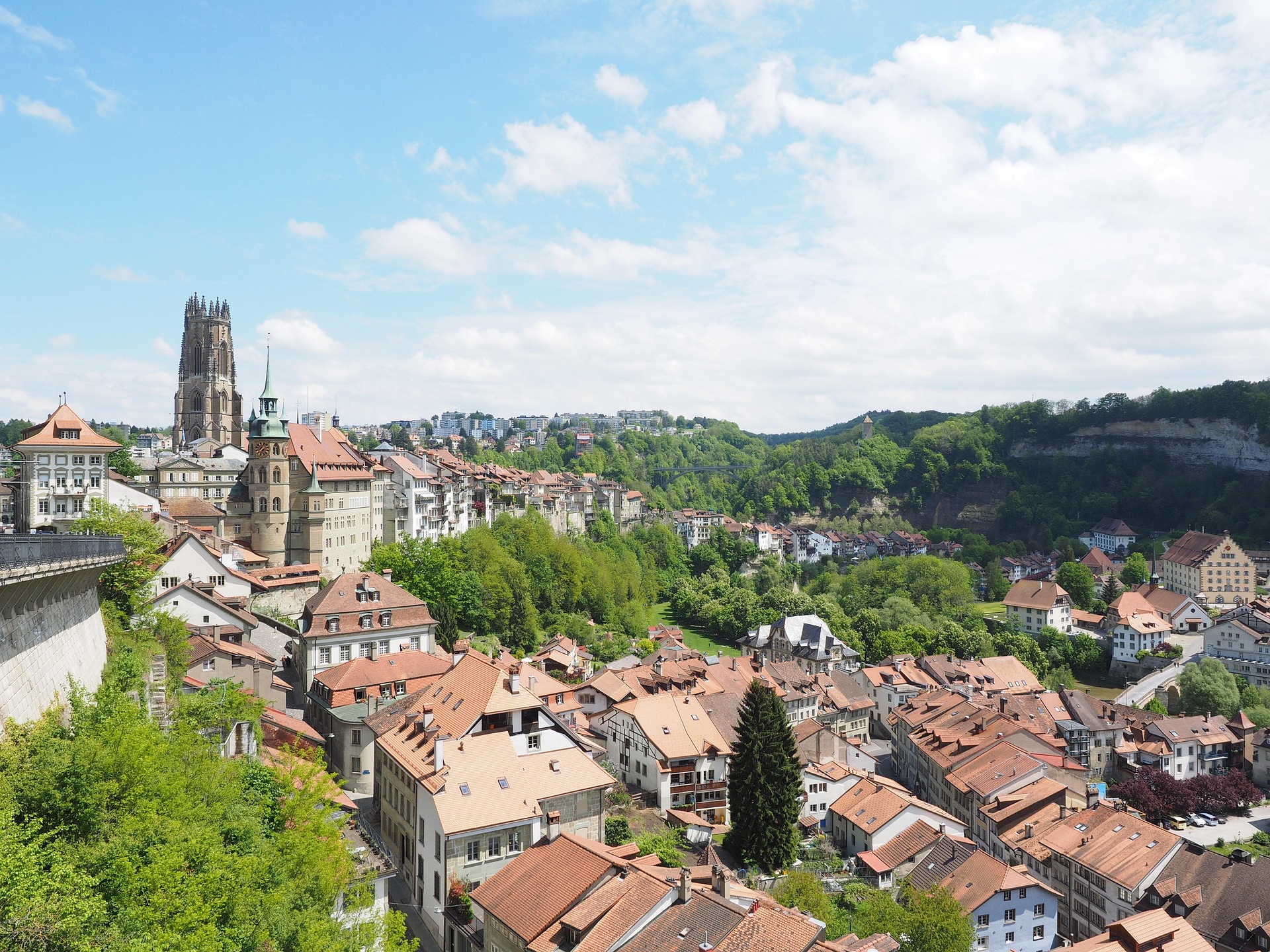
City view of Fribourg, Switzerland

Fribourg

Fribourg stands on a loop of the Sarine River, its bridges linking districts that developed under both French and German influence since the twelfth century. Gothic St Nicholas Cathedral dominates the skyline, while steep alleys drop toward lower town streets lined with fountains and sandstone houses. A funicular from 1899 still runs using wastewater as counterweight, an engineering curiosity proudly explained to visitors. Menus feature fondue moitie moitie with Gruyere and Vacherin cheese, followed by meringues and thick cream from nearby dairies. Students fill cafes in the upper town, while quieter lanes below hold antique shops and workshops. Walking the old quarter, you notice painted house signs that represent past trades through symbols rather than text. Locals describe these signs as an open air archive that reveals who worked where centuries ago without needing to read a single name.

Top attractions & things to do in Fribourg

If you’re searching for the best things to do in Fribourg, this guide brings together the top attractions and must-see places to visit in Fribourg. The top picks below highlight the most visited sights for first-time visitors, plus a few local favorites worth adding.

Fribourg Cathedral St Nicholas in Fribourg, Switzerland

Fribourg Cathedral St Nicholas

Fribourg Cathedral St Nicholas rises above the Sarine gorge, its tall tower anchoring almost every view of the old town. Approaching through narrow lanes, you pass houses with arcades before emerging onto a small square in front of the late Gothic facade. Inside, light filters through stained glass windows designed by Josef Mehoffer, colouring the stone floor with patches of blue, red and gold. Slender pillars and carved choir stalls reward slow exploration, while side chapels reveal centuries of local devotion. For many visitors the highlight is climbing the bell tower, where worn steps lead to an open gallery and a sweeping panorama over rooftops, bridges and distant hills. It is worth timing your visit for clear weather, when the contrasts between dark roofs, pale stone and green valley are sharpest. Modest clothing and calm behaviour are appreciated, as this is still an active place of worship at the heart of daily life. Outside, you can linger on nearby viewing terraces, watching trams and pedestrians weave slowly along the river bends below.
Ads place
Ads place
Ads place
Ads place
Ads place
Fribourg Funicular in Fribourg, Switzerland

Fribourg Funicular

The Fribourg Funicular is a short but memorable ride linking the upper town with the lower river district, using an unusual power source. Instead of electricity, the cars are moved by counterbalanced water tanks, making it one of the last water powered funiculars in Europe. At the upper station, a modest pavilion and historic machinery introduce the story, while below, rails dive into a steep cutting between stone retaining walls and gardens. The journey lasts only a few minutes, yet offers constantly shifting views of old roofs and towers as the car glides past. It runs as part of the public transport network, so you simply use a normal ticket, stepping aboard alongside locals. Riding down and then walking back up via lanes and stairways gives a strong sense of the town's vertical structure. For visitors who enjoy engineering heritage presented in an everyday setting, this little line becomes an unexpectedly charming highlight. Try to ride once in daylight and once after dark, when windows glow along the slope.
Ads place
Ads place
Ads place
Ads place
Ads place
Fribourg Old Town and Bern Bridge in Fribourg, Switzerland

Fribourg Old Town and Bern Bridge

Fribourg Old Town spreads across a steep slope above the Sarine, its upper streets linked to the riverside quarter by stairways, lifts and historic bridges. A good way to feel the layout is to stroll from the main shopping streets down toward the Bern Bridge, a roofed wooden crossing that still carries traffic across the river. On the way you pass arcaded houses, discreet monastery courtyards and painted fountains that mark small squares. Down by the water, the sound of wheels on planks and the smell of river spray evoke centuries of trade and travel. From the bridge and nearby paths you gain fine views of cliff hugging houses stacked above each other, church towers and the cathedral rising high above. Early evening brings warm light on the facades and long shadows in the alleys, ideal for photography. Wayfinding signs and colour coded walking circuits help you create your own loop between bridges, viewpoints and quieter corners without constantly checking a map.
Ads place
Ads place
Ads place
Ads place
Ads place
Gotteron Gorge Walk in Fribourg, Switzerland

Gotteron Gorge Walk

The Gotteron Gorge Walk starts at the edge of Fribourg and quickly feels surprisingly remote, as the path slips between steep rock walls and dense woodland. A narrow trail follows the Gotteron stream, crossing from side to side on simple wooden bridges and passing under overhanging limestone cliffs streaked with moss. In cooler months you may see icicles and frozen curtains forming along the walls, while spring brings fresh leaves and birdsong echoing through the ravine. Occasional clearings reveal views back toward cliff top farms and the outlines of the city above, reminding you how close town and nature sit here. Good shoes are essential, as sections can be damp and uneven, and it is wise to check local information after heavy rain. Completing the loop and re entering the streets gives a pleasant sense of transition, as if you have stepped back from a small, hidden world into everyday life after only a couple of hours on foot. Families often choose shorter picnic spots along the route, keeping the outing relaxed.
Ads place
Ads place
Ads place
Ads place
Ads place
Musee d'Art et d'Histoire Fribourg in Fribourg, Switzerland

Musee d'Art et d'Histoire Fribourg

Musee d'Art et d'Histoire Fribourg brings together fine arts, sculpture and local history in a group of historic buildings above the river. Inside, you move from rooms of medieval sculpture and painted altarpieces to galleries showing nineteenth century paintings and carefully crafted Art Nouveau objects. One wing houses the Espace Jean Tinguely Niki de Saint Phalle, where playful, kinetic works and colourful figures contrast with the quieter collections. Large windows and occasional balconies offer glimpses down to the Sarine and across to the old town, subtly linking exhibits to the landscape that shaped them. Clear labels in several languages and well designed routes make it easy to tailor your visit, whether you have an hour or an afternoon. A small cafe and museum shop provide a gentle transition back to city life. The museum is particularly pleasant on cool or rainy days, when its layered stories and varied textures turn a simple break from the weather into an engaging exploration of regional culture.
Ads place
Ads place
Ads place
Ads place
Ads place