
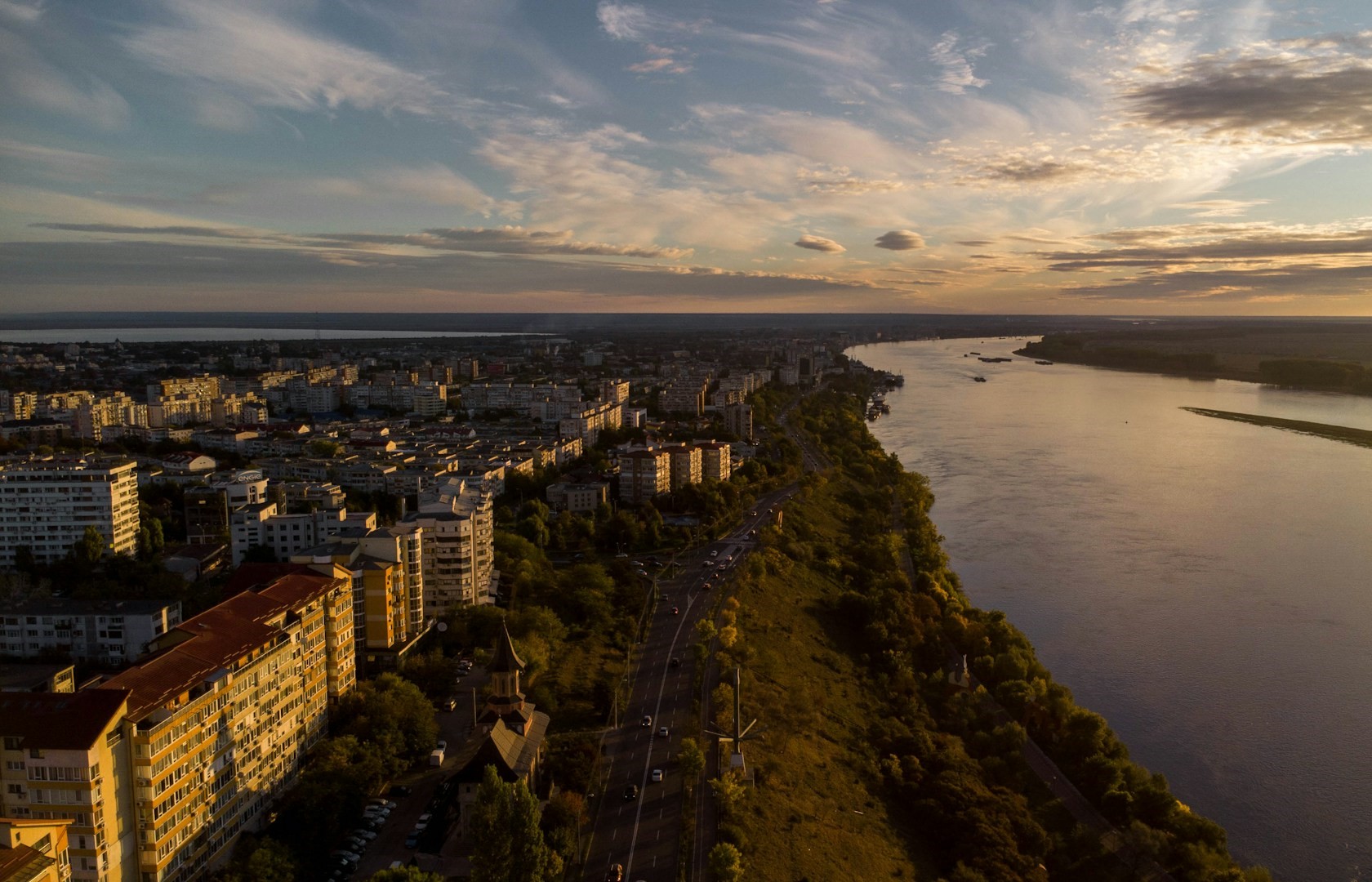
City view of Galati, Romania

Galati

Galati keeps one eye on the Danube and the other on shipyards that have shaped its identity for centuries. The riverbank carries promenades, statues, and occasional cargo cranes, a juxtaposition that locals accept as natural. Orthodox churches stand beside 19th-century mansions, some restored, others still waiting for their turn. Fish dominates the cuisine—soups sharp with vinegar, carp roasted with garlic—and markets testify to a city fed by both water and fertile plains. The Natural Sciences Museum surprises visitors with an aquarium where sturgeon glide like living fossils. Galati also holds a reputation for lively student life, fueled by its university and late-night cafes. Festivals bring theater and jazz, proving the town can improvise beyond industry. A curious fact: the Botanical Garden cultivates desert cacti in giant greenhouses, a surreal sight near the Danube’s waters. Galati walks the line between pragmatic work and cultural ambition, making both feel equally permanent.

Top attractions & things to do in Galati

If you’re searching for the best things to do in Galati, this guide brings together the top attractions and must-see places to visit in Galati. The top picks below highlight the most visited sights for first-time visitors, plus a few local favorites worth adding.

Danube Cliff Promenade (Faleza Dunarii) in Galati, Romania

Danube Cliff Promenade (Faleza Dunarii)

Even before breakfast the river is already at work, pushing light along the quay and nudging walkers toward the shade of plane trees. The sweep of the Danube feels almost oceanic here, wide enough to host barges, tugs, and the occasional river cruiser easing toward the Black Sea. In the 19th century the waterfront grew with shipyards and warehouses, and you can still read those layers in brick arches and railway stubs. Cyclists share the path with families while the EuroVelo 6 signs point across a continent in a handful of arrows. Street artists chalk quick portraits that the breeze edits but never quite erases. Old captains tell you how winter ice once locked hulls for weeks, a reminder that this corridor can be both highway and halt. At sunset the water becomes pewter and the city's conversation drops a register. The promenade teaches that scale is not about height but about reach, and the river has more reach than any skyline.
Ads place
Ads place
Ads place
Ads place
Ads place
Galati TV Tower in Galati, Romania

Galati TV Tower

From almost anywhere in town the tapering column marks direction like a practical compass. Raised in the 1970s as a broadcast hub, the television tower also hosts a revolving restaurant that completes a slow circle while plates arrive with unhurried confidence. Elevators lift you past a lace of reinforced concrete into a room of glass where the city flattens into a map and the Danube doubles as a silver road. On clear days the horizon stretches toward the Prut and thoughts wander with it. Engineers will enjoy the antenna arrays while everyone else counts ships and rooflines. During the 1980s the tower symbolized connection at a time when signals felt precious, a role it still plays in a more crowded spectrum. Sunset turns the river into copper and the shipyards into silhouettes. You ride down with a pocket full of small certainties, among them that perspective is a technology worth climbing for.
Ads place
Ads place
Ads place
Ads place
Ads place
Natural Sciences Museum Complex and Botanical Garden in Galati, Romania

Natural Sciences Museum Complex and Botanical Garden

A hillside opens into a campus where science behaves like a good host, offering paths between greenhouses, aquariums, and observatories. Founded in the 1960s, the complex combined a modern planetarium with an aquarium that favors Danube species, turning regional ecology into clear storytelling. Outside, the botanical garden arranges terraces by climate and utility so medicinal beds talk to rosaries and alleys of maples. Children queue for the dome where constellations advance with persuasive clarity while teachers quietly reclaim their students attention for the stars. The herbarium keeps drawers of pressed plants that smell faintly of old paper and summer fields. Exhibits on the Danube floodplain explain why reeds matter as much as ships and why wetlands are engines rather than leftovers. In spring the magnolias perform with extravagant confidence. The whole place feels like a promise kept to curiosity, a reminder that a city on a working river can also be a patient garden for ideas.
Ads place
Ads place
Ads place
Ads place
Ads place
Precista Church in Galati, Romania

Precista Church

Down by the river a compact fortress reveals itself as a place of worship, its walls thick enough to remember alarms. Built under Vasile Lupu in 1647, the church served both prayer and refuge during periods of frontier tension with Ottoman incursions. Stone buttresses and narrow windows signal caution while the interior settles into warmth, the Byzantine plan flowing toward an iconostasis heavy with gold leaf and smoke darkened saints. Guides point out trapdoors that once hid valuables and parish records written in a clerk's careful hand. The bell rings low over the floodplain and gulls circle as if on a schedule older than the clock. Restoration in the 20th century cleared later plaster to reveal brick patterns that read like a craftsman's signature. Step outside and the Danube presses a cool draft against the masonry. It is easy to imagine families gathering here at dusk, listening for news while counting blessings one candle at a time.
Ads place
Ads place
Ads place
Ads place
Ads place
Visual Art Museum Galati in Galati, Romania

Visual Art Museum Galati

Behind a measured facade the galleries pivot from quiet to provocative with admirable ease. Opened in 1967 as a pioneering home for contemporary art in Romania, the museum still treats new work with the same serious hospitality once reserved for classics. Curators splice regional painters with national names so the Danube setting becomes a context rather than a constraint. Archives preserve manifestos and catalogues that smell pleasantly of ink and ambition. Temporary shows flirt with installation and video yet always circle back to painting and drawing, crafts that still carry the city's pulse. In one corner a study room displays posters that chart late 20th century experimentation, proof that ideas travel even when borders do not. The building never shouts. It invites a slower look that rewards attention with connections you did not expect to make. You step back onto the street and notice color differently, which is the museum's quiet victory.
Ads place
Ads place
Ads place
Ads place
Ads place