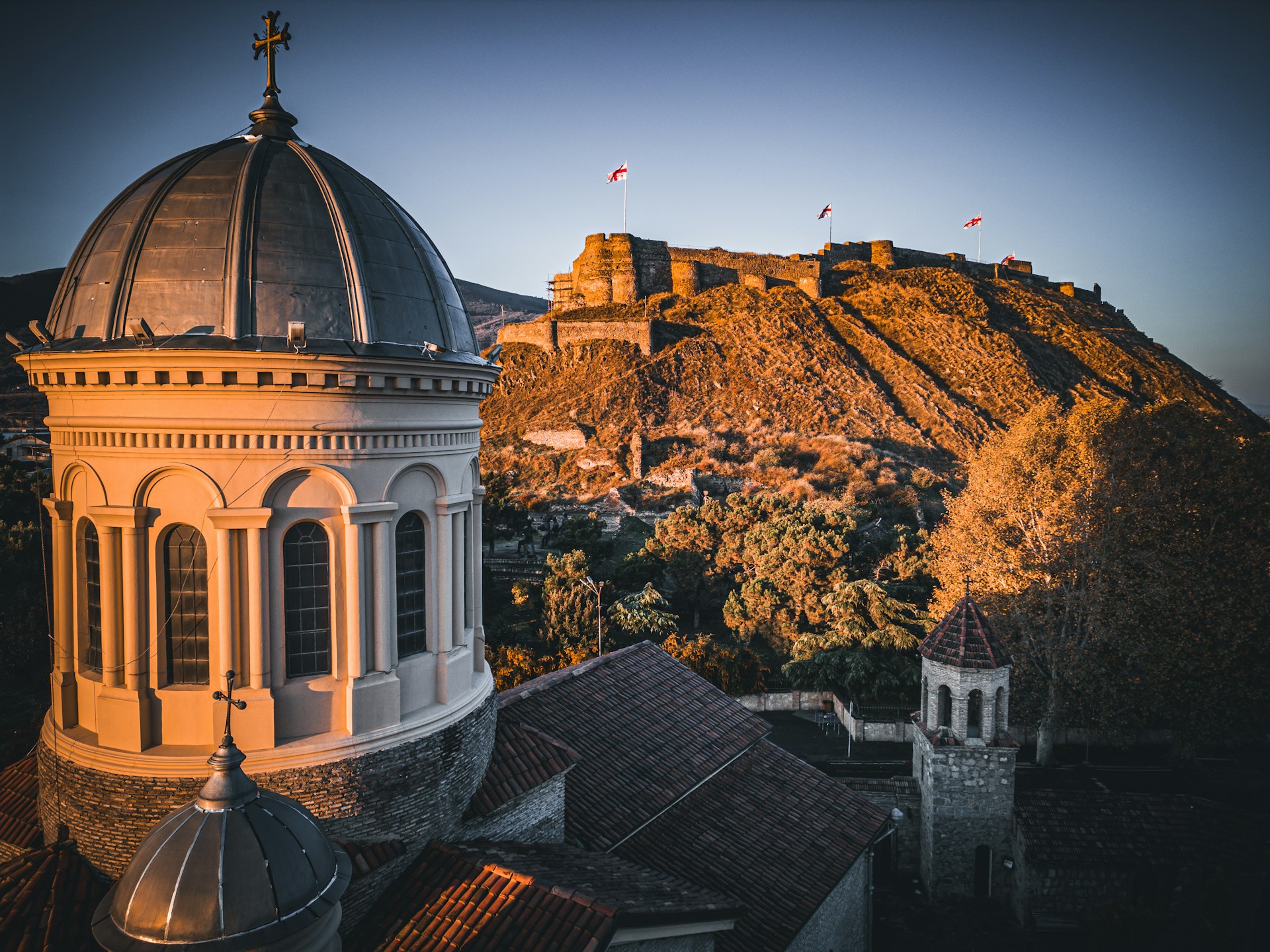

City view of Gori, Georgia

Gori

Gori, an industrial city in eastern Georgia, is best known as the birthplace of Joseph Stalin, yet its heritage stretches back millennia. At its core lies the Stalin Museum, a stark red brick complex honoring the Soviet leader with personal artifacts, period cars, and archival films—a polarizing yet compelling draw for history buffs. The museum’s adjacent childhood home and personal railway carriage evoke vivid glimpses of Stalin’s early life and rise to power. Beyond its 20th-century associations, Gori serves as the gateway to Uplistsikhe, an astonishing rock-hewn city carved into the cliffs above the Mtkvari River. Dating to the Iron Age, Uplistsikhe features pagan temples, wine cellars, and an ancient theater hewn directly from bedrock. The modern city—lined with parks, bustling bazaars, and a hilltop citadel—offers a surprisingly warm, small-town atmosphere. Visitors can sample local hospitality in family-run guesthouses, where hearty stews, cornbread, and regional wines round out an engaging journey through Georgia’s layered past.

Top attractions & things to do in Gori

If you’re searching for the best things to do in Gori, this guide brings together the top attractions and must-see places to visit in Gori. The top picks below highlight the most visited sights for first-time visitors, plus a few local favorites worth adding.

Ateni Sioni Monastery in Gori, Georgia

Ateni Sioni Monastery

Tucked into a wooded ravine just beyond Gori, Ateni Sioni Monastery was founded in 620 AD by Patriarch Kyrion I and later expanded by King Leon III in the 10th century. Its central church features the earliest surviving Georgian stone inscriptions in Asomtavruli script, carved above the door to proclaim divine protection. King Leon III’s 982 renovation added intricate reliefs of saints on the south façade, many still crisp after a millennium. Visitors descend a hidden stair into a crypt where obsidian-lined ossuaries once stored the remains of noble families. Archaeologists rediscovered a clandestine 19th-century printing press beneath the refectory in 2005, which quietly produced banned liturgical texts during Tsarist rule. Each July 15th, pilgrims gather beneath ancient walnut trees to celebrate the Feast of the Transfiguration, processing through the stone portal with hymns echoing among the cliffs. A hidden terrace offers sweeping views over the Kartli river valley, making Ateni Sioni both a spiritual haven and a living chronicle of Georgian resilience.
Ads place
Ads place
Ads place
Ads place
Ads place
Gori Fortress in Gori, Georgia

Gori Fortress

Dominating Gori’s skyline, the medieval fortress perches on a rocky outcrop overlooking the city and river below. Although a stronghold existed here in the 9th century, most surviving stone walls date to the 13th century, when King David IV reinforced the citadel during his campaigns to unify Georgia. In the northeast bastion, a hidden water well still runs, its secret access corridor once used to supply defenders under siege. Archaeologists uncovered a Byzantine-style chapel ruin with vivid fresco fragments of angels and local saints, hinting at early Christian worship within these ramparts. A steep climb rewards visitors with panoramic views of the Kartli plain and distant Caucasus foothills. Inside the lower bailey, a permanent exhibit displays recovered medieval weaponry—catapult fragments, arrowheads, and cavalry spurs—illuminating the fortress’s strategic role on the Silk Road frontier. Far from a simple photo stop, Gori Fortress stands as a testament to Georgia’s military ingenuity and the vision of its medieval monarchs.
Ads place
Ads place
Ads place
Ads place
Ads place
Gori Regional Museum of Local History in Gori, Georgia

Gori Regional Museum of Local History

Beyond its Stalin exhibits, the Gori Regional Museum charts Kartli province’s deep past through archaeological, ethnographic, and geological collections. The ceramics gallery traces pottery traditions from the Bronze Age to the medieval era, spotlighting a distinctive Gori-style glaze lost after the 14th century. In the numismatic section, rare Caucasian silver coins reveal trade links with Byzantine and Persian empires. A geological wing displays polished cross-sections of Mashavera basalt columns, formed by volcanic cooling more than 20 million years ago. Outdoors, a reconstructed 19th-century peasant home houses original samovars, plowshares, and icon corners rescued from local villages. The museum’s pride is an archive of 17th-century tax petitions, where farmers pleaded for relief after harsh winters—handwritten pleas that humanize centuries-old struggles. Monthly “memory box” exhibits, curated by local schoolchildren, keep the museum’s narrative fresh, reinforcing Gori’s identity as both a cradle of Georgian statehood and a living community of storytellers.
Ads place
Ads place
Ads place
Ads place
Ads place
Joseph Stalin Museum in Gori, Georgia

Joseph Stalin Museum

Nestled in Stalin’s childhood home, the Joseph Stalin Museum offers an intimate look at the Soviet leader’s formative years through original personal artifacts and archival photographs. The modest two-story house preserves the family’s furniture and handwritten school essays, while adjacent halls display the armored railway carriage used during World War II and Stalin’s private yacht, with its polished mahogany interiors. Behind the scenes, researchers are digitizing crates of personal correspondence discovered in 2018, shedding new light on his early relationships. The museum gardens feature a bust sculpted by Sergo Zakariadze in 1953 and a plaque commemorating local victims of Soviet purges. Multimedia kiosks present diverse perspectives on Stalin’s legacy, balancing reverence with critical context. A guided “behind the glass” tour lets visitors glimpse the leader’s bedroom fittings and bespoke silverware, creating a textured portrait of power, personality, and propaganda in 20th-century Georgia.
Ads place
Ads place
Ads place
Ads place
Ads place
Uplistsikhe Cave City in Gori, Georgia

Uplistsikhe Cave City

Carved into sandstone cliffs above the Mtkvari River, Uplistsikhe is one of the oldest urban settlements in the Caucasus, founded in the 5th century BC. This hilltop metropolis functioned as a pagan capital before the Christian era, featuring rock-hewn theatres, court chambers, and a sophisticated water system of carved tunnels and cisterns. In the 12th century, Queen Tamar commissioned a basilica that still crowns the highest ledge, its ruins framed by vaulted chambers below. Recent excavations revealed ancient wine presses and a subterranean bathhouse fed by a natural spring—evidence of daily life and ritual purification. Visitors tread narrow stairways worn smooth over millennia, pausing at carved reliefs of mythical beasts and geometric motifs. At sunset, shafts of light animate the cave interiors, illuminating weathered fresco fragments and offering sweeping views over the river valley. Off the beaten path and sparsely signed, Uplistsikhe rewards intrepid explorers with a rare glimpse of pre-Christian Georgia’s architectural innovation and religious syncretism.
Ads place
Ads place
Ads place
Ads place
Ads place