
City view of Guimaraes, Portugal

Guimaraes

Guimaraes carries the phrase where Portugal was born with quiet certainty. The sturdy castle and the Palace of the Dukes of Braganza bracket lanes paved for conversation rather than speed. At Largo da Oliveira, a fourteenth century stone canopy shades a square that doubles as living room and open air stage. Workshops still hammer copper and carve wood, and bakeries send out tortas rich with squash and almonds. A cable car rises to Penha for granite boulders and shaded walks, the kind that reset your sense of proportion. Museums handle medieval textiles with the same care bartenders give to a glass of vinho verde. Odd but true: a tiny plaque marks the home of a man who collected door knockers, a hobby that somehow suits a town where thresholds matter and every entrance feels like an invitation to linger. Stay a moment and the walls begin telling stories you were sure you already knew, only kinder and with better endings.

Top attractions & things to do in Guimaraes

If you’re searching for the best things to do in Guimaraes, this guide brings together the top attractions and must-see places to visit in Guimaraes. The top picks below highlight the most visited sights for first-time visitors, plus a few local favorites worth adding.

Alberto Sampaio Museum in Guimaraes, Portugal

Alberto Sampaio Museum

Behind a modest doorway, cloisters open to a museum that handles beauty with monastic composure. Founded in 1928 to preserve treasures from regional churches, it shelters textiles, sculpture, and altarpieces that chart faith as an art of materials. The star is the Golden Triptych of Nossa Senhora da Oliveira, a luminous anchor amid works that survived fire, reform, and the Napoleonic invasions. In a side room, you meet the Battle Standard of Sao Mamede tradition, threading the museum into stories of 1128 when Afonso Henriques moved from heir to contender. The cloister garden resets your pulse, framing carved capitals with herbs and sky. Labels favor clarity over jargon, and the building itself—once canonical quarters—keeps the scale humane. Leave by the quiet street and the bustle returns gently, as if the museum had tuned your ear and eye to smaller registers. It is a place that proves serenity is also evidence.
Ads place
Ads place
Ads place
Ads place
Ads place
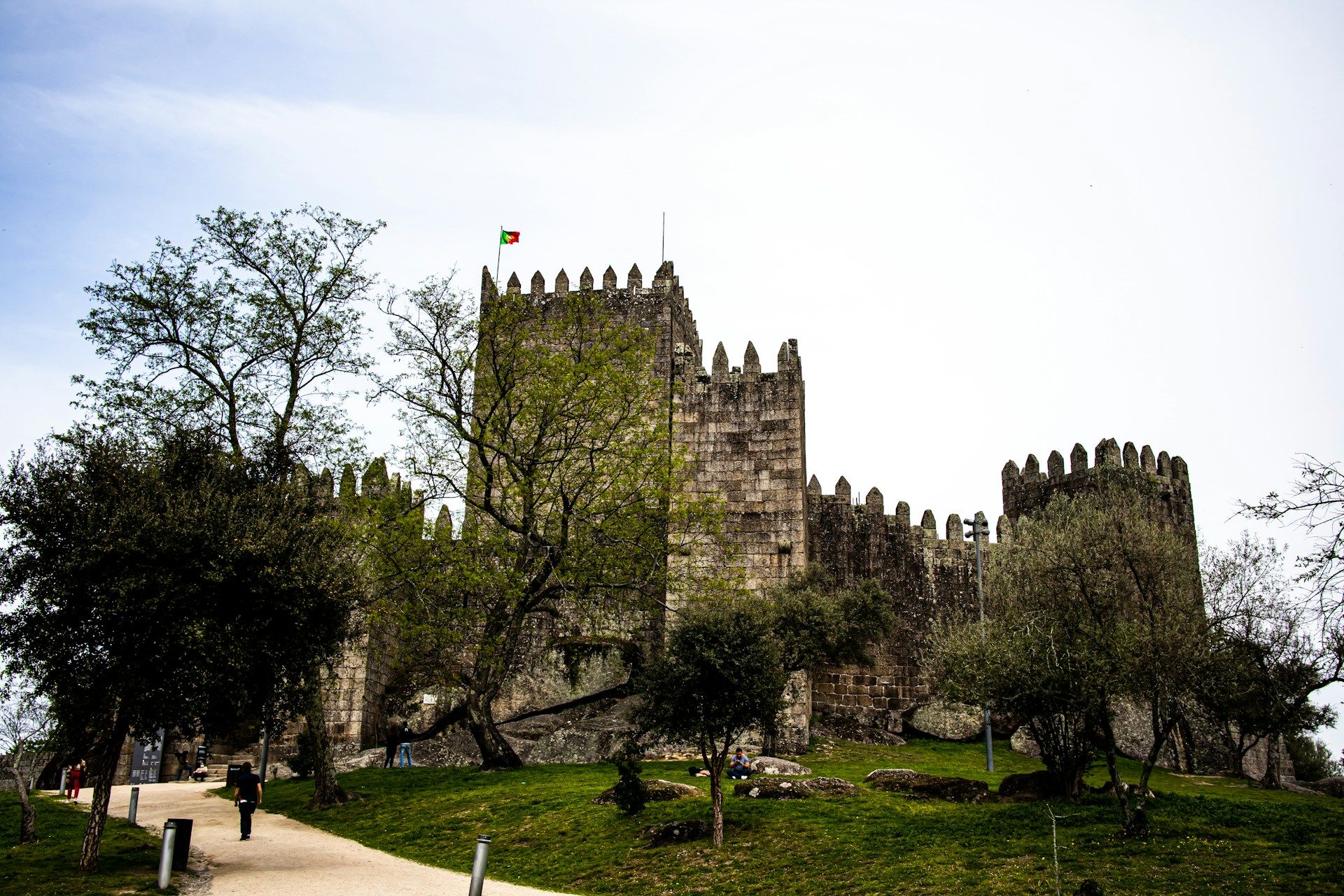
Guimaraes Castle in Guimaraes, Portugal

Guimaraes Castle

A crown of crenellations rises from a granite outcrop, its silhouette telling the story Portugal likes to begin with. Built across the 10th and 11th centuries to defend the monastery of Mumadona Dias, the fortress later watched over the childhood of Afonso Henriques, the future first king. Inside the walls, wooden walkways lead you past the keep, where exhibitions explain why this frontier needed stone courage and patient logistics. From the ramparts, the town gathers around you in roof lines and alleys, a reminder that power once meant altitude. The chapel of Sao Miguel at the foot of the castle holds a baptismal font tied by tradition to the royal infancy, a modest bowl with an oversized legend. Restorations in the 20th century returned the fortress to a lean profile, removing romantic clutter and keeping the military bones visible. On windy days the flags snap like drumrolls, and the granite seems to remember what it was built to do.
Ads place
Ads place
Ads place
Ads place
Ads place
Largo da Oliveira and Padrao do Salado in Guimaraes, Portugal

Largo da Oliveira and Padrao do Salado

In the old heart of Guimaraes, a square frames conversation with stone arcades and a Gothic canopy that looks like it walked out of a manuscript. The Padrao do Salado, raised in the 14th century, commemorates victory at Salado (1340), its cross sheltered beneath pointed arches that have survived markets, oaths, and rain. On one side stands the Igreja de Nossa Senhora da Oliveira, whose tower marks time with a confidence earned over centuries and restorations. Cafes spill onto the cobbles, where iron rings once tethered horses and now anchor chairs. Look up to see carved coats of arms and medieval windows, delicate as lace cut from granite. At dusk, lamps warm the masonry and the square becomes a stage for slow walking and slower talk. The trick here is scale: nothing is large, yet everything feels weighty. Even the paving stones seem to keep minutes, counting footfalls in a ledger older than the ledgers kept inside the guild halls.
Ads place
Ads place
Ads place
Ads place
Ads place
Mount Penha and Cable Car in Guimaraes, Portugal

Mount Penha and Cable Car

Granite boulders the size of cottages lean into chestnut woods, and chapel bells ring as if tuned to moss and wind. A cable car installed in 1995 lifts you from the city to the sanctuary on Penha, trading streets for slabs that look casually arranged by giants. Paths weave between stones polished by centuries of pilgrims; squeeze-throughs with names like “kiss rock” prove devotion also has a sense of humor. From the viewpoints, Minho hills unroll to the horizon, and Guimaraes shrinks to a model town. The sanctuary church, rebuilt in the 1930s, blends crisp lines with traditional granite, a dialogue between modernity and mountain. Picnic tables occupy terraces where hermits once kept their thoughts, and swifts trace calligraphy above. On hot days, the forest feels refrigerated by shade; on cool evenings, it smells of resin and damp stone. Come back down by cable and the rooftops rise to meet you like a welcome.
Ads place
Ads place
Ads place
Ads place
Ads place
Palace of the Dukes of Braganca in Guimaraes, Portugal

Palace of the Dukes of Braganca

A procession of chimneys rises like organ pipes above a palace that folds courtly ambition into stone. Begun in the 15th century by Dom Afonso, 1st Duke of Braganca, the residence mixes late-medieval austerity with Burgundian tastes learned across borders. Step through the arcaded courtyard and the timbered great hall opens its ribs, a ceiling shaped like an overturned ship—a nod to carpenters who thought in hulls. Tapestries recount crusades and politics with woven tact, while a small chapel gathers light that feels older than the glass admitting it. After centuries of neglect, the palace was reconstructed in the 20th century, sparking debate about authenticity that now forms part of the visit. Furniture, arms, and tiles assemble a portrait of power practiced at close range, where ceremony and routine shared the same corridors. From the windows, the castle hovers in view, as if lineage could be kept within arm’s reach and history within a single glance.
Ads place
Ads place
Ads place
Ads place
Ads place