
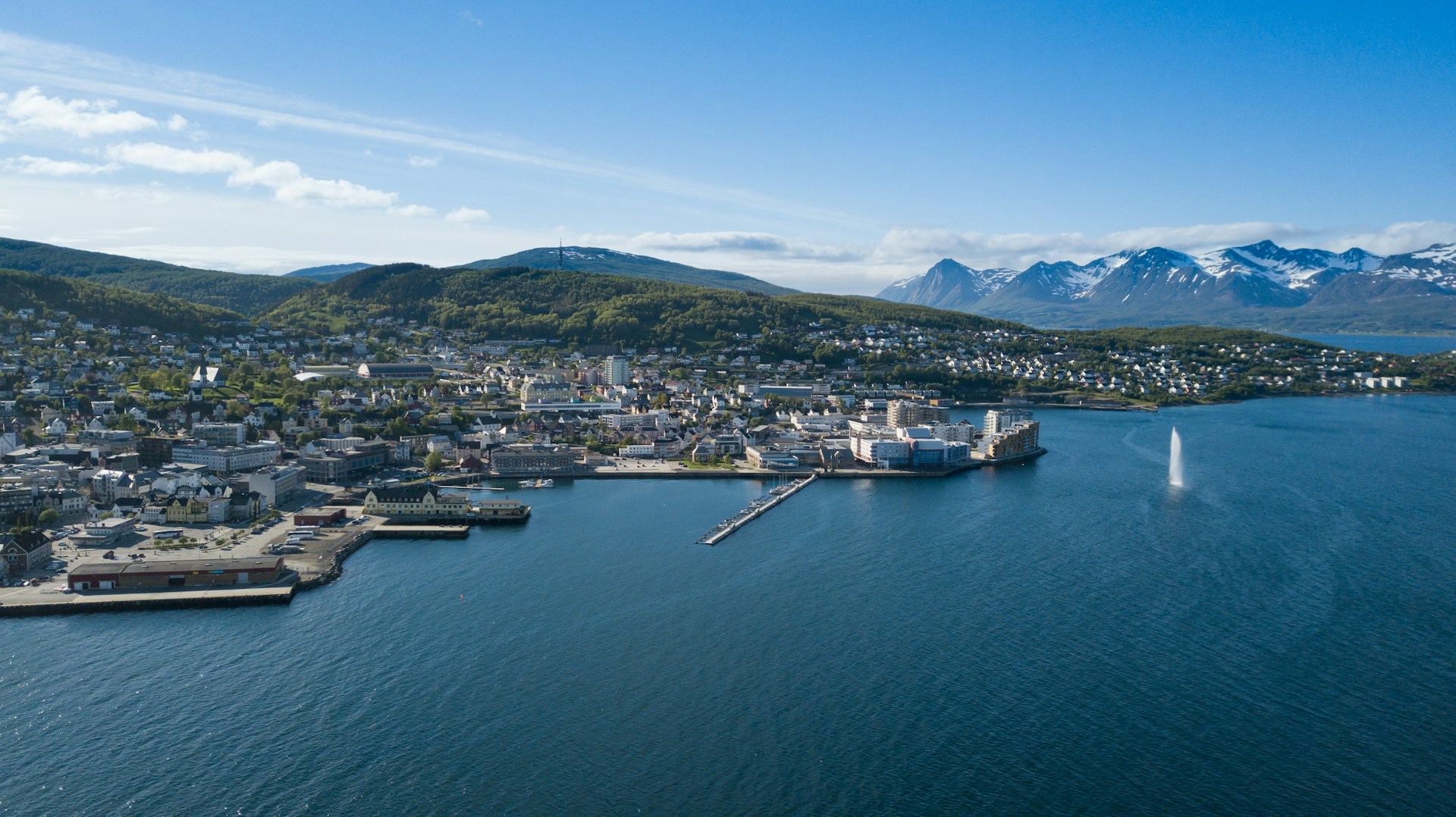
City view of Harstad, Norway

Harstad

Harstad, on Hinnoya island, combines cultural ambition with easy access to Arctic nature. The city’s concert hall, a striking modern structure, hosts performances ranging from classical to experimental. Offshore, fishing remains a way of life, and the surrounding fjords offer kayaking, sailing, and whale-watching opportunities. Local menus feature cod, halibut, and reindeer, often paired with berries gathered in nearby forests. History buffs can explore Trondenes Church, one of the oldest stone churches in northern Norway, along with a museum detailing the region’s role in Viking and World War II history. A small curiosity: Harstad boasts a surprisingly mild climate for its latitude, thanks to the Gulf Stream. This blend of cultural sophistication and outdoor adventure gives Harstad a rhythm that shifts with the seasons yet feels coherent year-round.

Top attractions & things to do in Harstad

If you’re searching for the best things to do in Harstad, this guide brings together the top attractions and must-see places to visit in Harstad. The top picks below highlight the most visited sights for first-time visitors, plus a few local favorites worth adding.

Adolfkanonen Coastal Battery in Harstad, Norway

Adolfkanonen Coastal Battery

Hidden among pines and heather is a colossal gun that relocates naval warfare onto land, a relic that feels improbable until you walk its circumference. Installed by the Kriegsmarine in 1943, the battery mounted a battleship caliber barrel of 40.6 cm, engineered to hurl shells across the Ofotfjord approaches. Guides lead visitors through ammunition lifts, galleries, and rangefinder bunkers, translating steel and concrete into the logistics of command and fear. The weapon boasted a theoretical reach of roughly 56 kilometers, a statistic that becomes unsettling when you trace the arc on a map. Panels place the site within the northern theater of World War II, from convoys and mines to air raids and occupation labor. Nature has softened edges with moss and silence, but the scale refuses to vanish. Standing on the turret roof, you see both harbor lights and mountains, and you realize that strategy once measured this beauty in trajectories.
Ads place
Ads place
Ads place
Ads place
Ads place
Grottebadet Waterpark in Harstad, Norway

Grottebadet Waterpark

Beneath a downtown ridge, architects tucked a public bath into real bedrock, so the first sensation is the cool breath of stone followed by the comfort of warm water. The design treats the pool hall as an underground plaza, where rough walls become scenery and echoes turn gentle under acoustic baffles. Families drift between a wave pool, quietly steaming saunas, and winding water slides, while skylights pull daylight down like liquid glass. Engineers used the natural granite cavern to stabilize temperature and humidity, a practical luxury during long Arctic winter months when outdoor swimming is fantasy. In the evenings, subtle lighting washes the rock in amber and blue, and the place feels part spa, part shelter. It is an urban cave that makes leisure feel local, marrying geology to play without losing a sense of restraint. You leave warmer than you arrived, and a little surprised that the city could hide a lagoon under its streets.
Ads place
Ads place
Ads place
Ads place
Ads place
Harstad Kulturhus in Harstad, Norway

Harstad Kulturhus

Facing the harbor, the cultural house acts like a well tuned instrument, taking the city's pulse through rehearsal schedules and late encores. The venue became a regional anchor in the 1990s, pairing crisp acoustics with stages designed for opera, jazz, and spoken word. Each June, the building serves as a key platform for the Festival of North Norway, when premieres and visiting ensembles test new work against northern light. Technicians praise the adaptable orchestra pit and fly tower; audiences praise the sightlines that make even experimental contemporary dance feel immediate. Foyers open to water views, so intermissions turn into small reunions of artists, sailors, and students. The programming is catholic in the best sense, mixing touring names with local choirs and youth theater. By night, glass turns the lobby into a lantern for Northern Norway, and the building proves that cultural infrastructure can be both welcoming and exacting.
Ads place
Ads place
Ads place
Ads place
Ads place
Trondenes Church in Harstad, Norway

Trondenes Church

A low headland of birch and sea grass frames massive stone walls that have weathered gales for centuries, and the approach feels like walking into a chapter that never quite closed. Built in the 13th century, the church is often described as the northernmost medieval stone church still in use, a claim that matches the austere beauty of its setting. Inside, light brushes whitewashed vaults and reveals traces of earlier decoration alongside a dignified 18th-century baroque altar. Pilgrim traditions linked to St. Olav mingle with parish life, so history is present without ceremony. Craftspeople point to shipbuilding echoes in the timbers, while the rugged exterior shows how faith learned the grammar of storms. Even the surrounding turf carries memories of World War II fortifications, a reminder that sacred places do not escape hard times. Stand by the doorway and the fjord air underlines the lesson of the Late Gothic interior: strength need not shout to endure.
Ads place
Ads place
Ads place
Ads place
Ads place
Trondenes Historical Center in Harstad, Norway

Trondenes Historical Center

On the same peninsula, the historical center gathers centuries into a walkable storyline where landscape explains the archive. Exhibitions move from the Viking Age shoreline to halls that map trade routes, taxes, and loyalties across northern waters, then linger over daily life in medieval Harstad. Voices of the Sami appear in textiles, tools, and photographs, placing indigenous knowledge beside coastal farming and fishing. A gallery confronts the Black Death and the economic pivots that followed, while another explores the Reformation and its impact on parish power and education. Later rooms address evacuation, rationing, and rebuilding during and after World War II, letting diaries and kitchenware carry the weight of big events. Outside, a path links the museum to farms and shoreline viewpoints, so the themes of subsistence and exchange step outdoors. By the end, the peninsula reads like a palimpsest, and the center serves as translator between ground, memory, and modern curiosity.
Ads place
Ads place
Ads place
Ads place
Ads place