
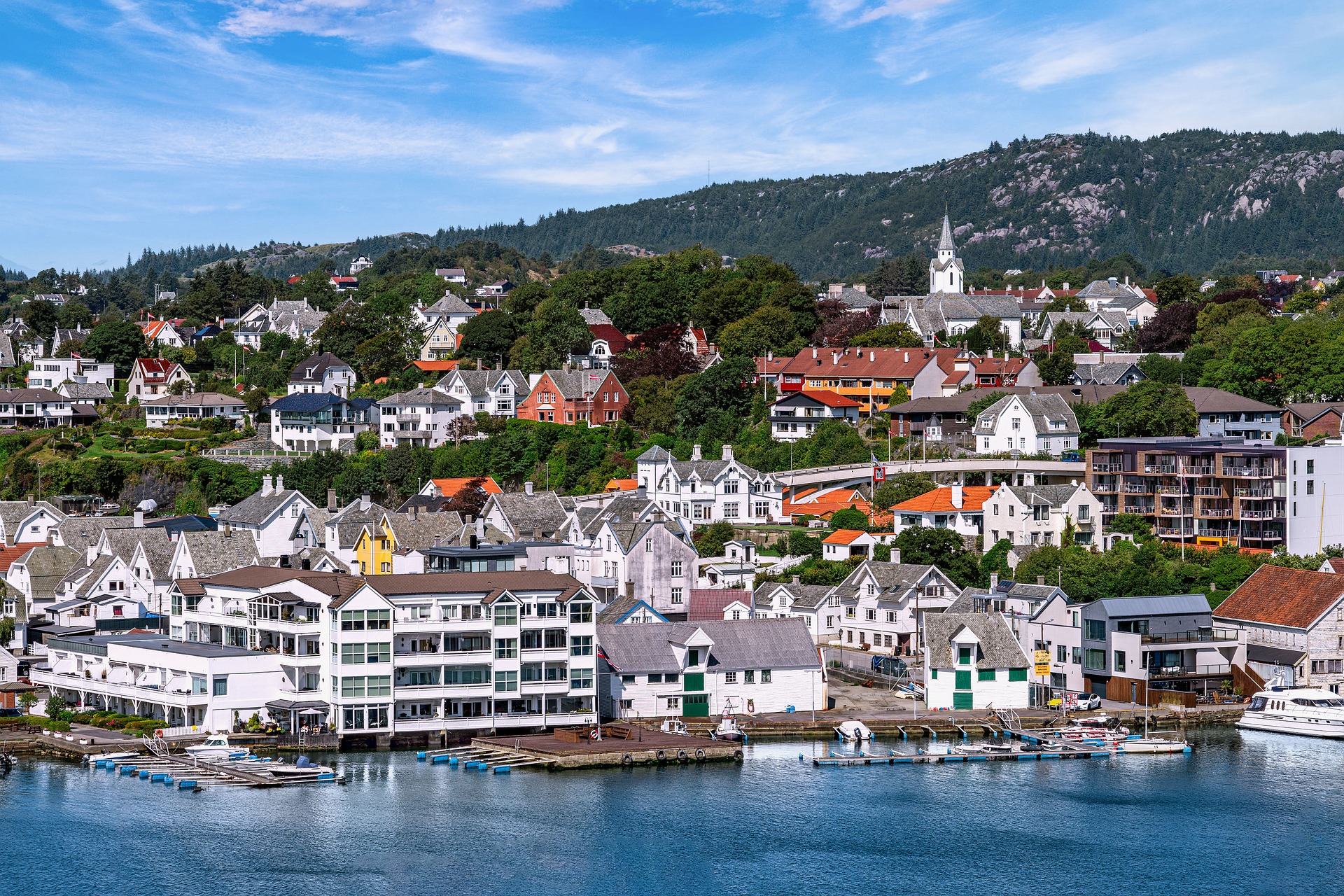
City view of Haugesund, Norway

Haugesund

Haugesund’s maritime history is woven into its streets and waterfront, where fishing boats and supply vessels still anchor daily. Once central to the herring trade, it has reinvented itself as a cultural stage, hosting international film and jazz festivals. The nearby island of Karmoy offers sandy beaches and the historic Avaldsnes church, tied to Norway’s earliest kings. Seafood dominates the dining scene, but there’s also a growing craft beer movement. The climate can shift quickly, making sudden sunshine or mist part of the local charm. An unusual note: Haugesund has a monument marking the reputed burial site of Harald Fairhair, the king credited with uniting Norway. This mixture of modern creativity, maritime grit, and historical depth keeps Haugesund firmly on the map for those who want a coastal city with its own confident stride.

Top attractions & things to do in Haugesund

If you’re searching for the best things to do in Haugesund, this guide brings together the top attractions and must-see places to visit in Haugesund. The top picks below highlight the most visited sights for first-time visitors, plus a few local favorites worth adding.

Avaldsnes Viking Farm and Nordvegen History Centre in Haugesund, Norway

Avaldsnes Viking Farm and Nordvegen History Centre

On Karmoy, a short hop from the city, a reconstructed longhouse breathes woodsmoke and old routines while the exhibition next door folds centuries into a single, navigable story. This coast once guarded the sailing lane nicknamed Nordvegen, “the way north,” a corridor that funneled trade and power long before modern charts. Kings including Harald Fairhair ruled from Avaldsnes, and the nearby stone church of St Olav, begun in the 13th century, keeps watch over the strait. Inside the center, ship models and artifacts explain how iron rivets, tar, and weather lore became statecraft. Outside, costumed interpreters stir kettles, card wool, and describe voyages measured in risk rather than miles. Children love the boathouse and the quiet authority of the longhouse; adults linger over timelines that connect farm plots to geopolitics. The result is not nostalgia but perspective: a working demonstration of how a narrow fairway once set the rhythm for an entire kingdom.
Ads place
Ads place
Ads place
Ads place
Ads place
Haraldshaugen National Monument in Haugesund, Norway

Haraldshaugen National Monument

A windswept hill north of town frames a granite column encircled by stones, a landscape composition that turns memory into geometry. Local tradition ties this ground to Harald Fairhair, the king credited with forging unity after the battle at Hafrsfjord around 872, and the site still carries the gravity of beginnings. The monument itself was unveiled in 1872, exactly a millennium later, as a civic gesture linking modern identity to the Viking Age. Plaques and paths invite a slow reading of history, while the sea keeps rewriting the soundtrack with weather. From the ridge you can trace shipping lanes and imagine signals racing along the coast when sails mattered more than clocks. Guides speak frankly about myth and archaeology, reminding visitors that stories, even contested ones, can steady a community. Far from a relic, the column behaves like a compass, orienting Haugesund between the unification of Norway and the working harbor below.
Ads place
Ads place
Ads place
Ads place
Ads place
Haugesund City Hall in Haugesund, Norway

Haugesund City Hall

A blush-pink facade rises above a clipped park where roses hold their lines against the sea breeze, and the whole ensemble reads like optimism rendered in masonry. Completed in 1931 with generous funding from shipowner Knut Knutsen and his family, the building embodies a restrained Nordic take on functionalism. Inside, stairwells curve with quiet confidence and council chambers balance daylight with duty, as if governance could be an art of proportion. The square outside acts as a civic stage for ceremonies, protests, and everyday errands, proof that architecture works best when it invites a crowd. Wartime photographs from WWII show sandbags and vigilance, yet the structure endured to anchor a rebuilt town. Gardeners still tend the rose garden as carefully as clerks tend archives, and summer concerts lend the terrace an easy cadence. Stand at the steps and the harbor soundtrack returns: gulls, horns, and the soft percussion of shoes on stone.
Ads place
Ads place
Ads place
Ads place
Ads place
Norwegian International Film Festival in Haugesund, Norway

Norwegian International Film Festival

Each August the harbor turns into a red-carpet thoroughfare, and cinema slips easily from theaters into cafes and late ferry rides. Founded in 1973, the Norwegian International Film Festival made Haugesund the natural meeting point for distributors, critics, and directors mapping the year ahead. The opening nights hum with expectation, but the real pulse lies in side screenings where debut features share air with veterans. Since 1985, the Amanda Awards have crowned the week, a homegrown honor that helped anchor Norway within Scandinavia’s broader film conversation. Industry panels debate funding and streaming while local volunteers keep the machine graceful, a choreography learned over decades. You may spot a director scribbling notes on the quay or hear a composer testing cues against the gulls. By the closing credits, it is clear that festivals can be laboratories as much as celebrations—places where new voices learn to project and audiences learn to listen.
Ads place
Ads place
Ads place
Ads place
Ads place
Rovaer Archipelago in Haugesund, Norway

Rovaer Archipelago

Beyond the breakwater, a scatter of low islands teaches the language of wind, where footpaths thread heather and boathouses sit with their backs to weather. Ferries cross quickly, yet the arrival feels like stepping sideways in time to a community shaped by the 19th century herring boom and the unforgiving North Sea. Sheltered coves remember wrecks and rescues; a small museum remembers families who read storms like ledgers. On clear evenings a lighthouse throws its rhythm across water, a pulse older than the engines that now answer it. Winter brings hard lessons about storm surges, while summer slackens the schedule to fishing, swimming, and patient conversations on piers. Guides point out traces of the Viking era in place-names, then pivot to modern ecology as eiders and kelp forests reclaim quiet corners. Rovaer rewards unhurried attention, revealing how a thin line between sea and home can still sustain a full, deliberate life.
Ads place
Ads place
Ads place
Ads place
Ads place