
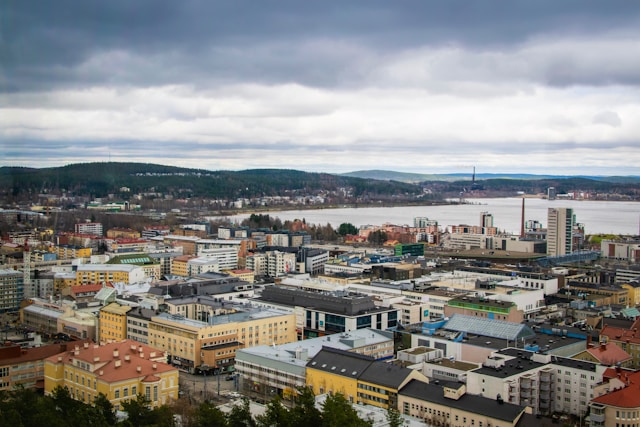
City view of Jyvaskyla, Finland

Jyvaskyla

Jyvaskyla feels like Finland's student heart, accelerating after the 1860s as Finnish language education expanded, and later shaped by Alvar Aalto in the 1920s and 1930s. Start at the Aalto Museum, then climb the Harju ridge to the tower for views over lakes and rooftops. The Lutakko waterfront mixes a concert hall with sauna rafts, and cafes serve karjalanpiirakka beside cinnamon rolls and espresso. For dinner, look for lake perch with potatoes and dill, or a creamy mushroom sauce in autumn. At Toivola Old Courtyard, small workshops sell crafts and pastries in restored buildings. In winter, the nearby Laajavuori slopes keep skiers busy, while summer brings long bike rides around Lake Jyvajarvi. Quirky fact: locals treat the city stairs as training grounds, and a few routes have unofficial names shared like secret shortcuts between lectures. After exams, students celebrate by jumping into the lake from sauna steps.

Top attractions & things to do in Jyvaskyla

If you’re searching for the best things to do in Jyvaskyla, this guide brings together the top attractions and must-see places to visit in Jyvaskyla. The top picks below highlight the most visited sights for first-time visitors, plus a few local favorites worth adding.

Aalto2 Museum Centre in Jyvaskyla, Finland

Aalto2 Museum Centre

In Jyvaskyla, one doorway can lead you into two of Alvar Aalto's most important public buildings, stitched together as Aalto2 Museum Centre. The complex brings the Alvar Aalto Museum and the Museum of Central Finland into one visit, so you can move from furniture-scale design thinking to regional stories without changing neighborhoods. Aalto's own museum building was inaugurated in 1973, while the neighboring Central Finland museum was completed in 1961, both set in Ruusupuisto like calm modernist companions. Inside, galleries favor clear daylight, generous corridors, and small pauses where you can look back at the architecture as part of the exhibition. The pleasure is the mix: a chair prototype here, a map of lake districts there, then a temporary show that links craft, planning, and identity. Give yourself time for the connective spaces too; they make the visit feel less like two separate tickets and more like one continuous conversation about how Finland is built. Finish with coffee and a slow walk toward Lake Jyvasjarvi, close enough to feel like an extra gallery wall.
Ads place
Ads place
Ads place
Ads place
Ads place
Harju Ridge & Vesilinna Observation Tower in Jyvaskyla, Finland

Harju Ridge & Vesilinna Observation Tower

A short climb from the center, Harju ridge turns Jyvaskyla into a city you can read from above, pine-scented and surprisingly quiet. The most memorable approach is up the Nero Stairs, built in 1925 as an unemployment relief project and named after engineer Oskar Nero. At the top sits Vesilinna, a combined water and observation tower built in 1953, which locals treat as a compass point you can spot from nearly anywhere. The tower also houses the Natural History Museum and a cafe-restaurant, so the viewpoint comes with a warm place to thaw out in winter. Walk the ridge paths before you go up; the pines soften traffic noise and make the city center feel briefly remote. From the platform, rooftops, lakes, and low hills stack into layers, and on clear evenings the light turns the whole panorama into a calm, bluish map. It is an easy stop between errands, yet it resets your sense of scale fast and leaves you oddly refreshed.
Ads place
Ads place
Ads place
Ads place
Ads place
Jyvaskyla City Church in Jyvaskyla, Finland

Jyvaskyla City Church

In the middle of Kirkkopuisto, Jyvaskyla City Church anchors the center with red brick and a calm public mood that suits the surrounding park. The church was built in 1880, becoming the first stone church in the Jyvaskyla region, and it was designed by architect L. I. Lindqvist. The setting has its own backstory: Kirkkopuisto began forming in the early 1800s, and the area functioned as the city's market square from the 1830s until the 1930s, so the building stands where everyday trade once happened. Step inside after a walk through the park and the temperature drops slightly, the acoustics soften, and the city feels briefly paused. Look for the way the church's massing reads as both Romanesque and Gothic-inspired without turning theatrical. Outside, benches and paths make it an easy stop between cafes and the harbor direction. Visit at dusk when the windows glow; the park becomes a quiet frame and the church feels like a lantern planted in the middle of town.
Ads place
Ads place
Ads place
Ads place
Ads place
Saynatsalo Town Hall in Jyvaskyla, Finland

Saynatsalo Town Hall

Across the water from central Jyvaskyla, Saynatsalo Town Hall shows how civic architecture can feel both monumental and intimate at once. Designed by Alvar Aalto, the complex was completed in 1952 and laid out as four two-storey wings around a square courtyard set one storey higher than its surroundings, like a small brick village turned inward. Apartments occupy one wing, while businesses face outward from the ground floors of two wings, and the administrative and cultural rooms look into the quiet center. The brickwork and stairs make the approach feel ceremonial, but once inside, the scale becomes human and the corridors invite wandering rather than rushing. Aalto used the plan to separate bustle from calm: street-facing edges for daily life, courtyard-facing edges for meetings and reading. Come on a bright day to watch shadows move across the courtyard walls, then walk down toward the lakeshore for a different perspective. It is often treated as a pilgrimage site for architecture fans, but you do not need a textbook to feel the confidence of the design.
Ads place
Ads place
Ads place
Ads place
Ads place
Toivola Old Courtyard in Jyvaskyla, Finland

Toivola Old Courtyard

Behind a modest gate near the center, Toivola Old Courtyard feels like a pocket-sized time machine, where wooden walls and small yards still hold the rhythm of working life. The courtyard is made up of seven wooden buildings from the late 19th century, including Toivola House, a former maternity hospital, a carpenter's house, and old storehouses that once kept tools and food through long winters. Today it stays lively rather than frozen in nostalgia: a cafe-restaurant, small shops, and the Craftsmen's Museum share the space, and workshops and seasonal events keep locals returning. The charm is in the details: uneven steps, tar-dark timber, and courtyards that create their own microclimate on windy days. Jyvaskyla itself was founded in 1837, and this little corner still carries the feeling of a town learning its trades. Come in the morning for quieter corners, then linger over coffee as the river of city life passes just outside the gate. It is one of those places that proves heritage can be used, not only admired.
Ads place
Ads place
Ads place
Ads place
Ads place