
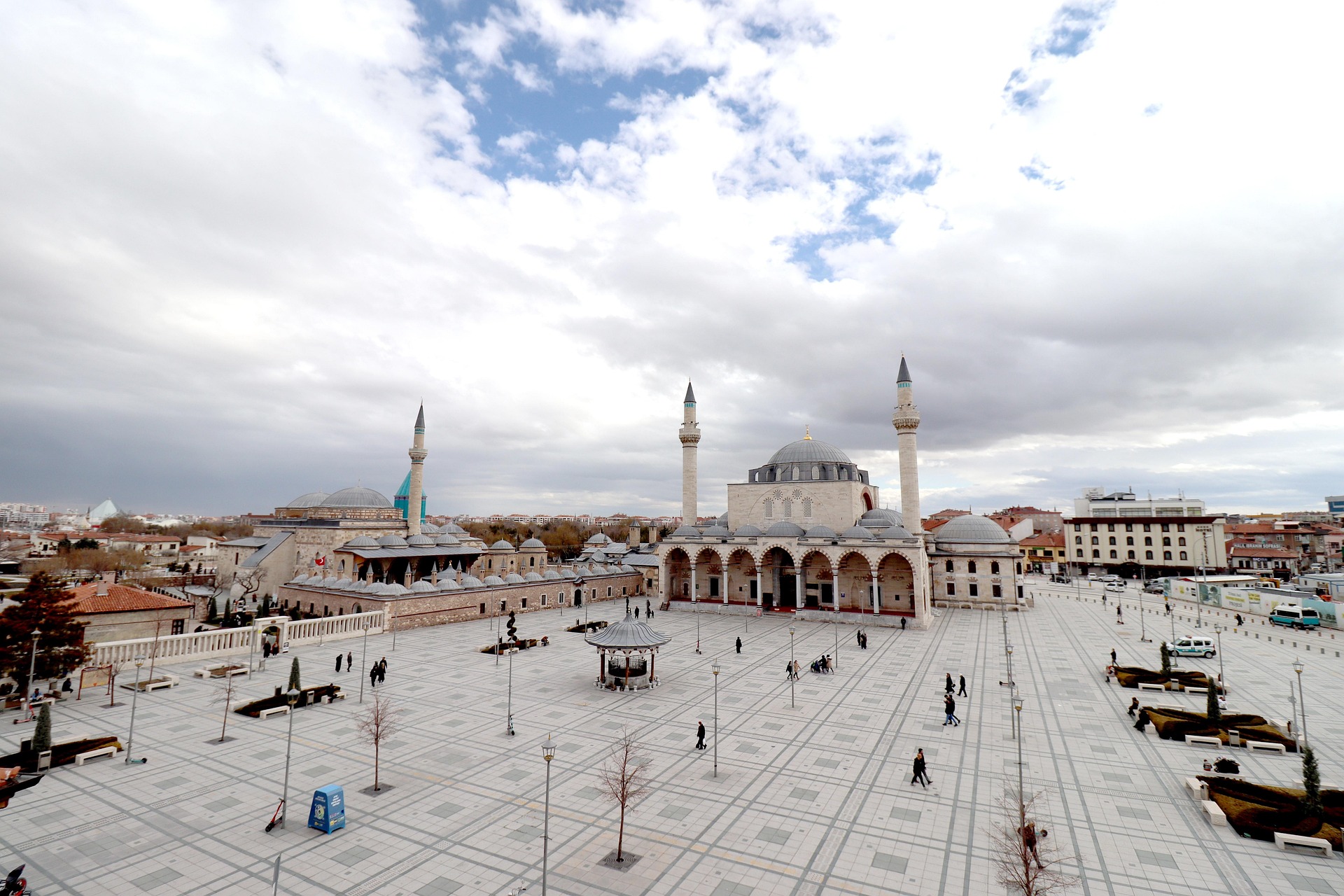
City view of Konya, Turkey

Konya

Konya, often called the spiritual heart of Turkey, reverberates with the legacy of Mevlana Jalaluddin Rumi, whose 13th-century poetry and Sufi philosophy continue to inspire seekers worldwide. Each December, pilgrims gather in the green-tiled Mevlana Museum, originally the dervish order’s lodge, to pay homage at Rumi’s ornately gilded tomb and view manuscripts adorned with delicate calligraphy. Beyond the museum’s solemn courtyards, the whirling dervish sema ceremony unfolds against walls of cobalt tiles, the dancers’ white skirts twirling like lotus petals in a meditative ritual. The city’s Seljuk heritage shines at the Alaeddin Hill, where the 12th-century Alaeddin Mosque and nearby tombs of sultans overlook manicured gardens. Sample bidirectional etli ekmek—thin, elongated meat pies—and hearty tavuk gögsü pudding in historic Karatay and Ince Minareli madrasas, now converted to museums of ceramics and tiles. As dawn breaks over the Taurus mountains, early risers climb the gently sloping plain to view the desert’s first light, recalling Konya’s role as a crossroads of caravans and ideas along the Silk Road. In Konya, mysticism and architectural splendor merge to create an experience both contemplative and deeply rooted in Anatolian history.

Top attractions & things to do in Konya

If you’re searching for the best things to do in Konya, this guide brings together the top attractions and must-see places to visit in Konya. The top picks below highlight the most visited sights for first-time visitors, plus a few local favorites worth adding.

Alaeddin Mosque in Konya, Turkey

Alaeddin Mosque

Perched atop Alaeddin Hill, the Alaeddin Mosque is Konya’s oldest and most significant Seljuk-era mosque, serving spiritual and political functions for centuries. Commissioned by Sultan Alaeddin Keykubad I in the early 13th century, it was built on the foundations of earlier Byzantine structures, reflecting a layered architectural history. The mosque features a unique flat wooden ceiling supported by repurposed Roman columns and adorned with intricate geometric carvings. Inside, the elaborately tiled mihrab and elegant iznik tiles showcase Seljuk artistry. Its courtyard contains the tombs of eight Seljuk sultans, underscoring the mosque’s dual spiritual and political roles. Over centuries, the mosque underwent Ottoman-era restorations that added inscribed calligraphy panels. Beneath the central dome, pointed arch windows create a dynamic interplay of light and shadow, exemplifying Seljuk architectural innovation. Visitors can climb to the hilltop garden for panoramic views of Konya’s skyline and surrounding plains, connecting the city’s historic core with its modern expansion.
Ads place
Ads place
Ads place
Ads place
Ads place
Catalhoyuk Archaeological Site in Konya, Turkey

Catalhoyuk Archaeological Site

The Catalhoyuk Archaeological Site, dating to around 7500 BC, stands as one of the world’s earliest Neolithic settlements. Discovered in 1958 by archaeologist James Mellaart, this UNESCO World Heritage site challenged traditional views on early urbanization. Excavations revealed densely packed mudbrick houses with entry through rooftop openings, vividly painted murals depicting bulls and hunting scenes, and intricately decorated religious shrines. Burials beneath floors and plastered skulls suggest complex spiritual beliefs. Artifacts such as polished stone tools, beads, and figurines provide insight into its agricultural economy and social organization. The site’s advanced community planning and symbolic art predate writing and stone monuments by millennia. Visitors can explore the partially excavated mounds and a museum displaying key finds. Guided tours emphasize Catalhoyuk’s role in reshaping our understanding of human settlement, offering a profound glimpse into prehistoric society and cultural innovation at the dawn of civilization.
Ads place
Ads place
Ads place
Ads place
Ads place
Karatay Medrese in Konya, Turkey

Karatay Medrese

Constructed in 1251 by the Seljuk vizier Celaleddin Karatay, the Karatay Medrese served as a center for Islamic theological and scientific education during the Seljuk era. Now housing the Tile Works Museum, it showcases a stunning collection of Seljuk and Ottoman-era ceramics and historical artifacts. The medrese’s ornate portal, carved with geometric patterns and Quranic inscriptions, exemplifies the zenith of Seljuk stone craftsmanship. Inside, a lofty vaulted dome and intricately tiled mihrab emphasize the fusion of functionality and ornamentation. Visitor flow through restored classrooms and a serene courtyard highlights medieval teaching practices, while interactive exhibits explain tile production methods. Recent conservation efforts have preserved original muqarnas vaulting and decorative friezes. Located on Konya’s historic campus avenue, the medrese remains an active cultural hub, hosting workshops and lectures that honor its educational legacy.
Ads place
Ads place
Ads place
Ads place
Ads place
Mevlana Museum in Konya, Turkey

Mevlana Museum

Nestled on the site of a former dervish lodge, the Mevlana Museum in Konya honors the life and legacy of the Persian mystic Jalal al-Din Rumi. After his death in 1273, his followers established a shrine that became a center for the Whirling Dervish ritual. The museum’s signature turquoise dome crowns Rumi’s marble tomb, surrounded by exquisite Ottoman tilework and delicate Islamic calligraphy narrating his teachings. Inside, carefully preserved manuscripts, priceless musical instruments, and ceremonial dervish robes showcase the art and spirituality of the sema ceremony. Adjacent to the mausoleum, a historic library contains rare editions of the Mathnawi and Divan-e Shams, revealing Rumi’s poetic depth. Guided tours explain the symbolism of the whirling dance and Rumi’s philosophy of divine love. Seasonal Sufi music concerts in the courtyard further animate the site, creating an immersive cultural experience. Visitors wander serene gardens and shaded arcades, reflecting on Konya’s profound Sufi heritage and the universal message of unity.
Ads place
Ads place
Ads place
Ads place
Ads place
Sille Village in Konya, Turkey

Sille Village

The ancient Sille Village, located five kilometers northwest of Konya, is a living mosaic of Greek Orthodox and Turkish heritage dating back over two millennia. Founded by Cappadocian Greeks, it flourished under the Byzantine and later Ottoman empires. The village is renowned for the Aya Eleni Church, constructed in 327 AD by Helena, mother of Emperor Constantine the Great. Its frescoes and stone architecture survive in remarkable condition, reflecting centuries of religious devotion. Traditional Ottoman-era stone houses with red-tiled roofs line cobblestone lanes, many converted into boutique guesthouses, local handicraft shops, and artisan tavernas. Seasonal festivals celebrate ancient customs with folk music, cuisine demonstrations, and pottery-making sessions. Olive groves and vineyards surrounding Sille produce specialty oils and wines featured at family-run tavernas. Walking tours guided by local historians provide insights into the village’s unique fusion of cultures. Sille Village offers an immersive glimpse into Anatolia’s shared past and enduring traditions.
Ads place
Ads place
Ads place
Ads place
Ads place