
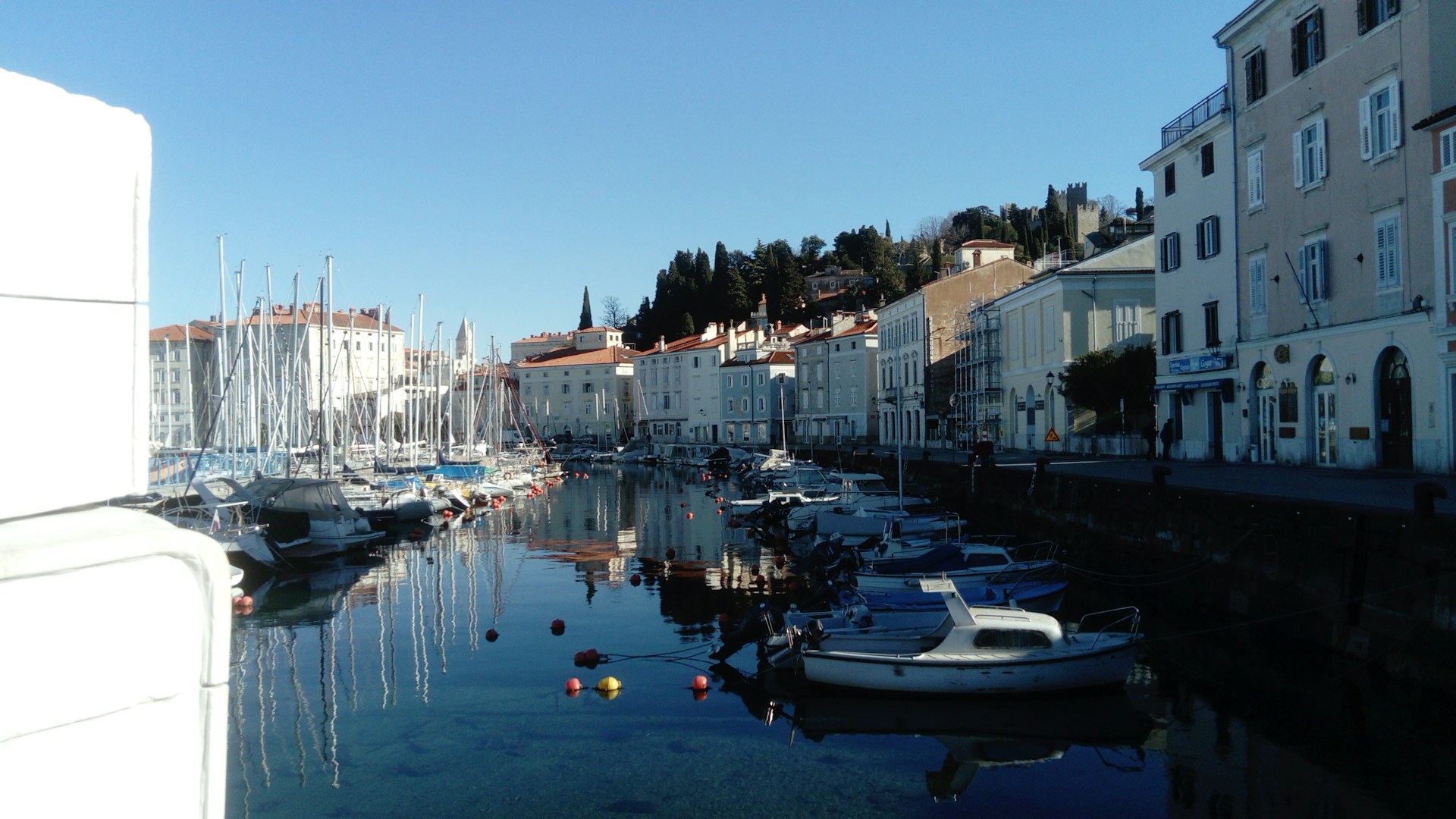
City view of Koper, Slovenia

Koper

Koper greets you with salt in the air and a square that remembers Venice without pretending to be Venice. Loggias and a striped cathedral tell the maritime story, while a small warren of lanes keeps bakeries close to the harbor. Try brodet with polenta or sardines under marinade, and order a glass of Refosk that tastes darker than the sun suggests. The town grew on salt pans; museums explain how evaporation calendars once ran the economy with tidy notebooks. Under the Republic of Venice, notaries filed contracts that still read sharply; later centuries traded flags but kept port habits. A curious trace remains in bilingual street plaques that teach you a little Italian while you look for gelato. Less expected: in certain storms, flying fish have been documented skipping the breakwater. Evening brings a percussion section of halyards against masts, and the old gate casts clean shadows across the promenade.

Top attractions & things to do in Koper

If you’re searching for the best things to do in Koper, this guide brings together the top attractions and must-see places to visit in Koper. The top picks below highlight the most visited sights for first-time visitors, plus a few local favorites worth adding.

Cathedral of the Assumption and Bell Tower in Koper, Slovenia

Cathedral of the Assumption and Bell Tower

A few steps from the palace, the Cathedral of the Assumption presents a layered interior where medieval bones meet later polish. Records mention a church here by the 12th century, but the current nave was reshaped with sober Baroque clarity after seismic repairs in the 17th century. The separate campanile doubles as a viewpoint; climb roughly 200 steps to read the roofscape and harbor cranes in one sweep. The main portal’s sculpted saints are weathered enough to feel human, and side chapels keep votive light low and steady. Conservators note lime-based plasters that breathe through humid summers, a practical choice in an Adriatic climate. On feast days the square fills, and the organ gathers air like a tide before releasing it in measured waves. From the tower balcony, the geometry of lanes below finally makes sense, a fan splayed from a former island toward the mainland.
Ads place
Ads place
Ads place
Ads place
Ads place
Koper Marina and Promenade in Koper, Slovenia

Koper Marina and Promenade

South of the old core, Koper Marina stretches its piers like fingers testing wind and tide. Opened to leisure craft in the 1980s, the basin offers about 350 berths and shelter from the bora behind engineered breakwaters rated for waves over 2 meters. Evenings bring a predictable choreography: rigging hum, halyards tapping masts, and runners circling the promenade’s smooth concrete. Lighting was updated in the 21st century with efficient fixtures that leave the stars some space. From certain angles, yacht masts align with distant gantries of the commercial port, a reminder that Koper balances play and work on the same water. Cafes handle breakfasts for crews and gelato for strollers; chandlers sell tape, blocks, and rope by the meter. Walk the outer arm for a horizon unrolled, then return when the first cabin lights click on and reflections double the fleet, turning the marina into a soft grid of floating neighborhoods.
Ads place
Ads place
Ads place
Ads place
Ads place
Muda Gate in Koper, Slovenia

Muda Gate

Once the ceremonial entry to a true island town, the Muda Gate still greets arrivals with a confident arch and a sprinkle of emblems. Completed around the 1516 urban renewal, it carries a Latin inscription and the winged lion of St. Mark, linking Koper firmly to Venice. Look for the precise joints in the Istrian limestone, which suggest careful quarrying and patient dressing rather than speed. The gate stood near a drawbridge, later replaced as the causeway widened in the 19th century; traffic now flows around it like water around a stone. At sunset, the reliefs sharpen and the shadows inside the arch feel almost theatrical. Nearby benches make it a natural pause between harbor and old town, a place to imagine guards checking loads of salt, wine, or wool. Even stripped of moat and chains, the gate still performs its role: compressing the city into a single framed promise of streets, bells, and conversation beyond.
Ads place
Ads place
Ads place
Ads place
Ads place
Taverna Salt Warehouse in Koper, Slovenia

Taverna Salt Warehouse

Facing the waterfront, the broad halls of the Taverna recall the time when salt financed ambition and paved streets. The structure, adapted in the 18th century, once stored blocks from nearby pans before shipment along the Adriatic. Massive timber trusses span the interior with a logic you can feel in your shoulders, and iron tie-rods added in the 19th century keep the roof honest. Today the space hosts markets and concerts, a modern echo of historic exchange. Floor markings preserve earlier bay divisions so curators can lay out stalls with near-archaeological accuracy. On breezy days, the smell of resin from boats across the quay mingles with coffee, and gulls edit the soundtrack with short cries. Stand at a corner column and you can trace tool marks left by masons who worked quickly before autumn rains. The building’s endurance proves that good proportions and simple ventilation were engineering before they were style.
Ads place
Ads place
Ads place
Ads place
Ads place
Tito Square and Praetorian Palace in Koper, Slovenia

Tito Square and Praetorian Palace

The heart of Koper gathers around Tito Square, where the Praetorian Palace pins the view with crenellations and a lace of stone balconies. Its present Venetian profile is mostly a product of the 15th century, with restorations after storms and political turns in the 16th century. The facade’s biforas and coats of arms read like a civic ledger, while the Loggia opposite shows a cooler Renaissance restraint. In summer, the square becomes a stage for municipal ceremonies, echoing the palace’s old function as the seat of rectors sent from Venice. Look down and you will notice paving joints guiding rain toward subtle drains, an urban trick probably refined in the 1700s. Cafes under arcades measure the day by bell peals, and late light lifts the pale Istrian stone into gold. Stand near the well-head and the palace’s symmetry tightens; stand near the cathedral steps and the whole composition relaxes into a lived-in panorama that still feels official.
Ads place
Ads place
Ads place
Ads place
Ads place