
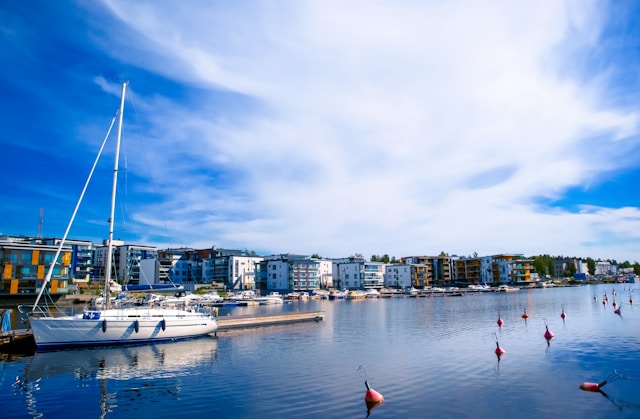
City view of Kuopio, Finland

Kuopio

Kuopio rises around Lake Kallavesi and has been a market town since the 1700s, with a harbour that feels like the region's front porch. Ride Puijo Tower for wide views and the outline of ski jumps, then drop into the Market Hall for kalakukko, a fish and pork pie baked inside rye bread. Coffee is constant, often paired with a berry bun, and evenings smell faintly of sauna smoke from lakeside cottages. Stroll the old quarter for pockets of wooden houses, then follow the waterfront to cruise boats and summer concerts. The VB Photography Centre offers a calmer indoor stop when weather shifts. In winter, locals ski across frozen bays with headlamps, treating darkness as part of the sport. A lesser known tidbit: the city has a long tradition of public weigh-ins at the market square, once used for farm trade and now remembered as a surprisingly social ritual.

Top attractions & things to do in Kuopio

If you’re searching for the best things to do in Kuopio, this guide brings together the top attractions and must-see places to visit in Kuopio. The top picks below highlight the most visited sights for first-time visitors, plus a few local favorites worth adding.

Kuopio Cathedral in Kuopio, Finland

Kuopio Cathedral

Kuopio Cathedral rewards a short uphill walk with a sense of calm authority that never feels showy. The stone church was built between 1806 and 1815 from plans by Per Wilhelm Palmroth, and its Neoclassical lines keep the exterior disciplined and bright. From outside you can read the cross-shaped plan, with the belfry marking the eastern end like a clean punctuation point. A satisfying detail is the bell tower height, about 35.5 m, which gives presence without dominating the skyline. Step inside and the mood shifts to pale surfaces and steady acoustics, where even small movements sound deliberate on winter afternoons. Circle the grounds to see how the masonry and siting connect to Kuopio's older street pattern, then pause for a final look back across the city. It works equally well as a quick photo stop or a slower reset, especially when the light is low and the stone turns warm.
Ads place
Ads place
Ads place
Ads place
Ads place
Kuopio Market Hall in Kuopio, Finland

Kuopio Market Hall

If you want to taste Kuopio instead of just photographing it, head straight for the market hall and follow your nose. Kuopio Market Hall began operations in August 1902 on the market square, designed by Johan Victor Stromberg in a friendly Art Nouveau style that still feels civic rather than fancy. Inside, around 30 vendors keep the browsing easy: cheeses, berries in season, and counters built for serious Finnish shopping. This is also the best place to try kalakukko, the local fish pie that tastes like comfort food with a history lesson baked in. Go mid-morning when displays are fullest, then take coffee by the windows and watch buses and cyclists cross the square outside. Even if you buy nothing, the hall is a masterclass in Kuopio rhythm, where quality is assumed and small talk is brief but warm. Step back outdoors and the open market suddenly feels louder, which is exactly why the hall is such a satisfying refuge year-round.
Ads place
Ads place
Ads place
Ads place
Ads place
Kuopio Museum in Kuopio, Finland

Kuopio Museum

Kuopio Museum sits beside Snellman Park like a small brick storybook, serious in outline and surprisingly playful once you start exploring. The historic building was completed in 1907 and designed by J. V. Stromberg, blending Art Nouveau curves with national-romantic hints inspired by Finnish castles. It is also known as the third oldest specially built museum building in Finland, which adds weight to its compact, approachable scale. Inside, exhibitions pair cultural history with natural history, so you can move from local livelihoods to geology and wildlife in one continuous loop. On average the museum welcomes about 30,000 visitors a year, lively but rarely overwhelming. Come on a gray day and the interior light feels especially calm, then step outside to the park for a quick contrast of fresh air and old brick. If you like architecture, linger on the stair landings; the building frames Kuopio in window views that feel like curated exhibits.
Ads place
Ads place
Ads place
Ads place
Ads place
Puijo Tower in Kuopio, Finland

Puijo Tower

Climb through spruce and birch and Kuopio suddenly opens beneath you like a living lake map. Puijo Tower was completed on 27 July 1963 to designs by Seppo Ruotsalainen, rising 75 m above Puijo hill for a panorama that feels endless on clear days. The official site notes the summit stands about 224 m above Lake Kallavesi, so even low clouds can drift under your horizon. Inside, the revolving restaurant turns the view into a slow, effortless scan while you warm up with coffee. Locals treat the tower as the start line for forest trails and nearby ski-jumping slopes, so the visit can be as active or as lazy as you want. Go near sunset when water catches copper light and the first city lights flicker on; the shift from day to night is where Kuopio feels most cinematic. In winter, the air is sharper and sightlines often stretch farther, making the tower feel like a lighthouse for the whole region.
Ads place
Ads place
Ads place
Ads place
Ads place
VB Photography Centre in Kuopio, Finland

VB Photography Centre

VB Photography Centre is small, sharp, and quietly addictive, the kind of place that changes how you look at Kuopio's light afterward. Founded in 1987, it operates in the former studio and home of photographer Victor Barsokevitch (1863-1933), an old wooden atelier house that keeps the visit intimate rather than institutional. It is described as Finland's first regional photography center, and the program reflects that ambition with rotating exhibitions from Finland and abroad. Rooms are compact, which keeps the experience focused: you can study a single series without distraction, then step out with images still buzzing in your head. Notice how daylight hits the timber surfaces and softens even minimalist prints, making the space feel warm in winter. Pair it with a coffee stop downtown or a lakeside walk; the center works best as a concentrated cultural detour between outdoor moments. As a simple ritual, choose one photograph to remember and let it follow you through the rest of the city.
Ads place
Ads place
Ads place
Ads place
Ads place