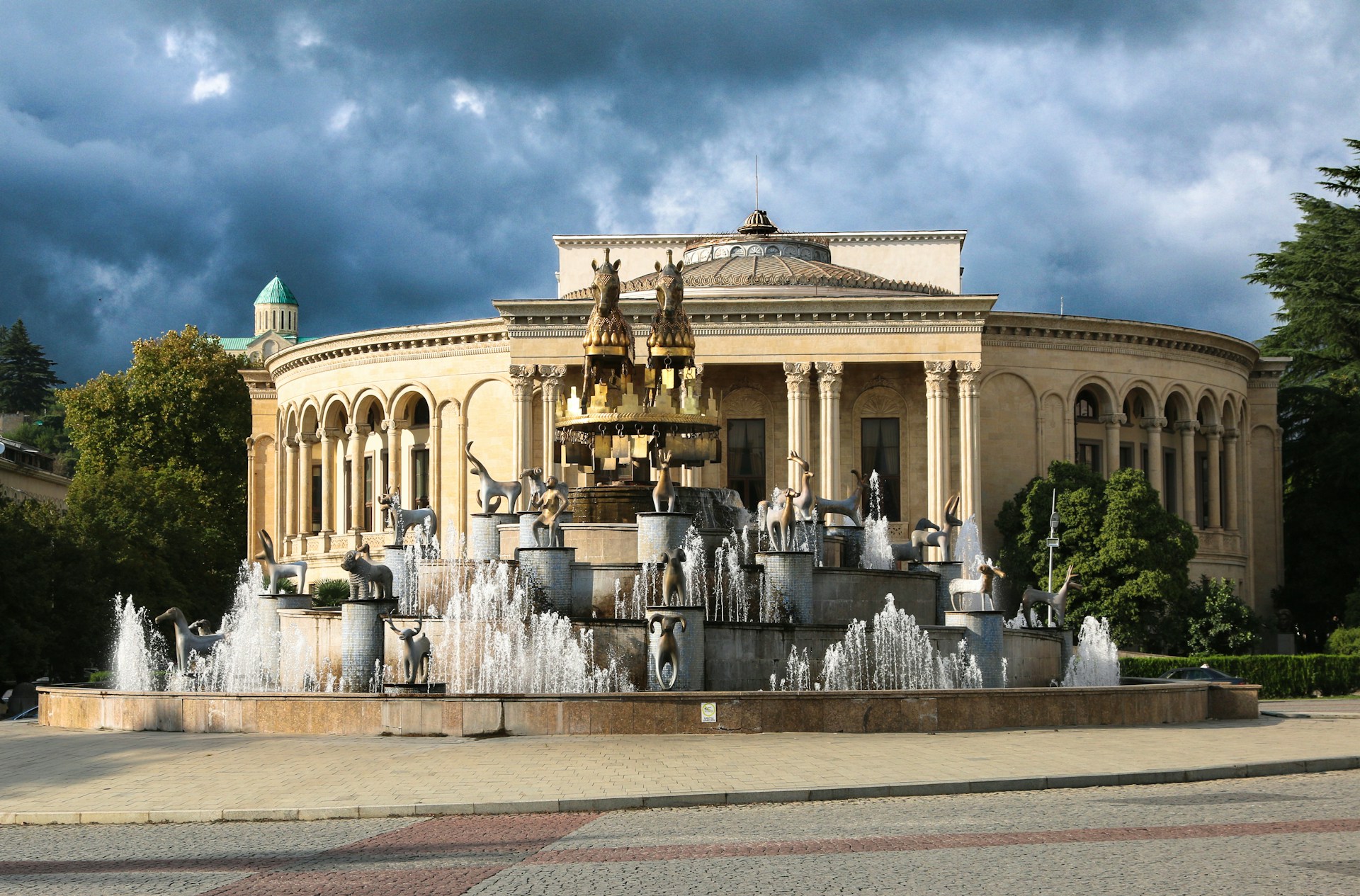

City view of Kutaisi, Georgia

Kutaisi

Kutaisi, often dubbed the cradle of Georgian civilization, is a living museum of medieval grandeur and fertile landscapes. Nestled on the banks of the Rioni River, the city was once the capital of the ancient Kingdom of Colchis—famed in Greek myth as the destination of Jason’s Argonauts. Today, Kutaisi’s UNESCO World Heritage listings spotlight two architectural marvels: the 11th-century Bagrati Cathedral, perched on Ukimerioni Hill, and the adjacent Gelati Monastery, a monastic complex founded by King David the Builder in 1106. Strolling through the bustling central market, visitors immerse themselves in regional flavors: crisp apples, artisanal cheese, and towering khachapuri. Beyond the city limits lie spectacular natural wonders: the Prometheus Cave dazzles with stalactites and subterranean lakes, while the Sataplia Nature Reserve offers panoramic cliff-edge views and preserved dinosaur footprints. Emerging as a gateway to western Georgia, Kutaisi marries mythic heritage with warm local hospitality and serves as a launching point for cultural exploration and alpine adventure.

Top attractions & things to do in Kutaisi

If you’re searching for the best things to do in Kutaisi, this guide brings together the top attractions and must-see places to visit in Kutaisi. The top picks below highlight the most visited sights for first-time visitors, plus a few local favorites worth adding.

Bagrati Cathedral in Kutaisi, Georgia

Bagrati Cathedral

Perched atop Ukimerioni Hill, Bagrati Cathedral was consecrated in 1003 under King Bagrat III, symbolizing Georgia’s first unified kingdom. Its soaring central dome and four-pillar cruciform plan exemplify 11th-century Georgian architecture. Despite suffering extensive damage during Ottoman sieges in 1692 and a partial collapse in 1832, Bagrati retains its imposing silhouette over Kutaisi. Recent restorations (2006–2012) reinforced the remaining walls, revealing original ornamental stone carvings—floral medallions and stylized crosses—hidden beneath centuries of mortar. From the southwest portal, visitors can spy the Rioni River meanders and the verdant expanse of Colchis lowlands below. Inside, a discreet Chapel of Saint Nicholas houses fragments of medieval frescoes depicting Christ Pantocrator and local saints, believed concealed since the 15th century. In 2017, UNESCO listed Bagrati as a “mixed authenticity” site, sparking debates over modern interventions. Nevertheless, its monumental ruins and panoramic vistas continue to inspire photographers and pilgrims, offering a poignant encounter with Georgia’s golden age of cathedral-building.
Ads place
Ads place
Ads place
Ads place
Ads place
Gelati Monastery in Kutaisi, Georgia

Gelati Monastery

Founded in 1106 by King David IV “the Builder,” Gelati Monastery stands as a masterpiece of medieval learning and Orthodox spirituality. Its main church, the Cathedral of the Virgin, boasts a gilded dome and vibrant 12th-century frescoes by the famed painter Damian, illustrating biblical scenes with Crusader-era stylistic influences. The monastic academy attracted scholars from across the Christian world, producing treatises on philosophy and astronomy. Inscriptions in ancient Georgian script decorate the cross-shaped cloister courtyard, marking donations from royal patrons. A newly excavated 13th-century archaeology trench revealed wine press remnants, suggesting monastic viticulture sustained the community. The treasury shop houses a fragment of Gelati’s original library cover—crafted from ebony and silver—once containing rare Georgian Gospel manuscripts. Set against terraced vineyards and the steep Rioni Gorge, Gelati remains a UNESCO World Heritage site and a testament to Georgia’s “Golden Age.” Guided tours highlight the adjoining academy’s lecture hall masonry and the acoustics that still carry Gregorian chant in the summer liturgies.
Ads place
Ads place
Ads place
Ads place
Ads place
Kutaisi Central Market in Kutaisi, Georgia

Kutaisi Central Market

Housed in a sprawling Soviet-era pavilion built in 1964, Kutaisi Central Market remains the beating heart of local commerce and gastronomy. Shopkeepers display multicolored mounds of Imeretian cheese, fresh foraged mushrooms, and jars of honey infused with acacia and chestnut nectars—reflecting regional floral diversity. In the meat halls, butchers hand-cut premium Satsuma pork and tender veal ribs, while fishmongers shuck Caspian sturgeon roe and freshly caught trout from nearby rivers. A lesser-known basement section contains a labyrinth of spice stalls, where specialized blends—such as Svan salt—lure visitors seeking authentic Georgian flavors. The market’s upper floor hosts a communal dining area serving piping-hot khachapuri and chikhirtma (spiced chicken soup) at family-run stalls. In 2019, restoration efforts repaired the pavilion’s original glass ceiling panels, flooding the aisles with natural light and reviving mid-century modernist aesthetics. Whether bargaining for ripe tomatoes in August or sampling seasonal elderflower cordial in spring, Kutaisi Central Market offers an immersive, multi-sensory journey into Imereti’s culinary traditions.
Ads place
Ads place
Ads place
Ads place
Ads place
Prometheus Cave in Kutaisi, Georgia

Prometheus Cave

Discovered in 1984 and opened to the public in 1989, Prometheus Cave (also known as Kumistavi Cave) stretches over 20 km of limestone passages beneath the Tskaltsitela River. Electric lighting highlights towering stalactites, cascading stalagmites, and crystalline flowstones—some over 30 m tall—while a guided boat tour navigates an underground river channel. The cave’s unique microclimate, with steady temperatures of 11–12 °C, supports rare troglobitic species such as blind amphipods and cave-dwelling crickets. In 2016, a newly excavated chamber revealed prehistoric pottery shards and bear bone fragments carbon-dated to 4,000 BCE, suggesting early human ritual visits. Interpretive panels along the 1.5-km tourist route explain the cave’s karst formation and local legends of Prometheus’s chains—tying myth to geology. Special-event lighting displays, synchronized to classical music, transform the Grand Hall into a subterranean amphitheater. As Georgia’s most visited show cave, Prometheus offers both scientific intrigue and theatrical spectacle amid its limestone wonders.
Ads place
Ads place
Ads place
Ads place
Ads place
Sataplia Nature Reserve in Kutaisi, Georgia

Sataplia Nature Reserve

Sataplia Nature Reserve, established in 1935, conserves a unique karst plateau where ancient dinosaur footprints in limestone are preserved under protective glass domes. Located just 10 km north of Kutaisi, the reserve’s elevated boardwalks lead through lush beech forests to panoramic cliff-edge lookouts. In 2012, new excavations uncovered 500-million-year-old stromatolite fossil rings, offering insights into early marine life. Sataplia’s “Glass Cave,” adorned with stalactites and airy skylights, is named for its reflective pools that mirror the cave ceiling. On select weekends, guided “Cave by Candlelight” tours illuminate hidden chambers where local folklore claims the fairytale hero Amiran once battled dragons. The reserve’s on-site museum displays scale models of the footprints—some measuring over 70 cm—and interactive touchscreens detailing the dinosaurs’ gait and habitat. Birdwatchers prize Sataplia for sightings of raptors riding the thermal winds above the grassy ridge. A small café overlooks the crater-shaped depression known as “Sataplia” (Georgian for “place of honey”), where wild bees still congregate in summer months.
Ads place
Ads place
Ads place
Ads place
Ads place