
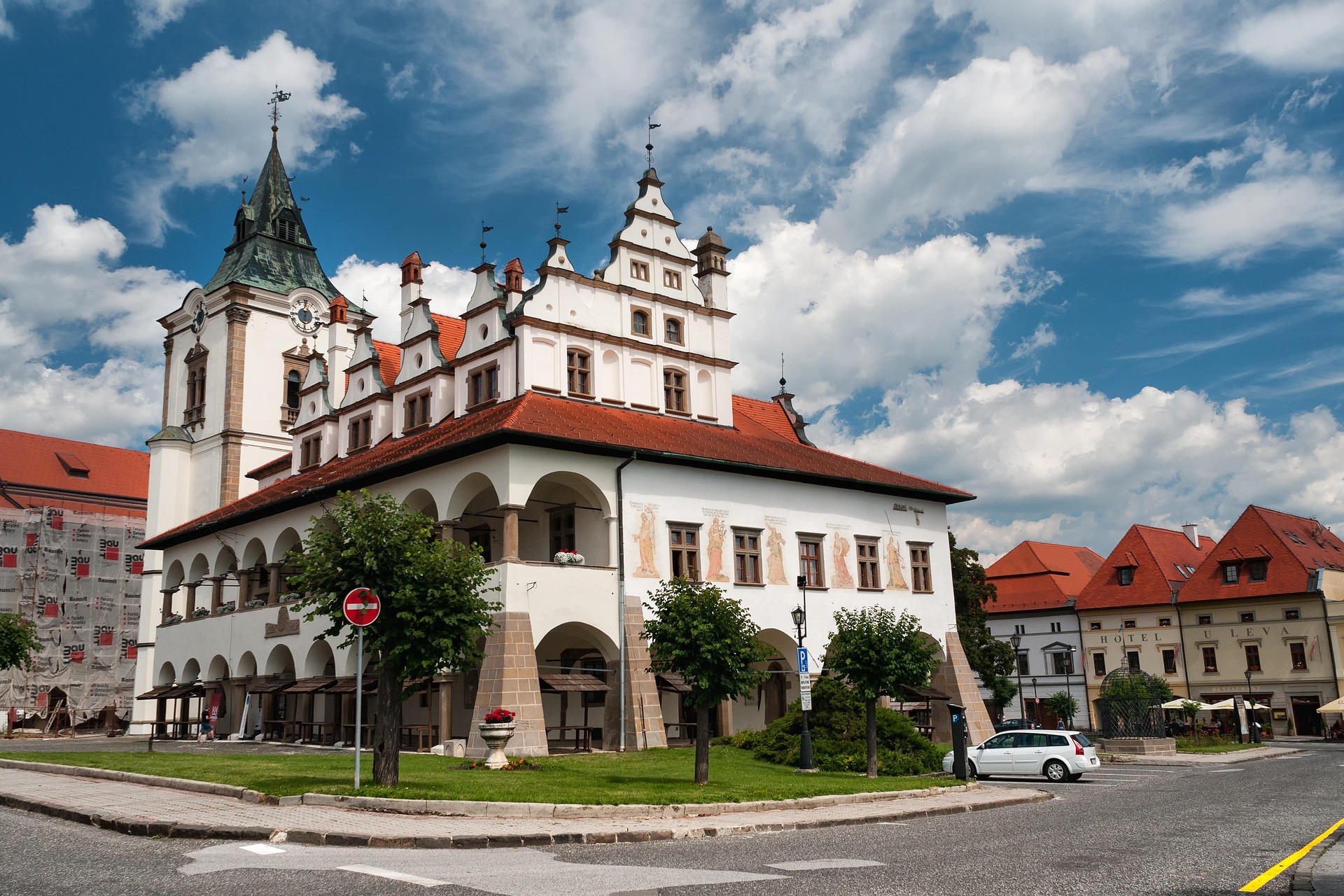
City view of Levoca, Slovakia

Levoca

Levoca favors detail over spectacle. Inside St James Church, Master Pavol’s wooden altarpiece rises like a carved forest and rewards every slow glance. The town’s Renaissance houses speak softly with painted sgraffito and angled arcades that keep rain off conversations. Pilgrims climb to Marian Hill each summer, turning the meadow into a sea of picnic blankets and hymnbooks. Restaurants cook trout with almond crust one night and old family recipes the next, while pastry counters lead with walnut spirals. Museums stay compact and well written, making the past feel legible rather than distant. Step through the old cage of shame in the square and consider how public opinion once wore iron. The extra twist, a tiny press prints souvenir prayer cards on hand powered machines, and visitors leave ink smudged and smiling, proof that Levoca still trusts the human hand more than buttons.

Top attractions & things to do in Levoca

If you’re searching for the best things to do in Levoca, this guide brings together the top attractions and must-see places to visit in Levoca. The top picks below highlight the most visited sights for first-time visitors, plus a few local favorites worth adding.

Marian Hill Basilica in Levoca, Slovakia

Marian Hill Basilica

Pilgrims take the slope in patient steps, pausing under trees that frame the town like a painted margin. Tradition on Marian Hill goes back to the 14th century, while the present Basilica of the Visitation carries the gentle drama of Neo-Gothic renewal with a pastoral conscience. Stations along the path, many from the 19th century, turn the climb into a slow conversation between landscape and memory. On major feast days, tens of thousands arrive, and the meadow becomes an orderly city of candles, blankets, and murmured intentions. The site gained fresh resonance after 1995, when a papal visit stitched a modern chapter into the pilgrimage notebook. Inside, look for votive plaques that map private geographies of thanks; outside, wind combs the grass like a small choir. Guides often note how the sanctuary anticipates bad weather with practical awnings and tidy drainage—devotion with engineering. Come for the panorama, stay for the hush, and leave with the gentle arithmetic of steps taken and burdens lightened.
Ads place
Ads place
Ads place
Ads place
Ads place
Master Paul's House in Levoca, Slovakia

Master Paul's House

On the square, a modest townhouse carries a celebrated name with working dignity. This is the address associated with Master Paul of Levoca, whose workshop turned limewood into saints and stories for parish and guild. Rooms today reconstruct benches, clamps, and pigments, explaining how polychromy sealed carvings and how apprentices learned by repetition rather than manifestos. Labels point to chisels with specific bites, and a panel outlines contracts from the early 16th century—deadlines, payments in kind, and the quiet prestige of signatures. A small gallery gathers fragments attributed to the atelier or its circle, while conservation notes discuss humidity, insect flight seasons, and reversible glues. The museum’s tone is practical: art as labor measured in hours, splinters, and steady hands. Outside, look back at the facade; its proportions follow the sober arithmetic of Renaissance townhouses. Visitors leave understanding that genius often looks like good management, sharp tools, and reliable wood. The house is less a shrine than a workshop paused mid-sentence, which feels exactly right.
Ads place
Ads place
Ads place
Ads place
Ads place
Medieval Walls and Historic Center in Levoca, Slovakia

Medieval Walls and Historic Center

Walk the ring streets and you can still trace the town’s defensive handwriting. Levoca keeps one of Slovakia’s most complete fortifications, a circuit begun in the 13th century and strengthened through the 15th century with towers and angled bastions. Guides often quote a surviving length of roughly 2.5 kilometers, though repairs over time have stitched old stone with prudent new work. Gates once controlled wagons of salt, cloth, and rumor; today they frame camera-friendly entries into a grid of burgher houses. The UNESCO inscription expanded in 2009 confirms the value of this urban textbook, where Gothic, Renaissance, and later facades argue politely across the square. Look for a barbican’s curved shadow on a sunny afternoon and for reused blocks marked with mason’s symbols—economy written in stone. Evenings are best: the walls hold a second breath of cool air, and footsteps turn metronomic. It is a compact city, yes, but its pages are long; take the time to read them slowly.
Ads place
Ads place
Ads place
Ads place
Ads place
St James Church in Levoca, Slovakia

St James Church

Step into the cool nave and the eye travels upward before being gently pulled to the famous high altar at the crossing. Carved by Master Paul of Levoca from seasoned limewood, the soaring structure reaches about 18.6 meters, a Late Gothic masterclass completed circa 1508–1517. Panels read like a catechism in timber, with patient folds, delicate fingers, and faces that seem to breathe between prayers. Side chapels keep quieter treasures—a painted Pieta, fragments of tabernacles, the practical furniture of devotion—while the pulpit shows how theology once traveled by voice. Restoration notes explain how wood moves with the seasons and how conservators calm it without erasing tool marks. Step close and you will notice tiny dowels anchoring saints to canopies, a carpenter’s lullaby in joinery. Beyond the altar, the town’s UNESCO listing, expanded in 2009, confirms what visitors feel anyway: the ensemble is a promise kept between craft, liturgy, and time. Leave by the south door and the square opens like a polite encore.
Ads place
Ads place
Ads place
Ads place
Ads place
Town Hall and Cage of Shame in Levoca, Slovakia

Town Hall and Cage of Shame

The arcaded Town Hall turns the main square into a stage where history still prefers dialogue to spectacle. Its current silhouette blends a 15th century core with post-fire rebuilding in the 16th century, when merchants favored airy loggias and sober Renaissance rhythm. Inside, a council chamber preserves portraits and seals that once arbitrated grain, guilds, and the town’s carefully guarded freedoms. Just outside stands the wrought-iron Cage of Shame, a 17th century contraption for petty offenses: gossip, brawls, after-hours songs that charmed no one. It looks theatrical until you read the bylaws and realize justice was also civic theater. Look for faint sgraffito and stone mason marks near the stair; they are signatures rather than ornaments. At dusk the building mirrors into shop windows and the square turns reflective in every sense. The ensemble feels balanced—law, trade, and ritual folding into one address—proof that city life is a durable craft when rules and rituals agree.
Ads place
Ads place
Ads place
Ads place
Ads place