
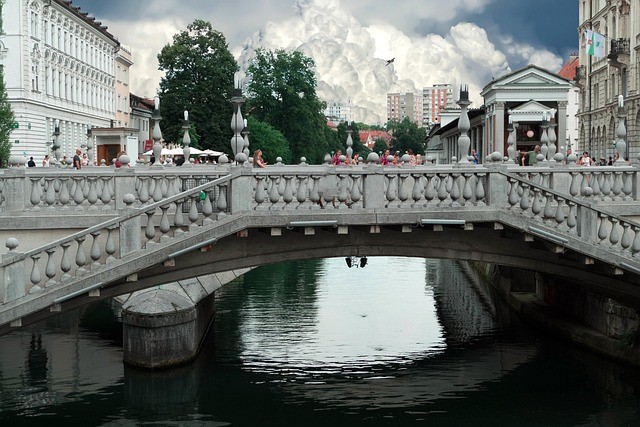
Triple Bridge (Tromostovje)
In Ljubljana, Slovenia .
More places to visit in Ljubljana
Discover more attractions and things to do in Ljubljana.
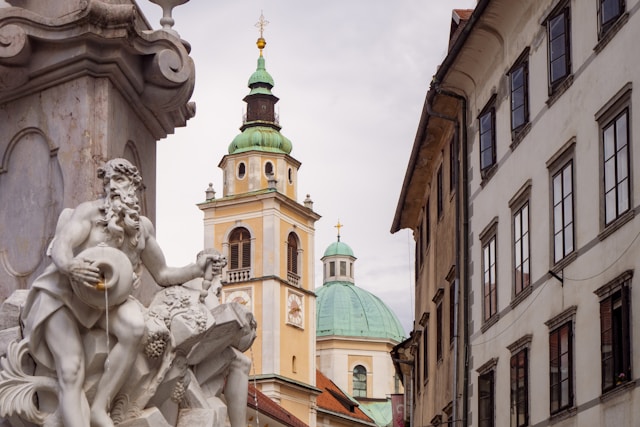
Cathedral of St Nicholas
Open the bronze doors and you enter a room that speaks fluent Baroque . The cathedral gained its present form in the 18th century with fresco cycles that keep color disciplined and light persuasive. Gilded altars balance marble columns; the choir’s organ pipes climb like a well-tuned forest. Reliefs on the portals commemorate a papal visit in 1996 and fold recent history into older stone. A chapel preserves a reliquary tradition with sober labels; floor slabs remember bishops and bakers alike. Outside, twin towers punctuate the market skyline and the dome guides lost walkers back to the river arcades. Maintenance notes record roof renewals and cleaning campaigns in the 20th century , evidence that devotion is logistics plus patience. Step out and the street noise returns politely, as if coached. The building proves ceremony and neighborhood can share the same schedule.
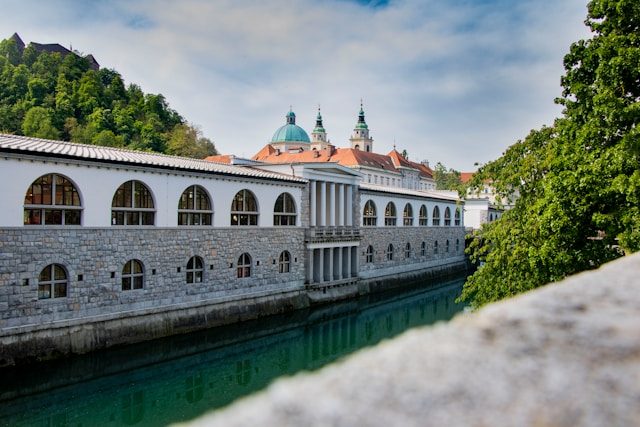
Central Market and Riverside Arcades
Follow the river’s bend and the city turns its appetite into architecture. Plecnik’s long market arcades, built between 1940–1942 , stage stalls under a rhythm of columns, small domes, and river-view windows that ventilate fishmongers with practical grace. Inside the covered hall, dairy counters, meat cases, and a string of bakeries run like a clock; outside, farmers sell berries and greens by the kilo. A riverside loggia links to the planned but unbuilt Butchers' Bridge of the era—today’s version finally arrived in the 2010s . Look for stone details reused from demolished houses, a thrifty habit Plecnik preferred. Markets tell truths about cities: prices, seasons, and politeness policies. Here, card terminals coexist with paper scales, and labels list farm names like signatures. Fridays often host an outdoor kitchen where chefs test sauces and patience in equal measure. Stand by the balustrade and watch the Ljubljanica behave; commerce, design, and river air collaborate neatly.
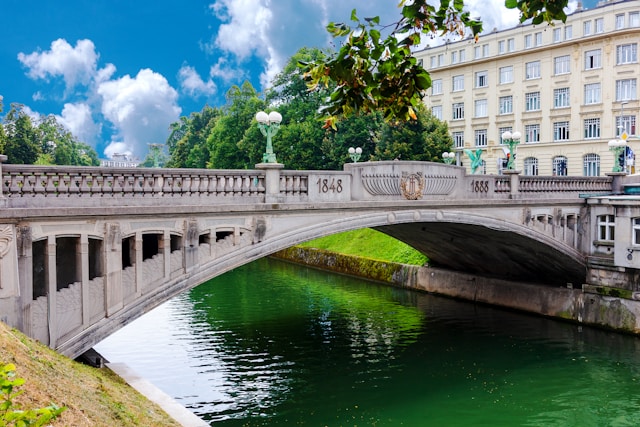
Dragon Bridge
A short stroll downstream introduces four watchful guardians with wings and attitude. Dragon Bridge opened in 1901 as an early reinforced-concrete span of the Vienna school, its copper dragons gaining their famous patina after decades of rain and pride. The deck’s Art Nouveau ornaments—lyres, masks, and crisp railings—frame tramless traffic the bridge was originally sized to carry. Locals trade stories about dragons in the city arms and about a tail that supposedly twitches during storms, a rumor the statues handle with stoic calm. Engineers admire the hinged joints and the elegant three-hinged arch; photographers prefer the angles where a dragon lines up with the castle. A discreet flood mark from the 1930s underlines the river’s moods, while maintenance logs note repainting and bolt checks with municipal precision. Visit early when market vans idle nearby and the guardians look like foremen. The bridge proves myth and infrastructure can share an address without fuss.
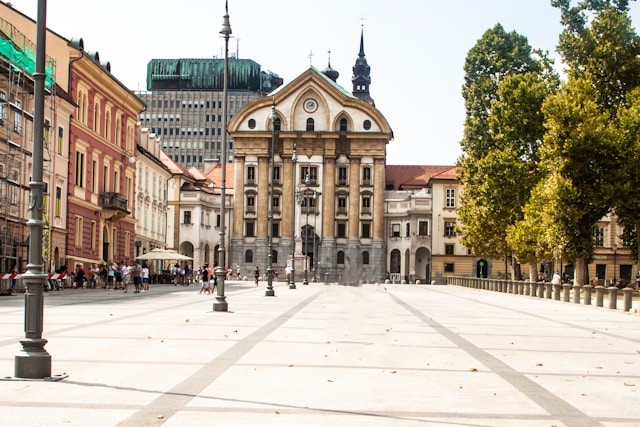
Kongresni Trg ( Congress Square )
Kongresni Trg unfolds like a civic drawing room, measured and open since its formal layout in 1821 for the Holy Alliance Congress. Linden trees frame lawns that once hosted military parades and later student protests, giving the square both ceremony and conscience. The Ursuline Church of the Holy Trinity anchors one side with a facade of curling pilasters, while the Philharmonic Hall, rebuilt after the 1895 earthquake, keeps music as its constant tenant. Beneath the paving lies a glimpse of Roman Emona foundations—revealed during 2010 renovations and sealed under glass. On summer nights, the square turns stage again for open-air concerts or film screenings, its symmetry doubling in the river’s calm reflection nearby. Locals treat its benches as quiet offices for reading or diplomacy, and every few years restoration crews recalibrate the balance between grass and granite. The result feels both stately and familiar, a space that carries history without theatrics.
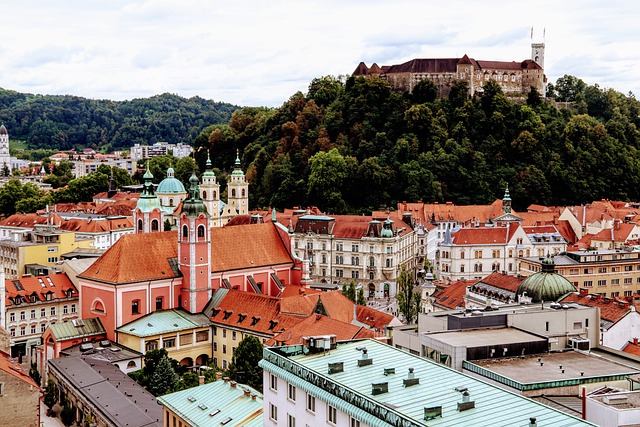
Ljubljana Castle
Climb by funicular or take the forested path and the hill unwraps a fortress that feels like a campus. The castle’s timeline runs from a medieval stronghold to a 19th-century prison and today’s museum hub, with bastions that learned to speak artillery in the 16th century . A glass box crowns the Outlook Tower for a 360-degree city read; below, the Roman lapidarium threads Emona’s stones into the story. Exhibits explain coins, sieges, and kitchens with tidy labels, while the chapel bears painted arms from 1747 . Evening programs turn the courtyard into a small theatre and the walls into an acoustic ally. Records from the 1895 quake show repairs that quietly modernized joints; today, conservation favors lime and restraint. Stand on the ramparts and trace the Ljubljanica, Tivoli’s tree grid, and the distant Alps like a practical map. It is less a monument than a civic toolbox—history, views, and concerts cooperating on one ridge.
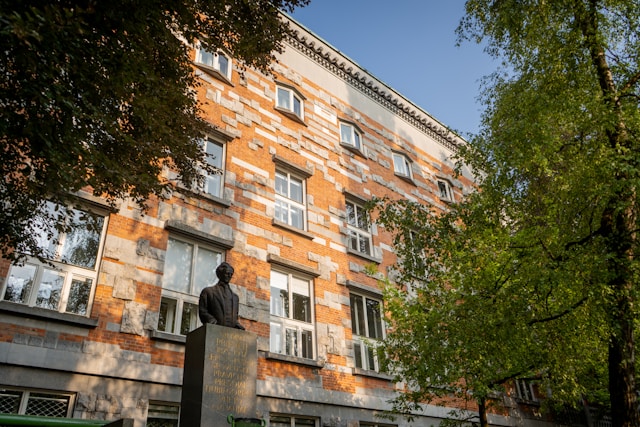
National and University Library (NUK)
Push the heavy door and the light changes on cue: Plecnik designed NUK in 1936–1941 as a temple for reading, using a brick-and-stone exterior that quotes Renaissance palazzi while staying modern. The grand staircase climbs through darkness to a bright reading room, rehearsing the idea that knowledge is ascent. Windows carry reused stones from vanished houses, making the facade a civic memory quilt. The catalog halls keep manuscripts and first editions behind glass with humidity measured to the decimal; students inhabit long tables where lamps look like well-behaved planets. A side courtyard hides a quiet lap for coffee between chapters. Plans for an expansion trace back to the 1990s , reminding visitors that libraries evolve like cities. Even non-readers feel the building’s choreography—silence, wood, leather, and the soft percussion of pages. It is one of the rare places where architecture teaches behavior without a sign.
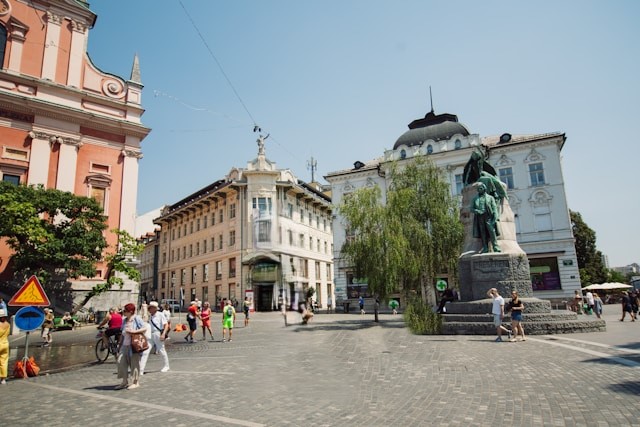
Preseren Square
The city’s social foyer is a triangle that behaves like a circle, ringed by facades that learned manners from Secession Vienna after the 1895 earthquake. France Preseren’s statue anchors the conversation, facing a church painted in measured pinks that photograph as cheer rather than sugar. Tram lines once crossed here; today, street musicians and rendezvous do. Stand near the Ursuline viewpoint to see the castle align with the Triple Bridge’s lamps. Guides point to the elaborate facade of the Hauptmann House and to attic statues that wink in certain light. A discreet plaque records the square’s renaming in 1905 ; another notes anniversary readings of Preseren’s verses each February. Quirky habit: locals use the bronze poet as a meeting clock, agreeing on “by the poet” without specifying which side. Even in rain the paving reads clearly, drying in handsome gradients. The square proves urbanity can be friendly—poetry, shops, and short walks negotiating equal time.
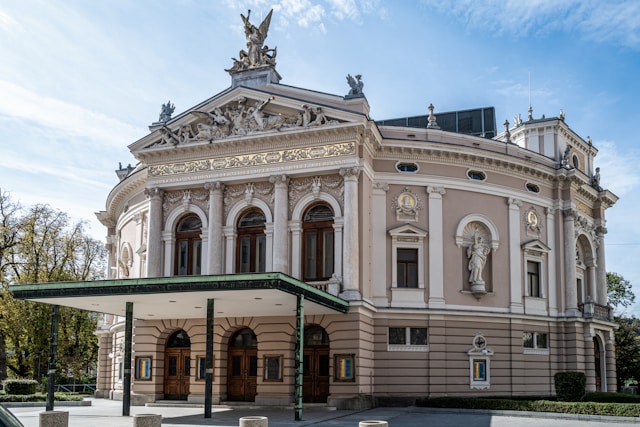
Slovenian National Opera and Ballet Theatre
Behind a neoclassical facade that measures elegance in columns and curve, the Slovenian National Opera and Ballet Theatre has staged applause since 1892 . Designed by Czech architect Jan V. Hruby , it began as a cultural pledge for a city still defining its modern voice. The horseshoe auditorium carries frescoed ceilings and gilded reliefs that survived both war and taste revisions with steady grace. A major renovation in 2011 discreetly added rehearsal wings, acoustics fine-tuned for strings and breath, and a subterranean stage elevator that works with magician’s precision. The repertoire moves from Verdi and Stravinsky to new Slovenian works that test local vowels in aria form. Before performances, audiences linger under chandeliers tracing their lineage to Vienna’s craftsmen. Even from the street, the building teaches posture—balanced, ornate, and sure of purpose. Stand at dusk when the portico lights flare and the facade seems to inhale; inside, the overture starts like a promise well kept.
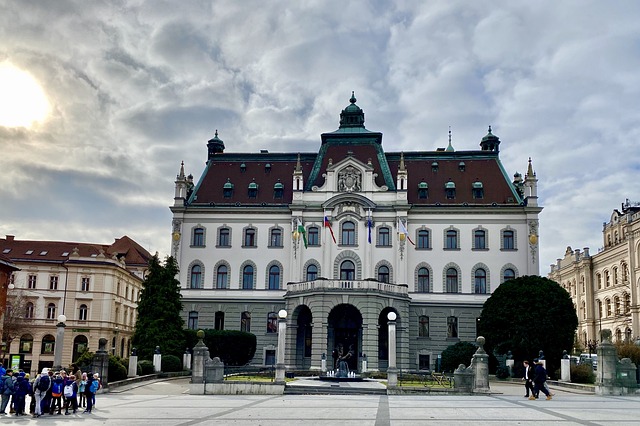
University of Ljubljana
Founded in 1919 after long campaigns for Slovene higher education, the University of Ljubljana occupies a building that once housed the Carniolan Provincial Government . Its Neo-Renaissance facade by architect Jan Hruby carries stone garlands, a central balcony, and a clock tower that still sets the rhythm for student marches on graduation day. Inside, marble staircases lead to halls named after scientists, linguists, and poets who helped frame national identity when borders were still uncertain. The university survived the turbulence of World War II , socialist reforms, and post- 1991 independence, expanding into a network of twenty-three faculties across the city. Professors’ offices keep oak doors and long memories; the assembly hall hosts recitals where rhetoric meets music. In winter, corridors smell faintly of chalk and coffee, while plaques recount Nobel collaborations and architectural additions. It remains not just a campus but a biography of Slovenia’s intellectual self-confidence, written in stone, syllabi, and steady ambition.