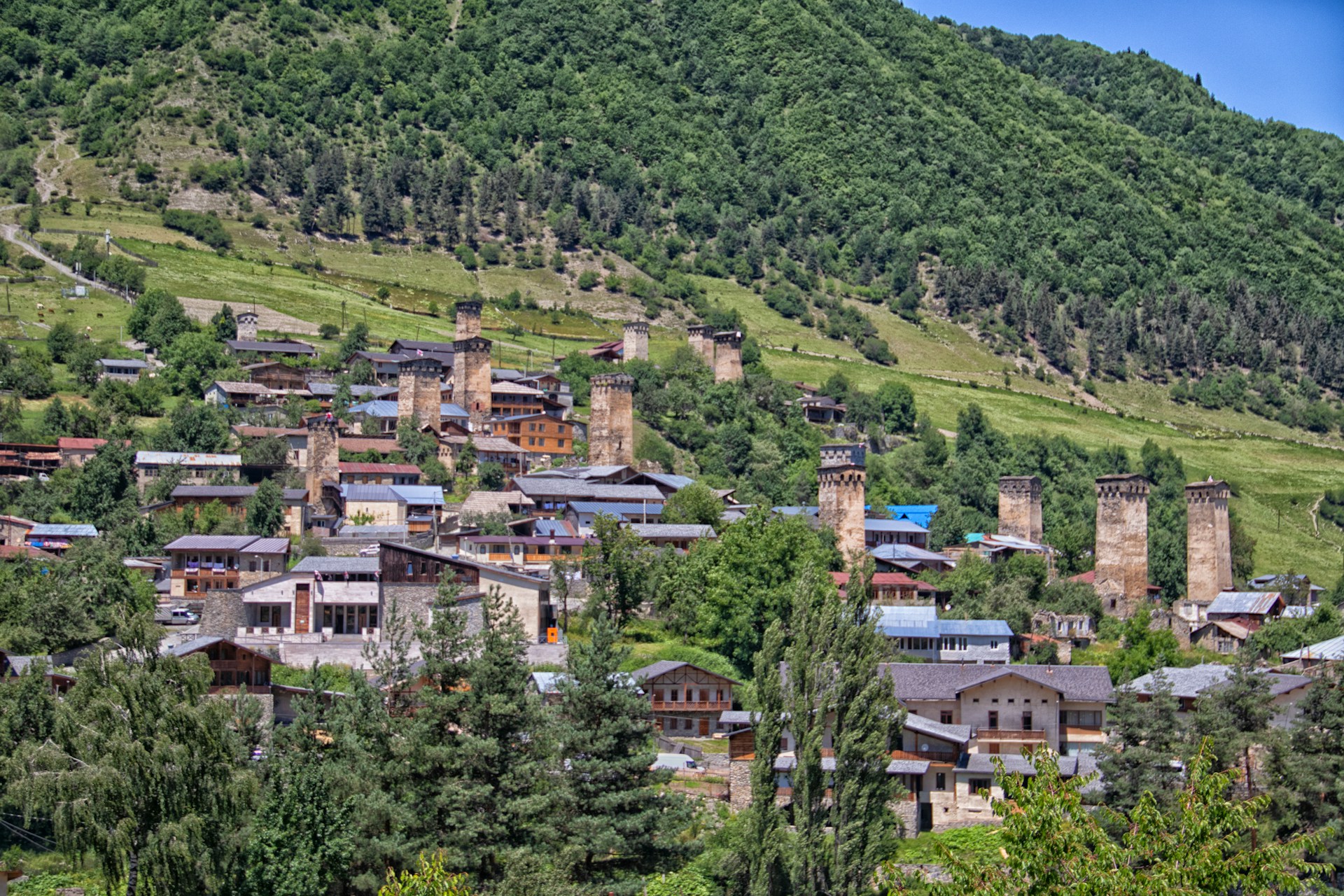

City view of Mestia, Georgia

Mestia

Mestia, nestled at 1,500 meters above sea level in the Svaneti highlands, feels plucked from a fairy tale. Snow-tipped peaks of the Greater Caucasus tower above a tapestry of verdant meadows and crystalline rivers. The town’s skyline bristles with svan towers—four- to five-story defensive structures built by medieval clans to shelter families in times of strife. Within Mestia’s compact center, modern guesthouses blend with stone cottages, creating cozy hubs for adventurers. Day-treks from town lead to alpine lakes like Koruldi and Gistola, while multi-day expeditions tackle treacherous ridges toward Mount Ushba. The UNESCO World Heritage village of Ushguli, a two-hour drive or multi-day trek away, boasts one of Europe’s highest permanent settlements, complete with five-century-old churches and towers. Mestia’s small museums preserve Svan traditions—hand-woven textiles, oral poetry, and centuries-old religious icons. For those seeking an immersive cultural and mountain experience, Mestia is unparalleled.

Top attractions & things to do in Mestia

If you’re searching for the best things to do in Mestia, this guide brings together the top attractions and must-see places to visit in Mestia. The top picks below highlight the most visited sights for first-time visitors, plus a few local favorites worth adding.

Chalaadi Glacier Trail in Mestia, Georgia

Chalaadi Glacier Trail

Beginning just 8 km from Mestia, the Chalaadi Glacier Trail leads hikers through ancient pine forests to a 36 m waterfall and onward to the terminus of the Chalaadi Glacier—a remnant of the last glacial maximum. First charted in 1895 by Russian geographer Pyotr Kozlov, the trail was later improved by local guides in the 1930s to support early Soviet mountaineering expeditions. Along the route, wooden signposts mark traditional Svan homesteads and ancestral burial grounds. The valley’s microclimate fosters a unique alpine flora assemblage, including the endemic yellow Svanetian primrose. Scientific studies in 2017 recorded annual glacier retreat rates of over 10 m, making Chalaadi a living laboratory for climate change research. At the glacier snout, hikers can inspect moraine-filled lakes where clear glacial silt gives the water a surreal turquoise hue. Return trips often end at a rustic shepherd’s hut serving warm soup and freshly baked bread—an authentic taste of Svan hospitality after a day amid ice and rock.
Ads place
Ads place
Ads place
Ads place
Ads place
Koruldi Lakes in Mestia, Georgia

Koruldi Lakes

High on the Koruldi Ridge at 2,350 m, the Koruldi Lakes are a chain of five alpine tarns nestled among rugged peaks—including the twin summits of Ushba. Although local lore claims the lakes were created by the tears of a Svan princess, scientific surveys from 2002 confirm they were carved by retreating glaciers over 10,000 years ago. The trek to the lakes passes medieval watchtowers and windswept heather meadows blanketed in fireweed each summer. Wildlife photographers prize Koruldi for sightings of the elusive Caucasian leopard and flocks of mountain partridges. At sunrise, the still waters mirror the pink glow of dawn-lit peaks, creating one of Georgia’s most coveted alpine vistas. A 2019 restoration project installed stone cairn markers and bench platforms crafted by local artisans, improving safety while preserving the landscape’s rugged integrity. For an off-peak experience, visitors camp under the Milky Way, sharing stories around campfires as the lakes reflect the stars above.
Ads place
Ads place
Ads place
Ads place
Ads place
Svan Towers of Mestia in Mestia, Georgia

Svan Towers of Mestia

Rising above Mestia’s clustered stone houses, the iconic Svan towers date from the 9th to 12th centuries and served as defensive refuges for clan families against invaders. Constructed of unmortared granite blocks, these four- to five-story towers feature narrow slit windows and trapdoors on each level—design choices that baffled Ottoman and Mongol raiders alike. Inside, local historians have discovered faint medieval fresco fragments depicting Georgian saints, suggesting these towers also held spiritual significance. A 2018 structural survey revealed that many towers subtly lean into the mountain slope, a testament to builders’ nuanced engineering. Today, about 200 of these towers remain standing in the broader Ushguli-Mestia area, but the cluster within Mestia itself—particularly around the Chazhashi churchyard—offers the most accessible concentration. Climbing the interior spiral stairways rewards visitors with panoramic views over the Enguri Valley and the snow-tipped peaks of the Greater Caucasus. As dusk falls, the towers’ silhouettes cast long shadows across slate rooftops, evoking a living tableau of medieval Svaneti.
Ads place
Ads place
Ads place
Ads place
Ads place
Svaneti Museum of History & Ethnography in Mestia, Georgia

Svaneti Museum of History & Ethnography

Founded in 1936 within a traditional Svan tower, the Svaneti Museum preserves the region’s distinctive cultural heritage through over 15,000 artifacts. Its collections include bronze-age axes from the Natsikhvani burial mounds, a rare 17th-century prince’s helmet engraved with Georgian script, and intricately carved wooden icons from mountain chapels. Ethnographic exhibits recreate a typical Svan home, complete with hand-woven textiles, clay cooking vessels, and a functional qvevri (wine amphora) for making amber-hued wine. The museum’s crown jewel is the “Golden Fleece” display—a patchwork of beaten silver plates salvaged from medieval horse trappings. Scholars regularly consult its archives of oral histories recorded in the 1970s by folklorist Ekvtime Takaishvili, preserving songs and legends on fragile reel-to-reel tapes. Seasonal workshops offer lessons in Svan calligraphy and tower masonry techniques, ensuring these ancient crafts endure for future generations. Located in the heart of Mestia, the museum stands as both repository and living classroom for Svaneti’s storied past.
Ads place
Ads place
Ads place
Ads place
Ads place
Ushguli Village in Mestia, Georgia

Ushguli Village

Perched at 2,200 m above sea level, Ushguli is one of Europe’s highest continuously inhabited settlements and a UNESCO World Heritage site since 1996. Comprising four hamlets linked by narrow lanes, Ushguli is renowned for its perfectly preserved 13th-century church of Lamaria and a cluster of Svan towers that once protected villagers from raiders. Seasonal road closures from November to May preserve Ushguli’s remote charm, leaving it accessible only by foot or 4×4. Local families still farm using bronze-era scythes and brew chacha (grape brandy) in underground cellars hewn into rock. Archaeological digs beneath the village have uncovered ancient grain storage pits dating to the Iron Age, hinting at Ushguli’s importance along trans-Caucasian trade routes. Travellers who trek here often exchange stories with Svan elders, learning folk songs and witnessing traditional dances performed on stone stages. Against a backdrop of towering glaciers, Ushguli offers a timeless glimpse into Svaneti’s living cultural landscape.
Ads place
Ads place
Ads place
Ads place
Ads place