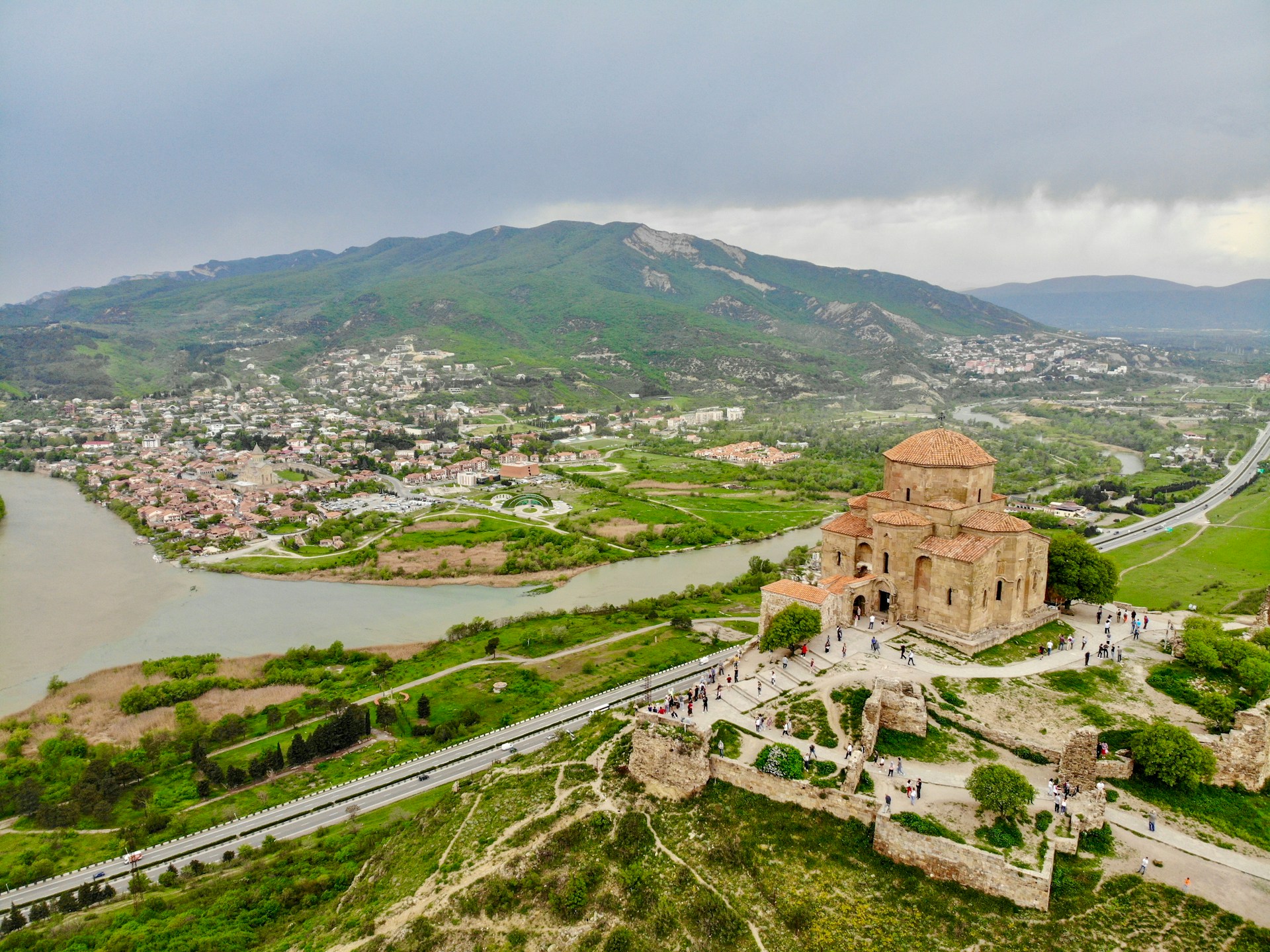

City view of Mtskheta, Georgia

Mtskheta

Mtskheta, Georgia’s former capital and spiritual heart, sits at the confluence of the Mtkvari and Aragvi Rivers, mere minutes north of present-day Tbilisi. With continuous habitation since the Bronze Age, this UNESCO World Heritage site embodies the nation’s Christian heritage, crystallized in two monumental edifices. The Svetitskhoveli Cathedral, a masterpiece of 11th-century stonework, is said to enshrine the tunic of Christ, drawing pilgrims and art historians alike to its fresco-adorned interiors. Perched on a wooded promontory above the rivers, the 6th-century Jvari Monastery offers sweeping vistas that encompass both the ancient city and modern Tbilisi in the distance. Along cobblestone lanes lined with pastel houses and shaded by linden trees, small chapels and craft shops reflect centuries of devotion and artisanal tradition. Mtskheta’s intimate scale and serene ambiance invite contemplation, while local guesthouses and family-run taverns serve traditional fare—churchkhela, mtsvadi, and amber-hued qvevri wines—ensuring visitors a profoundly rooted encounter with Georgian culture.

Top attractions & things to do in Mtskheta

If you’re searching for the best things to do in Mtskheta, this guide brings together the top attractions and must-see places to visit in Mtskheta. The top picks below highlight the most visited sights for first-time visitors, plus a few local favorites worth adding.

Armaztsikhe (Mtskheta Fortress) in Mtskheta, Georgia

Armaztsikhe (Mtskheta Fortress)

Overlooking the old capital, the Armaztsikhe Fortress—often called Mtskheta Fortress—traces its origins to the Hellenistic citadel of Armazis in the 3rd century BC. Rebuilt by King Mirian III in the 4th century to defend Georgia’s nascent Christian kingdom, its surviving ramparts and circular towers showcase layers of stonework from different eras. Visitors enter through the Eastern Gate, passing Byzantine-era guardrooms before ascending to a lookout platform that commands views of the Svetitskhoveli Cathedral and the Alazani Valley. Recent restoration efforts in 2011 revealed an underground cistern system that once supplied water during protracted sieges. A 2018 archaeological dig uncovered fragments of terracotta roof tiles bearing the stamp of King Vakhtang I Gorgasali’s reign, confirming written chronicles of his fortress enhancements. The fortress’s highest tower houses a small chapel dedicated to St. George, where annual liturgies commemorate Georgia’s patron saint. For history enthusiasts, Armaztsikhe offers a tangible link between Mtskheta’s pagan past and its Christian ascendancy.
Ads place
Ads place
Ads place
Ads place
Ads place
Armenian Church of Saint Gevorg in Mtskheta, Georgia

Armenian Church of Saint Gevorg

Tucked between Svetitskhoveli and the banks of the Mtkvari, the Armenian Church of Saint Gevorg was consecrated in 1724 by the local Armenian merchant community. Its octagonal drum and conical dome denote traditional Armenian ecclesiastical style, contrasting with nearby Georgian basilicas. Inside, vibrant 18th-century frescoes depict Armenian saints alongside local benefactors, a testament to Mtskheta’s multicultural past. Under the main floor lies a crypt housing several elaborately carved Armenian cross-stones (khachkars) dating to the 14th century. A stone inscription over the entrance records the church’s reconstruction after an earthquake in 1860. In 2017, conservationists restored the original Armenian khachkar display in the courtyard, making it one of the few public exhibits of medieval Armenian lapidary art in Georgia. The adjacent courtyard café, housed in a restored 19th-century merchant’s home, serves lavash bread and homemade cholovats, blending Armenian hospitality with panoramic views of Mtskheta’s historic skyline.
Ads place
Ads place
Ads place
Ads place
Ads place
Jvari Monastery in Mtskheta, Georgia

Jvari Monastery

Perched atop a conical hill overlooking the confluence of the Mtkvari and Aragvi rivers, Jvari Monastery was erected in 585 to commemorate Saint Nino’s conversion of Georgia to Christianity in the 4th century. Its compact tetraconch plan and central dome mark it as a masterpiece of early Georgian ecclesiastical design. The church’s unadorned exterior belies a majestic interior where natural light filters through narrow windows, illuminating subtle 6th-century stone carvings of crosses and vine motifs. Archeologists recently uncovered fragments of a pre-existing pagan shrine beneath the foundation, revealing how Christian builders repurposed sacred landscapes. A stone cross set into the hill’s bedrock is believed to bear Saint Nino’s handprint. The summit platform provides sweeping panoramas of Mtskheta’s red-tiled roofs and the distant Caucasus foothills. Each spring equinox, pilgrims gather at the cross for sunrise blessings, honoring Jvari’s legacy as Georgia’s “Monastery of the Cross.” With its blend of historical depth, sacred legend, and commanding views, Jvari remains a timeless symbol of Georgian faith.
Ads place
Ads place
Ads place
Ads place
Ads place
Samtavro Monastery in Mtskheta, Georgia

Samtavro Monastery

Founded in the 4th century by King Mirian III and his wife, Queen Nana, Samtavro Monastery remains a living monastic community and pilgrimage destination. Its principal church, rebuilt by King George II in 1049, features a distinctive rectangular nave and a semicircular apse adorned with late 11th-century fresco fragments. The monastery grounds encompass the Tomb of St. Nino, marked by a small chapel where the Georgian Enlightener is believed to rest. Pilgrims leave prayer ribbons tied to the ancient plane trees lining the central courtyard, a tradition dating back to the Middle Ages. In 2015, restorers discovered signed mason marks on foundation stones, attributing construction to master builder Basilius. The refectory’s basement houses an ossuary containing aristocratic remains, identified by intricately carved epitaph slabs. Every July 1st, the local feast day attracts clergy from across the Caucasus for solemn processions. Set against a backdrop of rolling hills, Samtavro combines active religious life with layers of Georgian ecclesiastical art and legend.
Ads place
Ads place
Ads place
Ads place
Ads place
Svetitskhoveli Cathedral in Mtskheta, Georgia

Svetitskhoveli Cathedral

Constructed in 1010 on the site of Christ’s original burial cloak, Svetitskhoveli Cathedral is Georgia’s spiritual heart and a UNESCO World Heritage Site since 1994. Commissioned by King George I, its cross-dome design epitomizes early medieval Georgian architecture, with four semicircular apses and a drum adorned by blind arcades. Inside, visitors discover 12th-century frescoes by the renowned painter Mikael Modrekili, whose vivid portraits of apostles and local saints remain remarkably intact. Beneath the vaulted floor lies a hidden crypt where 21 stone pillars support the nave, and local legend speaks of a miraculous column that exudes healing oil. The cathedral’s ornate gold-encrusted iconostasis was crafted in 1574 by master goldsmith Arsen. Annual celebrations on October 14th draw thousands to commemorate the Feast of Svetitskhoveli, processing relics through the ancient gates. Illuminated at dusk, the cathedral’s silhouette against the Aragvi River gorge leaves an indelible impression—an enduring testament to Georgia’s millennia-old Christian legacy.
Ads place
Ads place
Ads place
Ads place
Ads place