
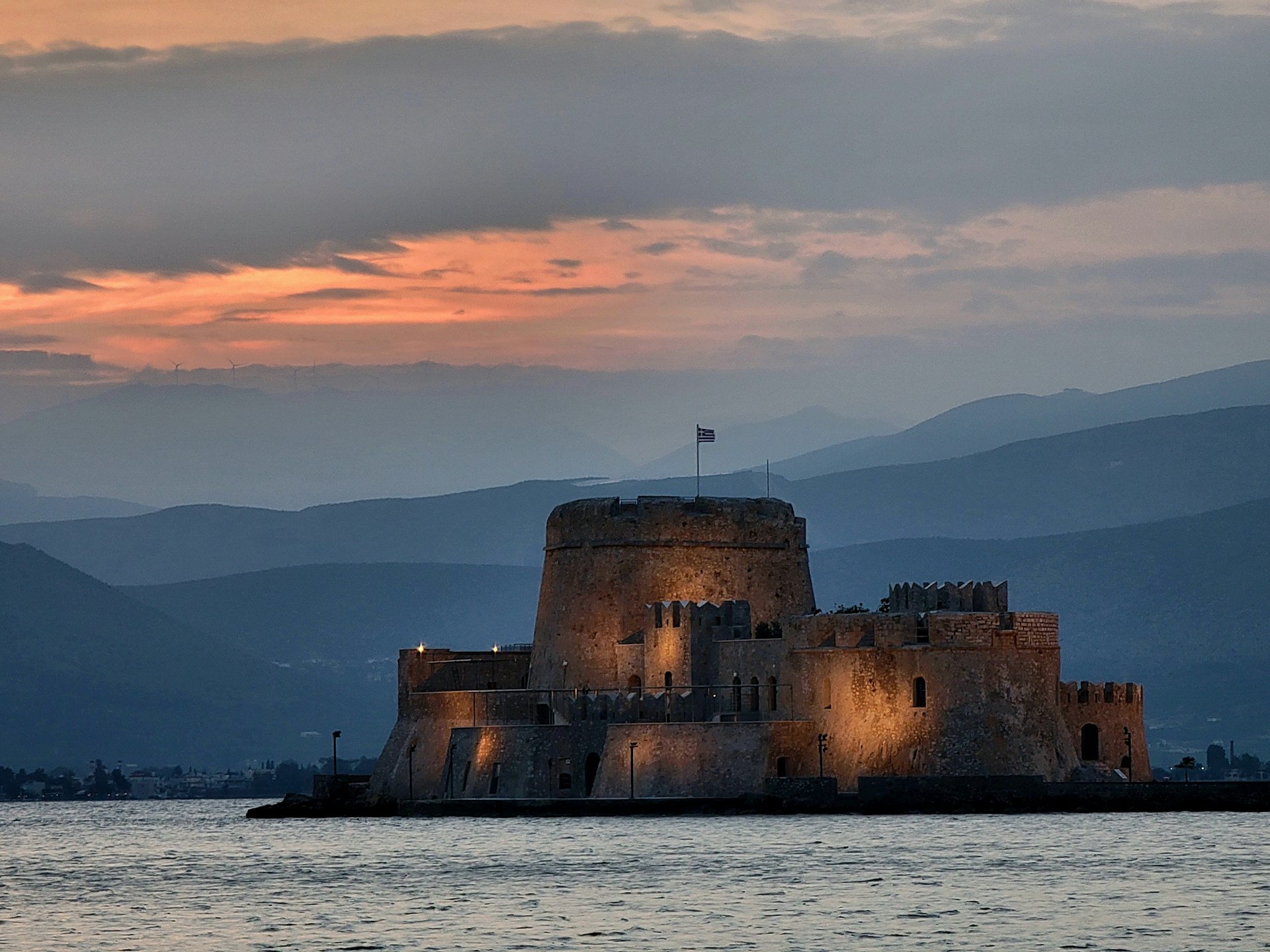
City view of Nafplio, Greece

Nafplio

Nafplio, Greece’s first modern capital after independence in 1829, enchants visitors with its blend of Venetian ramparts, neoclassical boulevards and Ottoman relics along a sunlit seafront promenade. The 18th-century Palamidi Fortress—constructed by Venetian engineers—crowns a rocky hill 216 m above sea level; intrepid travelers ascend its 999 stone steps for panoramic views over the Argolic Gulf, Mycenaean ruins and olive-clad hills. Offshore, the Bourtzi islet fortress once repelled pirate raids and today hosts summertime concerts in its restored chambers. In the old town, Syntagma Square’s neoclassical town hall anchors narrow lanes draped in bougainvillea and café terraces serving piping-hot loukoumades and citrus liqueur. The Archaeological Museum—housed in a former Ottoman mosque—displays Mycenaean funerary masks from nearby Tiryns alongside classical sculptures and pottery. Every February, Nafplio’s carnival transforms cobbled streets with masquerades, folk dances and vibrant processions, reaffirming its reputation as one of Greece’s most romantic and historically rich small cities.

Top attractions & things to do in Nafplio

If you’re searching for the best things to do in Nafplio, this guide brings together the top attractions and must-see places to visit in Nafplio. The top picks below highlight the most visited sights for first-time visitors, plus a few local favorites worth adding.

Akronafplia Castle in Nafplio, Greece

Akronafplia Castle

Dominating the headland between Arvanitia and the Old Town, Akronafplia Castle traces its roots to Mycenaean fortifications of the 13th century BC, later expanded by Byzantine and Frankish rulers through the medieval era. The Venetians added bastions and walls in the 15th century, creating a labyrinth of ramparts and hidden cisterns. During Ottoman occupation (1540–1686), Akronafplia's elevated position served as a watchtower for seaborne threats. In 1822, it briefly housed rebels of the newly formed Greek state. Today, accessible via winding pathways, visitors explore restored ramparts, a chapel dedicated to Agios Georgios, and panoramic terraces overlooking Palamidi and the Argolic Gulf. Botanists study rare flora within its secluded courtyards, while geology enthusiasts examine the distinct stratified sandstone formations. Akronafplia stands as a living palimpsest of antiquity, medieval strategy, and modern preservation.
Ads place
Ads place
Ads place
Ads place
Ads place
Arvanitia Promenade in Nafplio, Greece

Arvanitia Promenade

Winding along the rocky coast from Bourtzi Castle to Karathona Beach, the Arvanitia Promenade was laid out by local authorities in the 19th century under King Otto's administration to enhance seaside leisure. Also known as the "Queen’s Walk", it became a favoured route of Queen Amalia for evening strolls beneath olive groves and cypress trees. The shaded path crosses stone bridges and overlooks secluded coves where crystalline waves lap pebble shores. Intermittent benches and gazebos invite visitors to pause at scenic outlooks capturing the sunset over the Peloponnesian coastline. Naturalists appreciate the coastal flora including sea lavender and tamarisk, while fitness enthusiasts use the route for jogging at dawn. The promenade remains a cornerstone of Nafplio’s recreational life, blending royal heritage, coastal landscape, and modern-day serenity.
Ads place
Ads place
Ads place
Ads place
Ads place
Bourtzi Castle in Nafplio, Greece

Bourtzi Castle

Nestled on a tiny islet guarding Nafplio’s harbor, Bourtzi Castle was commissioned in 1473 by Venetian architect Antonio Gambello under the rule of the Republic of Venice. This compact fortress, encircled by a moat and seawater-channeled drawbridge, served as both defensive outpost and prison, notably detaining Ottoman captives during the 18th century. In the 19th century, it was converted into a royal guesthouse by King Otto and later repurposed as a maritime hotel in the 1960s. Restored in 2007, its cannons, guard towers, and inner courtyard are once again accessible via boat tours. Photographers prize the castle’s silhouette against sunrise, while historians study its layered Venetian, Ottoman, and modern adaptations. Seasonal open-air film screenings carried by sea breezes revive Bourtzi’s cinematic allure, blending medieval architecture with contemporary culture.
Ads place
Ads place
Ads place
Ads place
Ads place
Palamidi Fortress in Nafplio, Greece

Palamidi Fortress

Perched atop a limestone ridge 216 meters above sea level, the Palamidi Fortress was constructed by Venetian general Francesco Morosini between 1711–1714 to secure the gulf against Ottoman incursions. Accessed via the famous 999 stone steps carved into the hillside, each bastion offers commanding panoramas of Nafplio’s rooftops and the Argolic Gulf. During the Greek War of Independence (1821–1830), it served as the revolutionary capital’s last stronghold before falling to Ottoman-Egyptian forces. Following liberation, Governor Ioannis Kapodistrias briefly used Palamidi as a prison for political dissidents. Archaeologists have uncovered traces of earlier Mycenaean walls at the base, hinting at millennia of strategic occupation. Today, centuries-old cannons, olive tree groves, and restored ramparts invite exploration, while seasonal illumination highlights the fortress’s robust baroque bastion design at dusk. Palamidi remains a testament to Byzantine, Venetian, and modern Greek’s layered military heritage.
Ads place
Ads place
Ads place
Ads place
Ads place
Syntagma Square in Nafplio, Greece

Syntagma Square

At the heart of Nafplio's Old Town lies Syntagma Square, named after the 1833 Constitution ratified under Governor Ioannis Kapodistrias following Greece’s independence. Flanked by neoclassical mansions, the square's pavement showcases a distinctive pebble mosaic depicting olive branches, symbolizing peace and prosperity. The central Heracles Fountain, installed in 1839, was crafted from imported Italian marble and once supplied drinking water to local residents. Surrounding buildings include the elegant Francheskou Mansion—now a cultural center—and the former town hall, site of celebratory gatherings after liberation. Outdoor cafés and tavernas spill onto the square, serving regional specialties like baklava and local wines from the Peloponnese. Seasonal festivals and concerts animate the space, preserving its legacy as a focal point of civic life, constitutional history, and social exchange from Ottoman era to modern Greece.
Ads place
Ads place
Ads place
Ads place
Ads place