
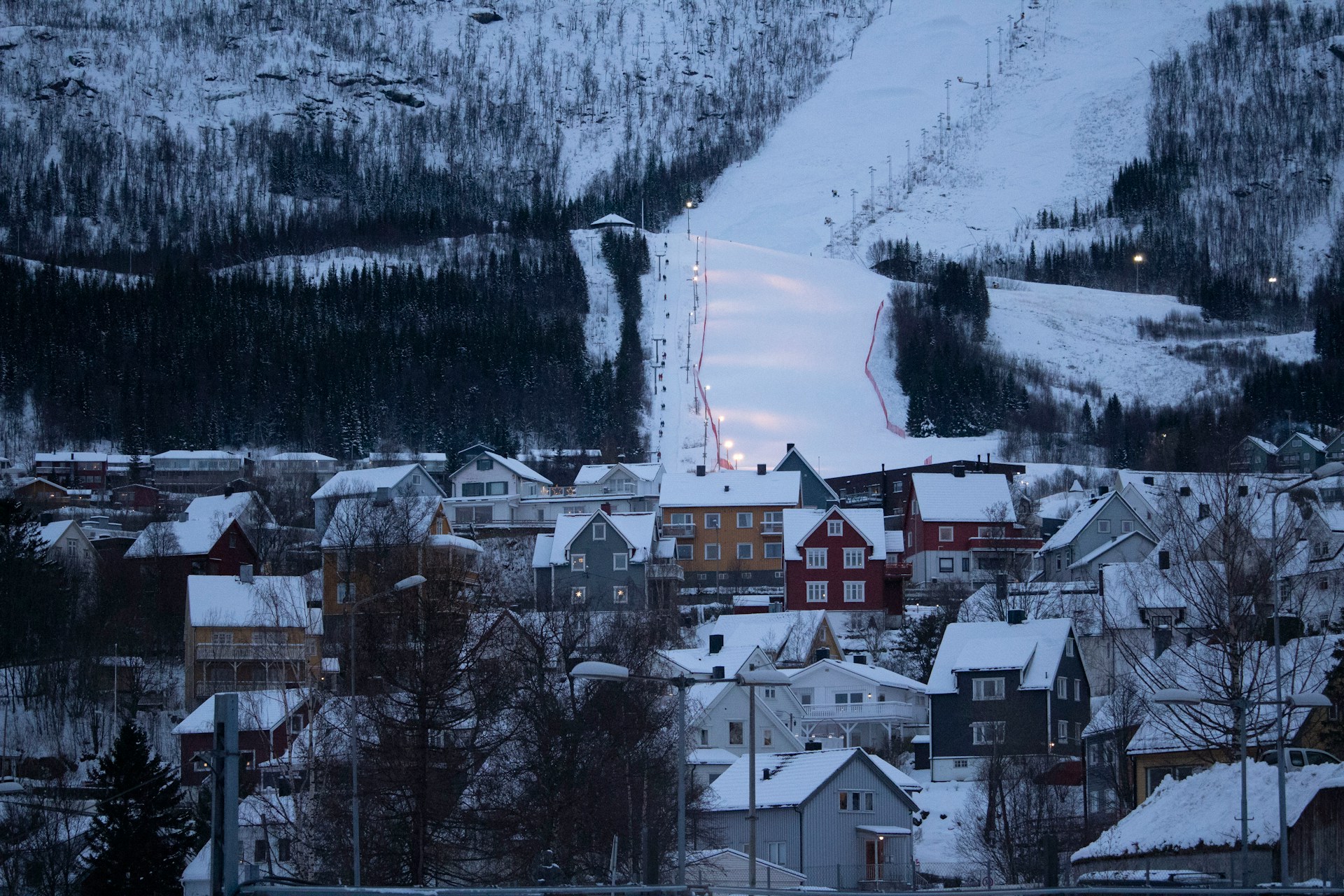
City view of Narvik, Norway

Narvik

Narvik’s location above the Arctic Circle gives it a unique role in Norway’s history and economy. The ice-free harbor has long been crucial for exporting iron ore, and the Ofoten Railway offers one of Europe’s most scenic train journeys. World War II left a deep imprint here, and the local museum tells gripping stories of battles fought in surrounding fjords. Outdoor pursuits are year-round: skiing under the northern lights in winter, hiking to panoramic ridges in summer. The mix of industrial infrastructure and dramatic nature is striking. An unusual feature: Narvik has a cable car that operates well into the night during summer, letting visitors watch the midnight sun from high above the fjord. This interplay of history, industry, and Arctic scenery creates an atmosphere unlike any other Norwegian town.

Top attractions & things to do in Narvik

If you’re searching for the best things to do in Narvik, this guide brings together the top attractions and must-see places to visit in Narvik. The top picks below highlight the most visited sights for first-time visitors, plus a few local favorites worth adding.

Arctic Train (Ofotbanen) in Narvik, Norway

Arctic Train (Ofotbanen)

Steel threads climb from the quay into a corridor of granite and birch, a route built to carry iron ore from Sweden to ice-free waters even when storms make a case for staying home. Opened in 1902, the line still moves heavy freight from LKAB mines near Kiruna, but the passenger coaches now slow for vistas that engineers once measured only in gradients. Snow sheds and tunnels tame avalanches, while switchbacks and bridges finesse the last steep kilometers toward Riksgransen at the border. Guides narrate labor camps, engineering mishaps, and small triumphs that stitched two countries together with rail and nerve. When the train pauses, you can read the valley like a schematic: construction roads, culverts, and abandoned pylons set against waterfalls that ignore every timetable. It is industrial poetry—steel, ice, and human design—woven into a journey that treats history as a fellow traveler rather than a distant footnote.
Ads place
Ads place
Ads place
Ads place
Ads place
Narvik Church in Narvik, Norway

Narvik Church

A steep roofline and a square tower rise cleanly above neighborhoods rebuilt more than once by weather and war, giving the parish a steady landmark in a city that knows change. Consecrated in 1925, the church pairs sturdy masonry with warm timber, a northern pragmatism softened by light. Stained-glass panels filter short winter days into color that lingers over pews, and an organ with commanding pipes anchors evening concerts. Bells roll across the harbor like a tide announcement, their cadence answering ship horns on foggy mornings. Exhibitions in the nave recall bomb damage and repairs during and after WWII, when the congregation doubled as a network for comfort and news. The atmosphere is neither grand nor austere; it is attentive, as a parish should be, to arrivals and departures in every season. Step outside and the wind finds the tower first, a reminder that faith here learned to stand where storms begin.
Ads place
Ads place
Ads place
Ads place
Ads place
Narvik War Museum in Narvik, Norway

Narvik War Museum

Norway's northern frontline is narrated here with a clarity that favors people over hardware, yet the artifacts still speak with chilling authority. The timeline opens in April 1940, when the Ofotfjord became the arena for the Battles of Narvik and the town learned how fragile a harbor can be under fire. Exhibits follow General Carl Gustav Fleischer and his alpine troops as they fought back through snow and rock, while vitrines track the duel between the Royal Navy and German destroyers that flickered across these waters. In another room, testimony and photos document how the Luftwaffe remade the skyline and how evacuation scattered families along the fjords. The final galleries weigh resistance, occupation, and rebuilding, inviting visitors to consider not only tactics but consequences. Standing among uniforms, maps, and letters, you feel the scale shrink to human decisions—made in haste, endured for decades—until the museum door opens and the same mountains reassert their silent witness.
Ads place
Ads place
Ads place
Ads place
Ads place
Narvikfjellet Cable Car in Narvik, Norway

Narvikfjellet Cable Car

A gondola lifts you above warehouses and quays until the Ofotfjord widens beneath the cabin like a living map. The new line opened in 2019, replacing an older lift and turning a local ski hill into a year-round balcony over sea and summits. On spring evenings the sun hesitates over snowfields and you can trace ridgelines for miles; by autumn the first flurries sketch the piste back into focus for alpine skiing. Clear nights bring the aurora borealis, and glass windows act like a lens that frames each flicker without stealing the cold. Trails fan out toward knuckles rising to over 1,000 meters, while the restaurant hovers above the harbor lights as if afloat. The view keeps finding new anchors—the iron-ore pier, the rail yards, the blue seam of the Ofotfjord—reminding you that industry, weather, and leisure share the same stage in Narvik's high amphitheater under the midnight sun.
Ads place
Ads place
Ads place
Ads place
Ads place
Rallarveien to Rombaksbotn in Narvik, Norway

Rallarveien to Rombaksbotn

The old construction road called Rallarveien drops from high country to the green bowl of Rombaksbotn, a hike that reads like a chapter from Norway's industrial epic. Built in the 1900s by hard-driving navvies, it stitched work camps to blasting sites with a web of switchbacks, culverts, and footbridges that still carry careful feet today. You pass mossy foundations of barracks where telegraph wires once buzzed with orders, and streams folded into dry-stone channels that have outlasted their makers. Along the river, rusted fittings hint at cableways that ferried supplies long before roads took over the job. Guides point out berries in late summer and avalanche paths in late winter, proof that nature edits the route without apology. Reaching the fjord, you can imagine barges loading rails while men counted wages in damp tents—a landscape of effort that now hosts picnics, campfire coffee, and a slower measure of time.
Ads place
Ads place
Ads place
Ads place
Ads place