
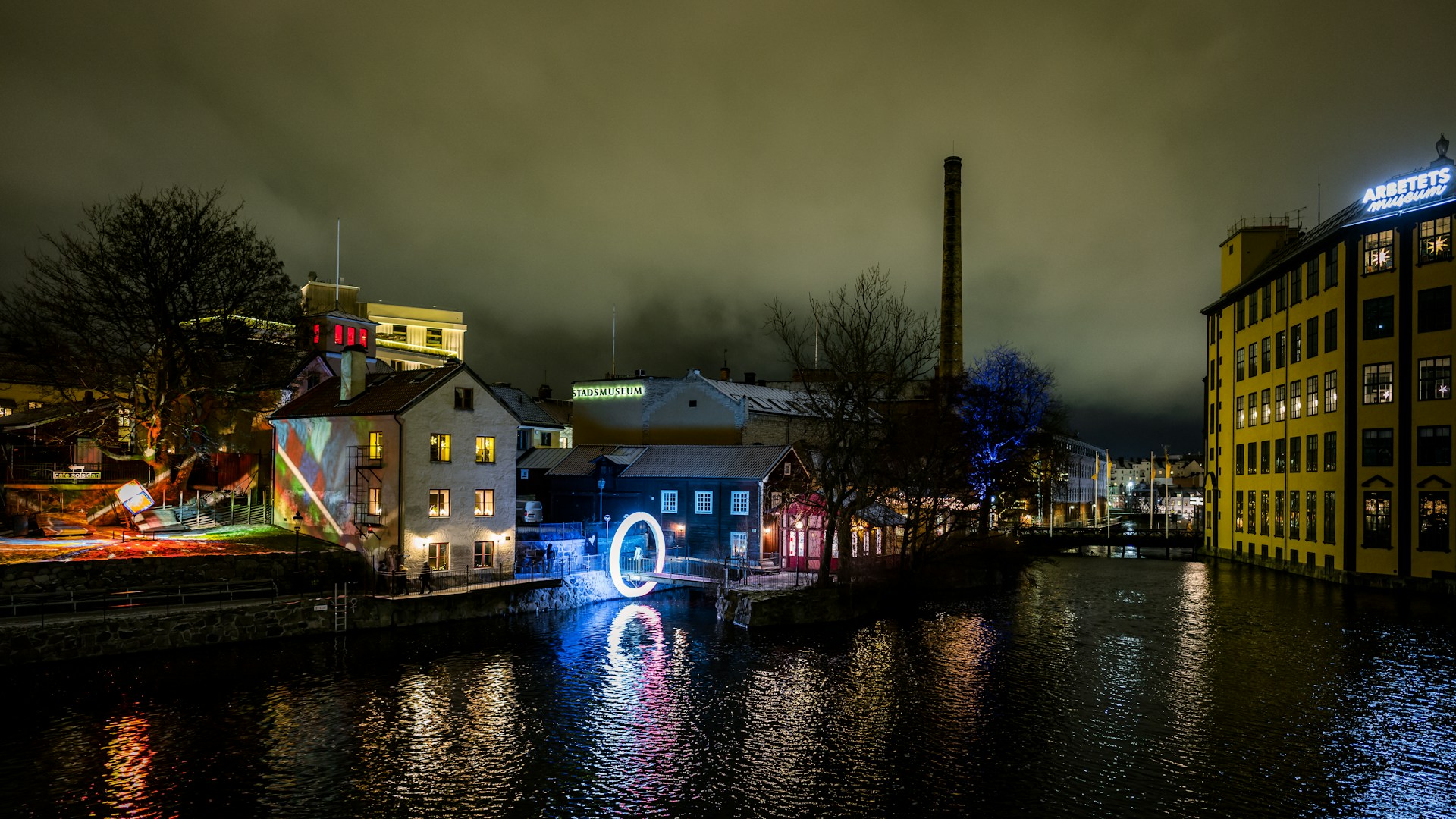
City view of Norrkoping, Sweden

Norrkoping

Motala Strom curls through Norrkoping's Industrial Landscape, where brick mills and power stations now run on culture. Walk past the turbine hall turned concert venue and into museums that explain how 19th century looms once set the town's tempo. The Visualization Center introduces virtual reality and space films, while a riverside path guides joggers under tall chimneys. Lunch can be fried herring or a meat free buffet; dessert might be salty licorice ice cream, a local debate starter. In Knappen, murals turn warehouse walls into cheerful landmarks. The old power canal lights up after dusk, and reflections make an accidental light show for photographers. A fun detail: a steam whistle once marked the factory day so reliably that people set home clocks by it, and a few still miss its punctual voice. Follow certain pipes in winter to discover heated benches, a cozy byproduct of district energy.

Top attractions & things to do in Norrkoping

If you’re searching for the best things to do in Norrkoping, this guide brings together the top attractions and must-see places to visit in Norrkoping. The top picks below highlight the most visited sights for first-time visitors, plus a few local favorites worth adding.

Arbetets Museum (Museum of Work) in Norrkoping, Sweden

Arbetets Museum (Museum of Work)

On the narrow island in Motala Strom, the workers museum Arbetets Museum occupies the seven sided Strykjarnet building, a wedge of yellow brick that once held offices for the Holmen textile mills. Completed in 1917 and nicknamed the Iron, it rises 7 floors above the water with windows on every side so clerks once worked in generous light while machines roared elsewhere. Today the museum curates rotating exhibitions on working life, migration, and everyday design, mixing oral histories with photographs and small objects that rarely appear in traditional art museums. A long running project follows the lives of industrial photographer Berndt Johanson, whose images from the 1950s and 1960s give the building unexpected intimacy. The top floor cafe looks straight across to red brick factories and down to kayakers sliding under the bridges. On rainy days families explore the children's gallery where games explain unions, salaries, and safety gear with disarming clarity. Arbetets Museum keeps the city's labour memory active without nostalgia, asking who makes things now and where their stories are being stored.
Ads place
Ads place
Ads place
Ads place
Ads place
Himmelstalund Rock Carvings in Norrkoping, Sweden

Himmelstalund Rock Carvings

West of the center, the meadow and cliffs of Himmelstalund hide one of Europe's densest collections of Bronze Age rock art, carved when the Motala Strom was a busy waterway long before turbines. More than 1,700 figures have been documented here, with ships, horses, and human silhouettes chipped into the red granite sometime between about 1800 and 500 BCE. Researchers from Linkoping University and national heritage agencies continue to map new details using raking light and digital tracing, and interpretive signs along the paths summarise their findings in clear Swedish and English. On dry summer days some carvings are highlighted with red pigment so they stand out without overpowering the stone, and low fences protect the most fragile panels from curious feet. The walkways themselves are modest, just gravel tracks and wooden platforms, which keeps the landscape feeling close. Himmelstalund asks you to slow your steps, notice every shallow line, and imagine the river valley as a busy meeting point thousands of years before factories and football pitches took over the floodplain.
Ads place
Ads place
Ads place
Ads place
Ads place
Industrial Landscape by Motala Strom in Norrkoping, Sweden

Industrial Landscape by Motala Strom

Start at the Motala Strom and you understand why Norrkoping calls its former mills the Industrial Landscape, a tight run of brick facades, chimneys, and bridges where factories met falling water. Along barely one kilometer more than 20 preserved buildings tell the story of a boom that peaked around 1900 when the city was known as Sweden's Manchester and textile whistles ruled the clock. Today spinning rooms host studios, tech firms, and campus spaces for Linkoping University, while boardwalks and metal walkways let you follow the currents at eye level. Night lighting designed in the early 2000s turns walls and spray into a kind of open air stage, especially in winter when steam hangs low. Information panels explain how turbines, sluice gates, and the Holmen company once managed power long before anyone spoke about sustainability. Sit on the steps near the yellow power station, listen to the river, and the city's shift from smoke to culture feels less like a makeover and more like the next chapter of the same industrious story.
Ads place
Ads place
Ads place
Ads place
Ads place
Norrkoping Art Museum in Norrkoping, Sweden

Norrkoping Art Museum

At the top of Karl Johans Park, Norrkoping Art Museum offers calm white galleries that quietly hold one of Sweden's strongest collections of twentieth century painting. The institution dates to 1913 and moved into its present Functionalist building in 1946, later extended with a wing whose skylights pour soft northern light onto canvases. Works by Isaac Grunewald, Sigrid Hjerten, and other modernists share space with contemporary installations so you can trace how color and politics evolved across the decades. The museum now cares for more than 5,000 works, and staff frequently rotate displays so repeat visitors meet new pairings. A learning studio on the lower level invites children to test techniques with real materials rather than plastic toys. Outside, sculptures spill into the surrounding park, and from the entrance steps you can watch trams glide past the river toward the Industrial Landscape. Norrkoping Art Museum feels compact yet dense, the sort of place where an hour with three paintings might stay with you longer than a day of sightseeing elsewhere.
Ads place
Ads place
Ads place
Ads place
Ads place
Visualization Center C in Norrkoping, Sweden

Visualization Center C

Down by the inner harbour at Lindoe, Visualization Center C turns research into something you can sit inside, thanks to collaborations between Linkoping University, Norrkoping Municipality, and regional industry. The heart of the building is a full dome theater with a diameter of about 15 meters, where immersive films about space, oceans, or microscopic worlds wrap completely around your field of view. Opened to the public in 2010 and designed by Sandell Sandberg, the center also houses interactive labs where you can test motion capture, data art, and city planning tools built on real local statistics. Exhibitions change often but usually highlight at least one global project, from climate models to reconstructions of ancient Norrkoping using game engines. A cafe and terrace look out toward the Motala river mouth and the remnants of the harbor cranes that once drove exports. For families and curious adults alike, Visualization Center C offers a compact way to feel how digital models are quietly steering decisions in classrooms, council chambers, and design studios far beyond this dockside block.
Ads place
Ads place
Ads place
Ads place
Ads place