
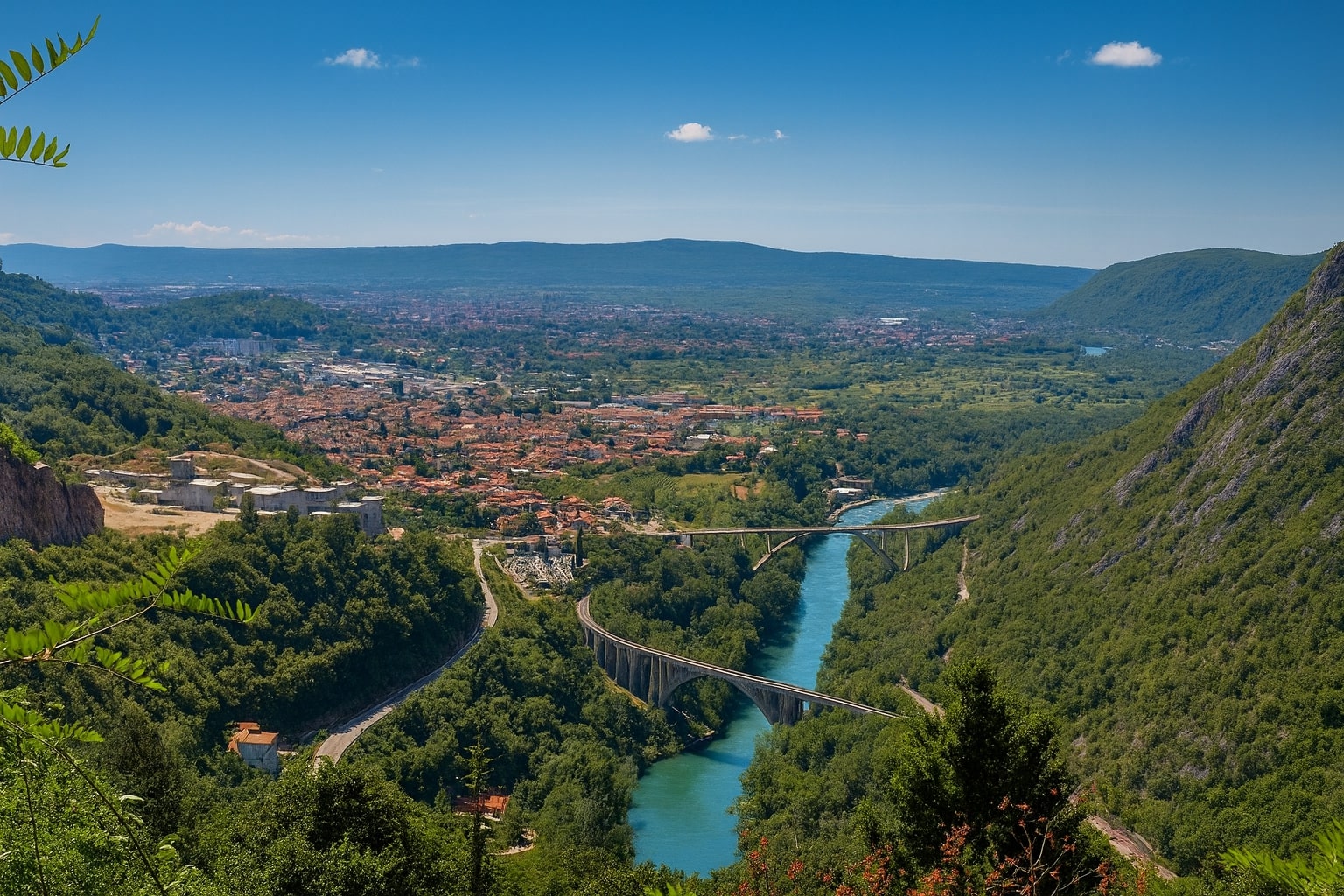
City view of Nova Gorica, Slovenia

Nova Gorica

Nova Gorica began after the border moved, a planned town from 1947 that learned to grow beside a twin city across a line drawn through old gardens. Today, footpaths and trains knit daily life with Gorizia in Italy, and a new shared square is turning paperwork into a plaza with trees and shade. Try frtalja herb omelet or prosciutto sliced thin enough to read through, and pour Rebula from the Brda hills until conversation softens. The Kostanjevica monastery above town holds Bourbon tombs and a library where sunlight behaves and dust motes look like actors. A casino district once headlined the economy; now tech offices and bike tourism write quieter copy without changing the accents. Lesser known: a cross border brass band rehearses in alternating languages and never misses a beat on parade day. Evening rides along the Soca corridor feel cinematic, and the railway museum in nearby Pristava explains why engineers make good storytellers with diagrams.

Top attractions & things to do in Nova Gorica

If you’re searching for the best things to do in Nova Gorica, this guide brings together the top attractions and must-see places to visit in Nova Gorica. The top picks below highlight the most visited sights for first-time visitors, plus a few local favorites worth adding.

Europe Square and Transalpina in Nova Gorica, Slovenia

Europe Square and Transalpina

On a flat, sunlit plaza the border that once divided lives is now a line you step across for coffee or a photograph. Europe Square opened in 2004 as a joint civic room for Nova Gorica and Gorizia; with Schengen 2007 the barriers vanished, and the space began to behave like a neighborhood rather than a checkpoint. A mosaic compass anchors the paving, and the old Italian station—named Transalpina—faces the newer Slovenian facades with an almost theatrical symmetry. Families teach children to hop the line; cyclists roll through without a pause; festivals string lights from one jurisdiction to the other as if borders were simply wiring diagrams. Plaques summarize a century of adjustments in a few paragraphs, and benches invite the longer version from grandparents who remember papers and delays. The square’s trick is simple and rare: it uses design to make politics legible, then hospitable. Stand by the station clock, listen for trains, and watch a lesson in Europe play out at walking speed.
Ads place
Ads place
Ads place
Ads place
Ads place
Kostanjevica Monastery and Bourbon Crypt in Nova Gorica, Slovenia

Kostanjevica Monastery and Bourbon Crypt

A short climb brings you to Kostanjevica, a Franciscan house whose church and cloister sit among roses, looking down over two towns and one valley. The ensemble dates to the early 17th century and keeps a restrained Baroque vocabulary: white walls, measured cornices, and a nave that carries sound without strain. Beneath the chapel lies the Bourbon crypt, final resting place of the exiled French king Charles X, who died in 1836, and close relatives whose lives bent with Europe’s tides. A modest library preserves early prints and travel accounts, and friars still tend the garden with the quiet efficiency of long practice. The view gathers rail lines, vineyards, and the Soca’s corridor into one map you can read without a legend. It is not a large complex, but it turns scale to its advantage: a handful of rooms, a handful of graves, and an outlook that argues for patience. Come at evening and the bells fold into leaf noise; come at noon and the cloister stones offer shade and a seat.
Ads place
Ads place
Ads place
Ads place
Ads place
Kromberk Castle and Goriska Museum in Nova Gorica, Slovenia

Kromberk Castle and Goriska Museum

South of the center, Kromberk Castle sets a calm rectangle above terraces and vines, its four corner towers and slim loggias announcing Renaissance intent more than swagger. The present outlines settled in the 17th century after earlier damage, and today the Goriska Museum—founded in the 1950s—fills rooms with archaeology, fine art, and WWI material that links the hills to larger maps. Courtyards frame a well and orange trees; arcades temper heat and invite loitering. In galleries, a measured display explains how silk, stone, and wine shaped local fortunes, while upstairs portraits follow families that negotiated shifting borders with patience. A model shows bastions in plan, an engineer’s geometry tucked into a house that reads domestic from the road. The castle’s grace is not theatrical; proportions carry the day, and small choices—limewash, wooden shutters, gravel—keep echoes soft. From the rampart path the view runs to Sabotin and the Soca, and you can see why the museum adopted this balcony: scholarship with a horizon, and history shown at the scale of rooms rather than slogans.
Ads place
Ads place
Ads place
Ads place
Ads place
Sabotin Peace Park in Nova Gorica, Slovenia

Sabotin Peace Park

Above the town, Sabotin lifts to 609 meters, a hill scored by trenches and galleries that now host an open-air museum rather than troops. Waymarked paths thread old positions from the Isonzo Front, with panels that explain the 1916 fighting in clear diagrams and modest prose. Tunnels cut into limestone cool the air even on hot days; bring a lamp for side passages and patience for tight turns. From the ridge the Soca looks impossibly calm, a bright ribbon that once mattered more for crossings than for views. The park’s small visitor center serves coffee and lends maps; staff steer newcomers toward circuits that match legs and daylight. Wildflowers reclaim parapets in spring; in autumn, light aligns with the valley and traces old lines with sudden precision. Sabotin does not dramatize; it documents, then lets the landscape do the rest. You leave with dates, names, and a view that refuses melodrama, which is exactly why it lingers longer than monuments.
Ads place
Ads place
Ads place
Ads place
Ads place
Solkan Bridge Railway Arch in Nova Gorica, Slovenia

Solkan Bridge Railway Arch

Where the railway meets the Soca, Solkan Bridge draws a single gesture across green water: the world’s largest stone arch of its kind, measuring about 85 meters. Completed in 1905 for the Bohinj line, it pairs bravado with precision, its ring stones keyed like careful teeth against flood and time. Trains still ease over the span, a scale reference for the arch’s poise, while rafts and kayaks pass below on bright weekends. The approaches carry plaques that summarize wartime damage and repairs without turning the bridge into a sermon. Stand at the upstream footpath and the curve seems to lift the valley’s sides; stand midriver in a boat and the geometry tightens into a circle you can almost complete with your arms. The nearby station platform makes an impromptu balcony for photographers. It is infrastructure first, yes, yet it behaves like sculpture, persuading even hurried passengers to look up from screens and measure distance in stone, water, and the timing of wheels on track.
Ads place
Ads place
Ads place
Ads place
Ads place