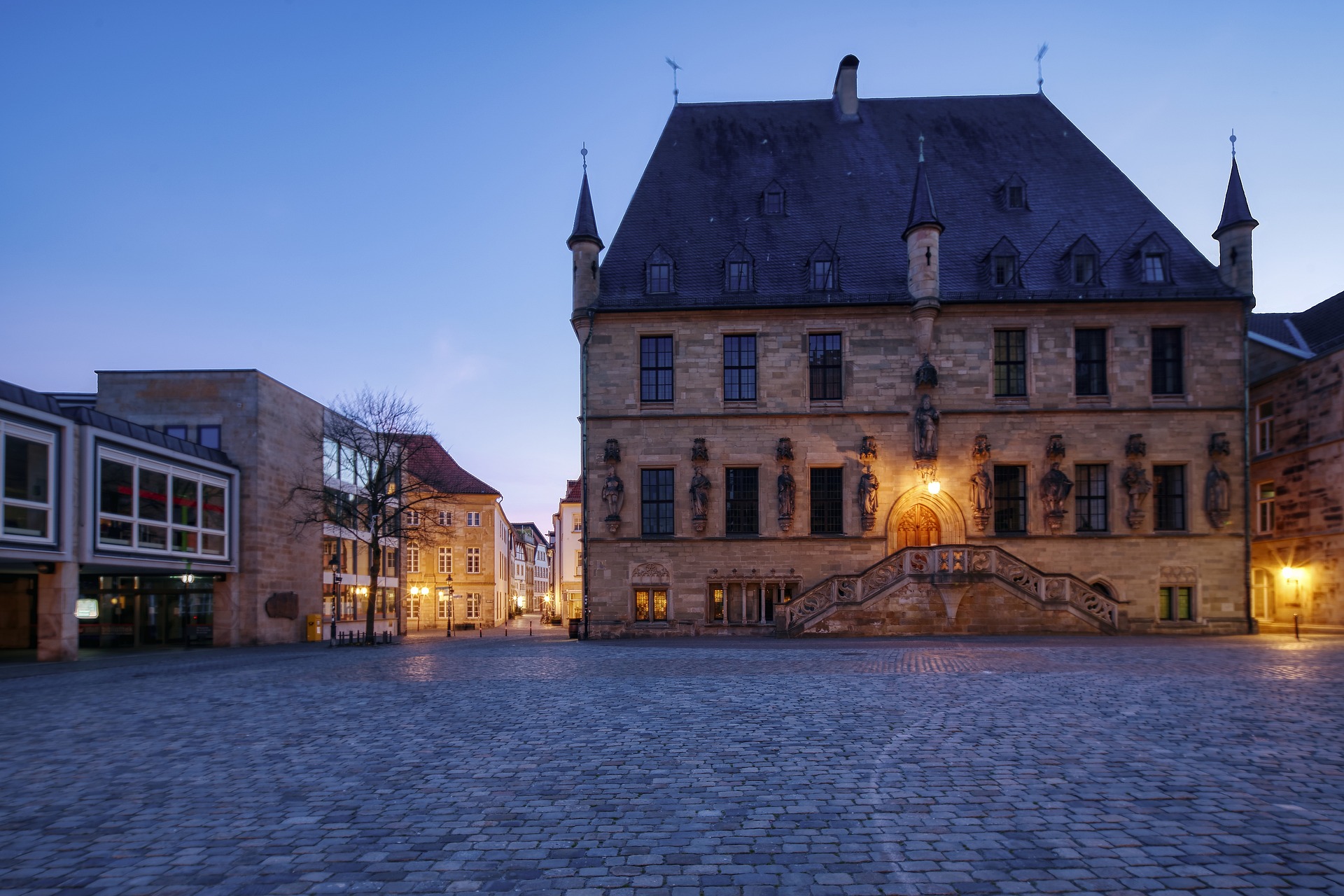

City view of Osnabrück, Germany

Osnabrück

Osnabrück, located in Lower Saxony, is known as the 'City of Peace' for its role in the Peace of Westphalia treaties that ended the Thirty Years' War. The city's historic market square is surrounded by Renaissance and Baroque architecture. Osnabrück Cathedral, a Romanesque structure dedicated to St. Peter, is a key landmark. The Felix Nussbaum House, designed by architect Daniel Libeskind, displays the works of the Jewish painter Felix Nussbaum. The city's vibrant cultural scene and proximity to the Teutoburg Forest make it appealing to both history enthusiasts and nature lovers.

Top attractions & things to do in Osnabrück

If you’re searching for the best things to do in Osnabrück, this guide brings together the top attractions and must-see places to visit in Osnabrück. The top picks below highlight the most visited sights for first-time visitors, plus a few local favorites worth adding.

Botanischer Garten Osnabrück in Osnabrück, Germany

Botanischer Garten Osnabrück

The Botanischer Garten Osnabrück, founded in 1984, spans 5.6 hectares with over 8,000 plant species. The Alpinum recreates Himalayan slopes using sandstone from the nearby Tecklenburg quarries. The Carnivorous Plant House nurtures rare *Nepenthes rajah* pitchers, while the Mediterranean Terrace blooms with Sicilian olives and Cretan herbs. The garden's Evolution Path traces plant development from mosses to flowering angiosperms. Researchers here pioneered drought-resistant wheat strains using CRISPR gene editing. The Bee Education Center maintains 20 hives producing "Peace Honey," sold to fund global reforestation. Winter illuminations highlight frost-resistant species like Witch Hazel and Snow Rose. A living lab for sustainability, the garden bridges science and public wonder.
Ads place
Ads place
Ads place
Ads place
Ads place
Heger Tor in Osnabrück, Germany

Heger Tor

Heger Tor, a neoclassical triumphal arch built in 1817, commemorates Osnabrück's fallen in the Napoleonic Wars. Designed by Johann Christian Sieckmann, its Doric columns frame a 4-meter bronze statue of *Mars*, the Roman god of war. The gate's frieze depicts the 1633 Siege of Osnabrück, with Swedish troops storming the original medieval walls. The adjacent Heger Park features a replica 19th-century Prussian cannon and a rose garden honoring war widows. Beneath the arch, cobblestones mark the old Hanseatic trade route to Bremen. At night, LED projections animate the gate with scenes from the 1648 peace negotiations. The nearby Kaffeemühle Café, housed in a converted mill, serves *Friedenstorte* (Peace Cake) modeled on 17th-century recipes.
Ads place
Ads place
Ads place
Ads place
Ads place
Museum of Cultural History in Osnabrück, Germany

Museum of Cultural History

Housed in the Prince-Bishops' Palace (1648), the Museum of Cultural History spans 1,200 years of Osnabrück's legacy. The Peace Hall displays original quills and seals from the 1648 Peace of Westphalia treaties. The Medieval Gallery features a 9th-century *Codex Osnabrugensis* manuscript and armor worn during the 1345 Guild Revolt. The Felix Nussbaum Wing showcases haunting Holocaust-era paintings by the Osnabrück-born artist. Interactive exhibits reconstruct the Heger Tor Gate's 1815 defenses using augmented reality. Don't miss the Silver Treasure—16kg of liturgical objects hidden during Napoleonic looting. The museum's Renaissance Garden grows heirloom plants from 16th-century herbals. Temporary exhibits like 2023's *Witchcraft in Westphalia* explore local folklore through trial records and "witch bottles."
Ads place
Ads place
Ads place
Ads place
Ads place
Osnabrück Castle in Osnabrück, Germany

Osnabrück Castle

Osnabrück Castle (Schloss Osnabrück), a Baroque masterpiece completed in 1673, was commissioned by Prince-Bishop Ernst August I of Hanover. Designed by architect Johann Peter Wachter, its double-winged structure features ornate gables and a central clock tower housing a 17th-century carillon. The castle's Great Hall displays ceiling frescoes depicting the Peace of Westphalia (1648), negotiated in Osnabrück. Converted into a university in 1974, the castle now hosts lectures in the Bishop's Throne Room, where original 18th-century tapestries illustrate biblical scenes. The Hedge Maze Garden, replanted in 1998 using 17th-century blueprints, blooms with medicinal herbs and Baroque-era roses. Don't miss the Underground Vaults, where archaeologists uncovered medieval torture devices and witch trial records. Summer concerts on the Schlossplatz terrace feature Handel's *Water Music*, echoing the castle's aristocratic past.
Ads place
Ads place
Ads place
Ads place
Ads place
St. Peter's Cathedral in Osnabrück, Germany

St. Peter's Cathedral

St. Peter's Cathedral, a Romanesque-Gothic hybrid begun in 1218, towers over Osnabrück with its 103-meter westwerk (façade). The Astronomical Clock (1543) in the north transept tracks lunar phases, while the Twelve Apostles Altar (1520) showcases intricate oak carvings of Judgment Day. The cathedral's St. Mary's Chapel shelters the *Golden Madonna* (1230), a Byzantine-inspired reliquary holding fragments of St. Peter's chains. During WWII, the stained-glass windows (1280) were hidden in salt mines; today, they cast kaleidoscopic light onto the nave's checkerboard floor. Climb the 265-step south tower for views of the Teutoburg Forest. The crypt houses the tomb of Prince-Bishop Franz Wilhelm von Wartenberg, who governed during the Thirty Years' War. Annual highlights include the Christmas Market, where mulled wine is served beneath the cathedral's flying buttresses.
Ads place
Ads place
Ads place
Ads place
Ads place