
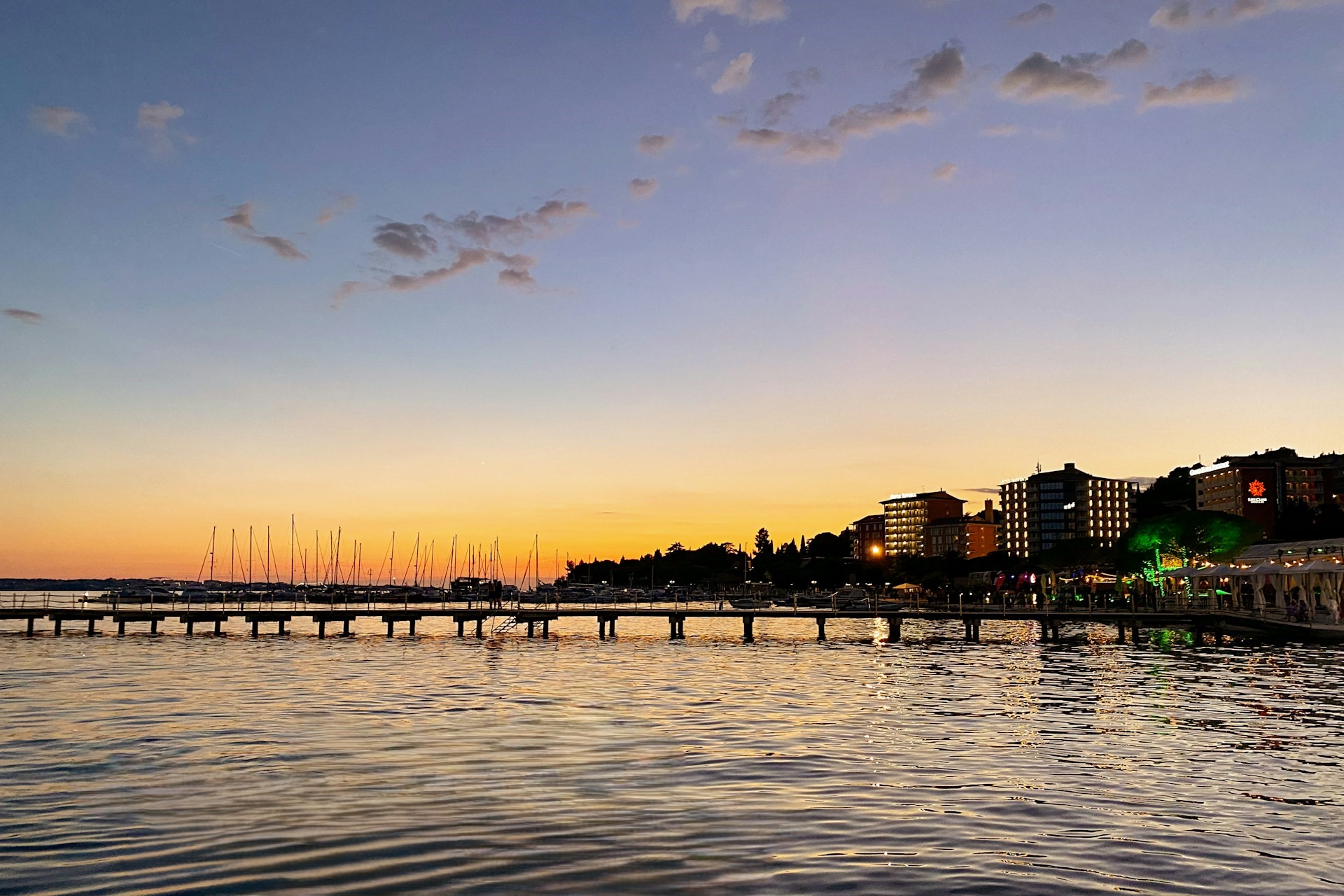
City view of Portoroz, Slovenia

Portoroz

Portoroz reads like a syllabus for leisure learned over a century. Grand hotels from the early 1900s line the bay with palms and verandas, while modern pools extend the spa habit into every season. Salt pans nearby once supplied pharmacies with mineral mud; today, wellness menus turn that history into timed treatments. Walk the seafront to Piran or hire a boat and learn the wind's grammar by practice. Order black risotto, grilled prawns, or a plate of fuzi with truffles from the hills, and pour Malvazija that feels born for sunset. Records from the Austro Hungarian era show trains full of holidaymakers; postcards still capture the same curve of shore. Unexpected note: a local regatta once required formal hats at the prize giving, and the trend briefly returned. Night falls with live music on terraces and a slow parade of gelato, sandals, and small dogs convinced they own the promenade.

Top attractions & things to do in Portoroz

If you’re searching for the best things to do in Portoroz, this guide brings together the top attractions and must-see places to visit in Portoroz. The top picks below highlight the most visited sights for first-time visitors, plus a few local favorites worth adding.

Auditorium Portoroz in Portoroz, Slovenia

Auditorium Portoroz

Auditorium Portoroz gives the town a cultural engine shaped for conferences, concerts, and film festivals that stretch well past summer. The complex, opened in the 1970s, combines an indoor hall with an outdoor amphitheater seating over 1,000 and a foyer that reads like a civic porch. Acoustics are tuned with panels and drapes; stage grids make fast work of visiting productions. During the 1980s and later, programming broadened to include jazz, theater, and local premieres. A modernization in the 2000s improved lighting and crowd flow, while retaining the friendly scale. The indoor hall seats roughly 500 and hosts chamber concerts and talks when weather turns. The campus plan manages movement with terraces and stairs that keep sea breezes moving, and a planted court offers shade at intermission. In shoulder seasons, trade fairs and workshops replace beach events, giving Portoroz a year-round rhythm. Stand on the upper balcony at sunset and the amphitheater's curve echoes the bay, a reminder that culture here always faces outward.
Ads place
Ads place
Ads place
Ads place
Ads place
Bernardin Monastery Complex in Portoroz, Slovenia

Bernardin Monastery Complex

Between Piran and Portoroz, the Bernardin complex layers monastery history with seaside leisure. The original Franciscan house is generally dated to the 15th century, and remnants of cloisters flank a church whose walls endured storms and adaptations into the 19th century. After wartime damage and postwar improvisations, planners in the 20th century recast the headland as a hospitality cluster, keeping fragments of stonework as anchors to the past. Archaeological probes in the 1990s recovered tiles and coins, and a restrained Romanesque echo survives in a bell gable that reads sacred even beside pools. The seaside promenade threads through, offering views back to Piran's ridge and forward to hotel piers. A modest plaque notes repairs recorded in the 1680s, a reminder that maintenance kept the complex standing long before tourism. At dusk, lamps pool light in the arcades and the church profile turns to a clean graphic, while the water throws a second set of arches below. The site's grace lies in restraint: enough history to bear witness, enough adaptation to keep the shoreline public for the next generation.
Ads place
Ads place
Ads place
Ads place
Ads place
Marina Portoroz in Portoroz, Slovenia

Marina Portoroz

Marina Portoroz gathers masts like a carefully combed field, a basin carved for pleasure craft when the resort began its modern expansion in the 1970s. Berths number around 1,000, with travel lifts, chandlers, and winter cradles turning maintenance into a slow routine. Breakwaters handle bora gusts and waves reported above 2 meters, keeping docks quiet enough for evening rigging talk. Channel depth is maintained near 4 meters, and shore power and water are standard at most slips. A customs pier and fuel berth simplify departures, and sailing schools share slips with cruising families. Night lighting was updated in the 21st century to reduce glare; at dawn, gulls ride the pressure waves off bows. From the quay you can watch technicians balance propellers and divers check anodes, small rituals that explain why departures happen on time. Walk the outer arm for a long view of the bay, then return past cafes comparing forecasts and headings. On race days, horns and flags animate the basin and the marina turns briefly into a floating stadium.
Ads place
Ads place
Ads place
Ads place
Ads place
Portoroz Promenade in Portoroz, Slovenia

Portoroz Promenade

Portoroz Promenade stacks palms, cafes, and hotel facades along a calm arc of shoreline where the Adriatic begins to feel domestic. The resort identity took shape in the 19th century with spa treatments and sea baths, then expanded after the 1950s as modern hotels arrived. Today a broad walkway links gardens, terraces, and beach clubs, while a cycling lane runs the length for easy laps at sunset. Sand and gravel are replenished each spring, and lifeguards patrol the marked zone through the summer season. The main stretch measures roughly 1 kilometer, with piers that pull sunbathers a few meters over water for an instant breeze. Music drifts from verandas; in quieter months the soundtrack shifts to cutlery and gulls. Look for tile patterns from mid-century renovations and discreet lights added in the 21st century. The promenade works because it is generous rather than grand: a horizontal living room for families, conferences, and evening strollers that always ends, helpfully, at gelato or coffee.
Ads place
Ads place
Ads place
Ads place
Ads place
Secovlje Salina Nature Park in Portoroz, Slovenia

Secovlje Salina Nature Park

East of town sprawls Secovlje Salina Nature Park, a centuries-old salt landscape where dikes, pans, and wooden rakes compose a grid against the sky. Archival mentions run deep into the 14th century, and a field museum interprets the older petola method, a living carpet that protects brine and shapes crystals. Production shifted and shrank in the 20th century, but harvesting still follows the slow calendar of wind and sun. The park covers several hundred hectares, with footpaths and bird towers that tally herons, avocets, and terns. A narrow gauge line, recorded in the 1930s, once hauled sacks to the storehouses; today, interpretive boards map the channels and sluices with crisp diagrams. Designation as a protected landscape in the 1990s secured careful management that balances wildlife with work. Visit late afternoon to watch pans turn pink, a cue for photographers and for workers who gauge salinity by eye and float. The salt here is not a souvenir so much as a memory of labor performed at the edge of sea and land, repeated under rules that read like weather poetry.
Ads place
Ads place
Ads place
Ads place
Ads place