
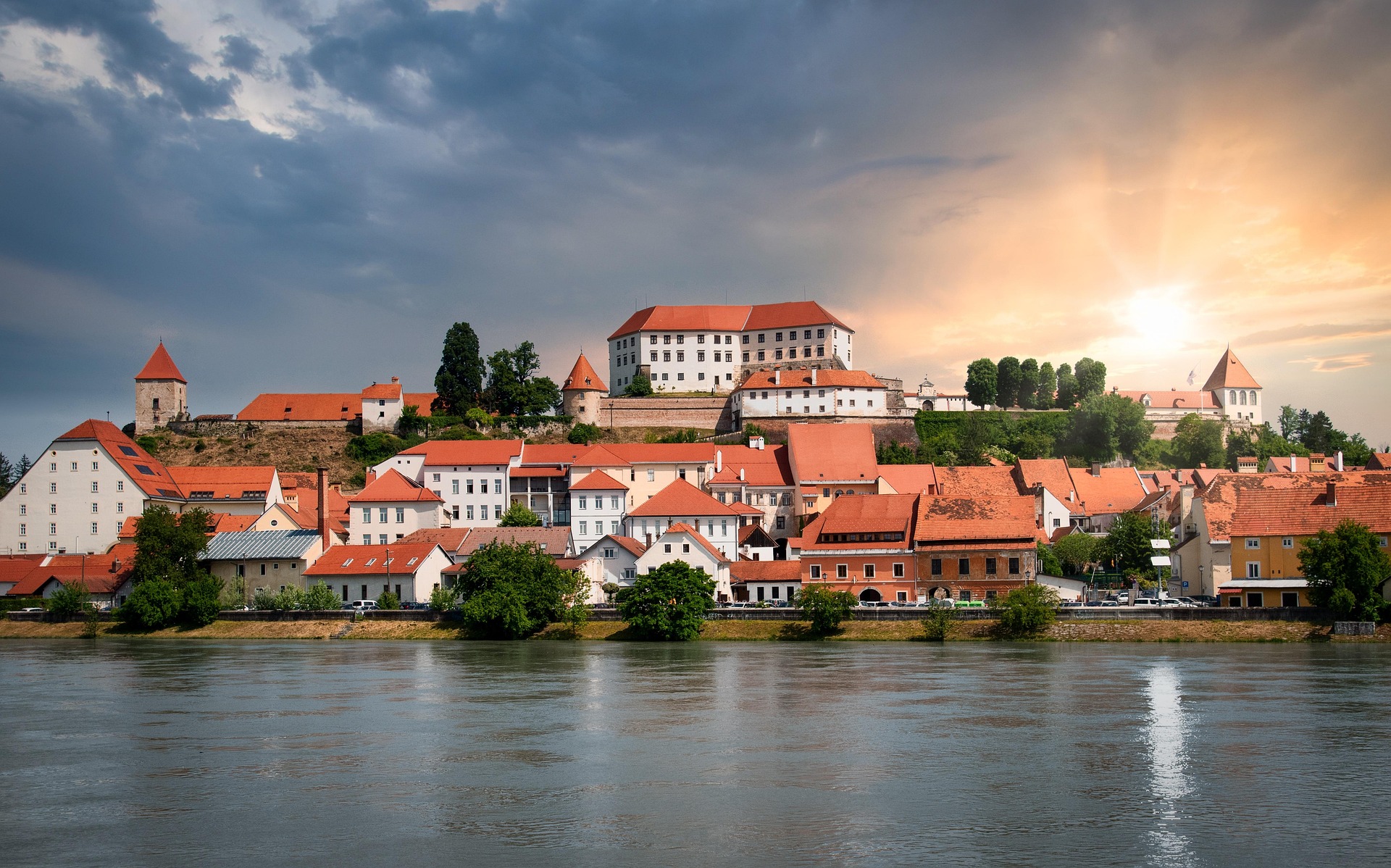
City view of Ptuj, Slovenia

Ptuj

Ptuj looks upstream with seniority; Romans called the settlement Poetovio and left records as tidy as the grid. A castle on the rise now hosts instruments and carnival masks that explain the Kurent, a fur clad reveler who chases winter away. Cellars under town hide mature wines and a few stories best told after the second glass. Try koline platters in cold months or gibanica layered like a good argument; both match well with Haloze hillsides in a bottle. Charters from the 12th century define markets and tolls; later, craft guilds learned to schedule by bell and sundial. Lesser known detail: an annual rowing race once required crews to wear historical costumes, a rule that made splashes look theatrical. Walk the Drava embankment to watch swans navigate current like pros, then follow narrow streets back to the main square for quiet coffee.

Top attractions & things to do in Ptuj

If you’re searching for the best things to do in Ptuj, this guide brings together the top attractions and must-see places to visit in Ptuj. The top picks below highlight the most visited sights for first-time visitors, plus a few local favorites worth adding.

Dominican Monastery in Ptuj, Slovenia

Dominican Monastery

Just off the old trade route, the Dominican Monastery folds cloister, church, and refectory into a complex that maps faith onto centuries of town life. Founding documents trace the arrival of friars to the 13th century, and later rebuilds after fires added sober Baroque lines to earlier stone. In the long nave, fragments of wall painting survive like sentence beginnings; excavations have also turned up pottery from the 14th century, archived with careful tags. During secularization in the 18th century, parts of the complex shifted to administrative uses, a pragmatic fate that spared demolition but left patched doorways and altered floors. Today, exhibitions and concerts use the acoustics to gentle effect, while the cloister's arcade counts twenty-four bays around a small garden that catches afternoon sun. A walk along the exterior shows how buttresses stepped out over time, each addition a footnote to worries about soil, roof load, and the slow force of wind along the Drava. If doors are open, the scent of old timber lingers, a quiet record of heated winters.
Ads place
Ads place
Ads place
Ads place
Ads place
Drava Riverside Walk and Footbridge in Ptuj, Slovenia

Drava Riverside Walk and Footbridge

Following the Drava downstream from the old bridge, a riverside path threads reeds, fish ladders, and mooring rings that recall busier cargo years. Interpretive boards outline flood levels from 1964 and 2012, showing how embankments and sluices disciplined the current without silencing it. Across the span, a modern footbridge brings cyclists and strollers over to allotment gardens, where plum trees and sheds mark a local calendar. Engineers note a steel arch of roughly 90 meters with a deck designed for wind and the occasional driftwood strike; anglers lean on railings as if deputized to monitor flow. In summer, rowing shells trace thin wakes; in winter, black-headed gulls turn and shear like paper cutouts over the gray water. Walk at twilight to catch shop lights climbing the castle hill, and let the river's low register score an amble that takes about forty-five minutes round trip when you are not in a hurry. The newest lighting, installed in the 21st century, casts an even, warm wash that makes the riverbanks feel shared rather than staged.
Ads place
Ads place
Ads place
Ads place
Ads place
Orpheus Monument in Ptuj, Slovenia

Orpheus Monument

In front of the Town Tower stands the Orpheus Monument, a Roman necropolis stone repurposed for public life and municipal justice over many centuries. Carved in white limestone, the relief once marked a magistrate's grave, and by the 16th century it served as a pillory, its base scarred by shackles and weather. Scholars date the original to the 2nd century, when the colony of Poetovio thrived on the Amber Road, and inscriptions record an official named Marcus Valerius. Damage includes deliberate defacement in turbulent 1848, when symbols of old authority met new politics, alongside slow erosion from freeze-thaw cycles. Today it stands as a layered object: funerary marker, civic noticeboard, and now open-air museum label, framed by the square's cobbles and the Town Tower's clock of five bells. Walk a slow circle and the figures seem to move with you; the story survives not by completeness but by persistence in a place that refused to forget. Local guides note a copy in the museum, but the square's weathered original carries the stronger voice.
Ads place
Ads place
Ads place
Ads place
Ads place
Ptuj Castle in Ptuj, Slovenia

Ptuj Castle

Set on a low hill above red roofs, Ptuj Castle oversees the river bend with the calm of a veteran officer, its courtyards stepping gently toward the town. Charters mention the site by 12th century, and later lords rebuilt after conflicts in the 16th century, leaving layered wings that mix Renaissance detail with pragmatic Baroque. Inside, the Regional Museum arranges rooms of weapons, portraits, and festival masks; the Kurent costume—fur, bells, and a wooden club—appears with notes on winter rites and field fertility. A small music display presents a 17th-century lute and a square piano from around 1800, reminders that salons once echoed above storerooms. From the terrace, count the church towers and the straight line of the Roman road beneath the modern street; on hazy days the Drava reads as tin. Arrive near closing to avoid school groups, and you may hear only your steps on the stair, a rhythm that makes the armour seem briefly inhabited. The well head in the courtyard shows rope wear, a small index of daily medieval logistics.
Ads place
Ads place
Ads place
Ads place
Ads place
Ptuj City Tower in Ptuj, Slovenia

Ptuj City Tower

The City Tower anchors Ptuj's main square with a layered belfry that functions as both landmark and metronome, measuring market days and processions. Chronicles mention predecessors damaged by quakes, while the current form took shape in the 18th century, adding an elegant onion dome in the regional Baroque taste. The clock face, reset after storms, keeps step with the Town Hall, and the bell frame—records cite four principal bells—has rung for fires, floods, and Kurentovanje gatherings. Look closely at the plaster; repairs from 1898 sit beside newer fills, a visible palimpsest of upkeep that makes the tower a textbook of maintenance. Standing under the eaves, you hear pigeons and the soft rattle of loose glass in wind, while the square's paving, relaid in the 20th century, guides runoff into subtle channels. When fog comes off the river, the tower recedes to a silhouette, and the clock's minute hand seems to move not forward but through the weather itself. At dusk, its dial glows faintly, a calm instruction to head slowly homeward.
Ads place
Ads place
Ads place
Ads place
Ads place