
City view of Rovaniemi, Finland

Rovaniemi

Rovaniemi is the gateway to Lapland, rebuilt after heavy destruction in 1944 and later planned with a street layout often compared to reindeer antlers. The Arktikum museum tells Arctic stories, while riverside paths along the Kemijoki invite slow walks under wide skies. In winter, visitors chase northern lights and sip hot berry juice, while locals keep to sauna routines and hearty salmon soup. Santa Claus Village adds a playful stop, yet the town also offers serious nature: short drives lead to forests where snow muffles every sound. Try reindeer stew with mashed potatoes, then warm up with coffee and a pulla bun. A lesser known attraction is the old lumberjack heritage site on the riverbanks, recalling the era when logs floated downstream. Surprising fact: the local library is famous for lending out outdoor gear in some seasons, a practical idea that turns reading habits into hiking habits.

Top attractions & things to do in Rovaniemi

If you’re searching for the best things to do in Rovaniemi, this guide brings together the top attractions and must-see places to visit in Rovaniemi. The top picks below highlight the most visited sights for first-time visitors, plus a few local favorites worth adding.

Arktikum Science Centre and Museum in Rovaniemi, Finland

Arktikum Science Centre and Museum

Arktikum feels like a modern Arctic expedition that starts in the city and ends under glass, with the river and forest framing the approach. Opened on 6 December 1992, the building was designed by the Danish team Birch-Bonderup & Thorup-Waade and is recognized by its 172 metres long glass tube that points north. Look up and you will notice the engineering charm: the tube uses about 1,000 special glass panes, making daylight part of the visit even in deep winter. Most exhibition spaces are underground, which keeps the atmosphere steady when Lapland weather flips fast. An extension opened in September 1997, so the building reads like a layered project rather than a one-off icon. Inside you can move from Arctic science to regional history without feeling you are switching venues, and the long corridor turns walking into a slow, cinematic reveal. Come at dusk when the glass reflects snow and streetlights, and the place feels half museum, half lantern.
Ads place
Ads place
Ads place
Ads place
Ads place
Korundi House of Culture in Rovaniemi, Finland

Korundi House of Culture

Korundi is where Rovaniemi's tougher history turns into culture you can actually spend an evening with. The red-brick landmark began as a mail truck depot completed in 1933, one of the few buildings to survive the Second World War. A major transformation in 2009-2010 was designed by architect Juhani Pallasmaa, keeping the industrial shell but adding a modern interior rhythm. Korundi opened on 25 May 2011 and now houses the Rovaniemi Art Museum and the Lapland Chamber Orchestra, so you can pair exhibitions with concerts in a single stop. The total floor area is about 5,300 m2, large enough for breathing room yet compact enough to feel friendly. Details matter here: salvaged brick, generous corridors, and acoustics designed for clarity rather than sheer volume. Arrive before a performance and wander the galleries first; the shift from visual art to live sound makes the building feel like it is still delivering messages, just in a new language.
Ads place
Ads place
Ads place
Ads place
Ads place
Ounasvaara Hill and Ski Resort in Rovaniemi, Finland

Ounasvaara Hill and Ski Resort

Ounasvaara is the city's everyday escape hatch, a forested hill that turns Rovaniemi into a place you can hike, ski, or simply breathe within minutes. The ridge rises to over 200 metres above sea level, and the biggest altitude drop is about 140 m on the FIS competition slope, which explains why locals treat it as a serious training ground. Downhill runs are typically 500-600 metres long, while cross-country skiers get roughly 100 km of tracked routes that connect into a wider city network. The first snow trail often opens at the end of October, when autumn colors are still hanging on in the birches. Since 1984, summer activities like scenic lifts and a sled run have kept the hill busy even when the snow disappears. Go for a sunrise walk if you can: the viewpoints make the river and town feel small, and the silence has a clean, northern quality that stays with you long after you head back down.
Ads place
Ads place
Ads place
Ads place
Ads place
Rovaniemi Church in Rovaniemi, Finland

Rovaniemi Church

Rovaniemi Church is a postwar landmark that carries the city's memory in stone and light. The present building was completed in 1950 after the previous church was destroyed during the razing of the town in 1944, and architect Bertel Liljeqvist kept the exterior calm and functional. Inside, the real drama is the altar wall: a 14 meters high fresco called The Source of Life, painted in 1951 by Professor Lennart Segerstrale. The tower rises to 54 meters, and the scale becomes even more impressive when music starts, because the organ installed later holds about 4,000 pipes. These are not just trivia points; they shape the experience, from the long sightline to the way sound fills the nave. Visit late afternoon when daylight fades and the fresco still glows, then step outside and notice how quiet the city center can feel under snow. If you catch a rehearsal, even a single chord feels like a northern hymn.
Ads place
Ads place
Ads place
Ads place
Ads place
Santa Claus Village in Rovaniemi, Finland

Santa Claus Village

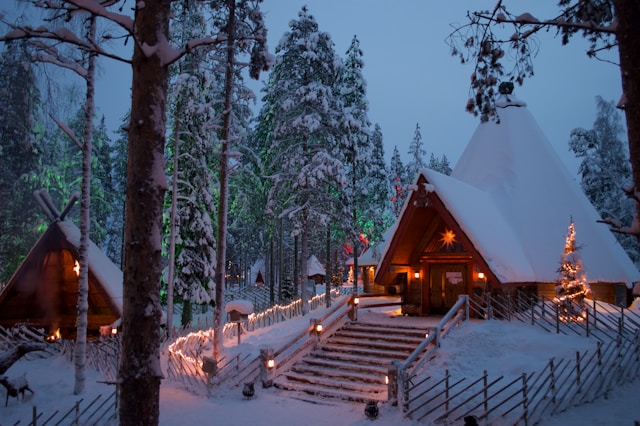
Rovaniemi's most famous line is not a street but a latitude, and Santa Claus Village lets you step over it with a grin. Santa established an office here in 1985, and today the Arctic Circle runs straight through the site, clearly marked so you can cross it in ordinary shoes. The village sits about 8 kilometres north of the city centre, yet it feels like a small world of its own: reindeer encounters, snow activities, and the warm bustle of the Santa Claus Main Post Office. Many visitors pick up a crossing certificate as a souvenir, a simple ritual that becomes oddly satisfying in the cold air. Tourism here is huge, often reported at 600,000 visitors a year, so go early in the morning for quieter photos and softer light. Even outside peak season, the place is open every day of the year, and that everydayness is part of the charm: Lapland does not feel staged so much as patiently ready.
Ads place
Ads place
Ads place
Ads place
Ads place