
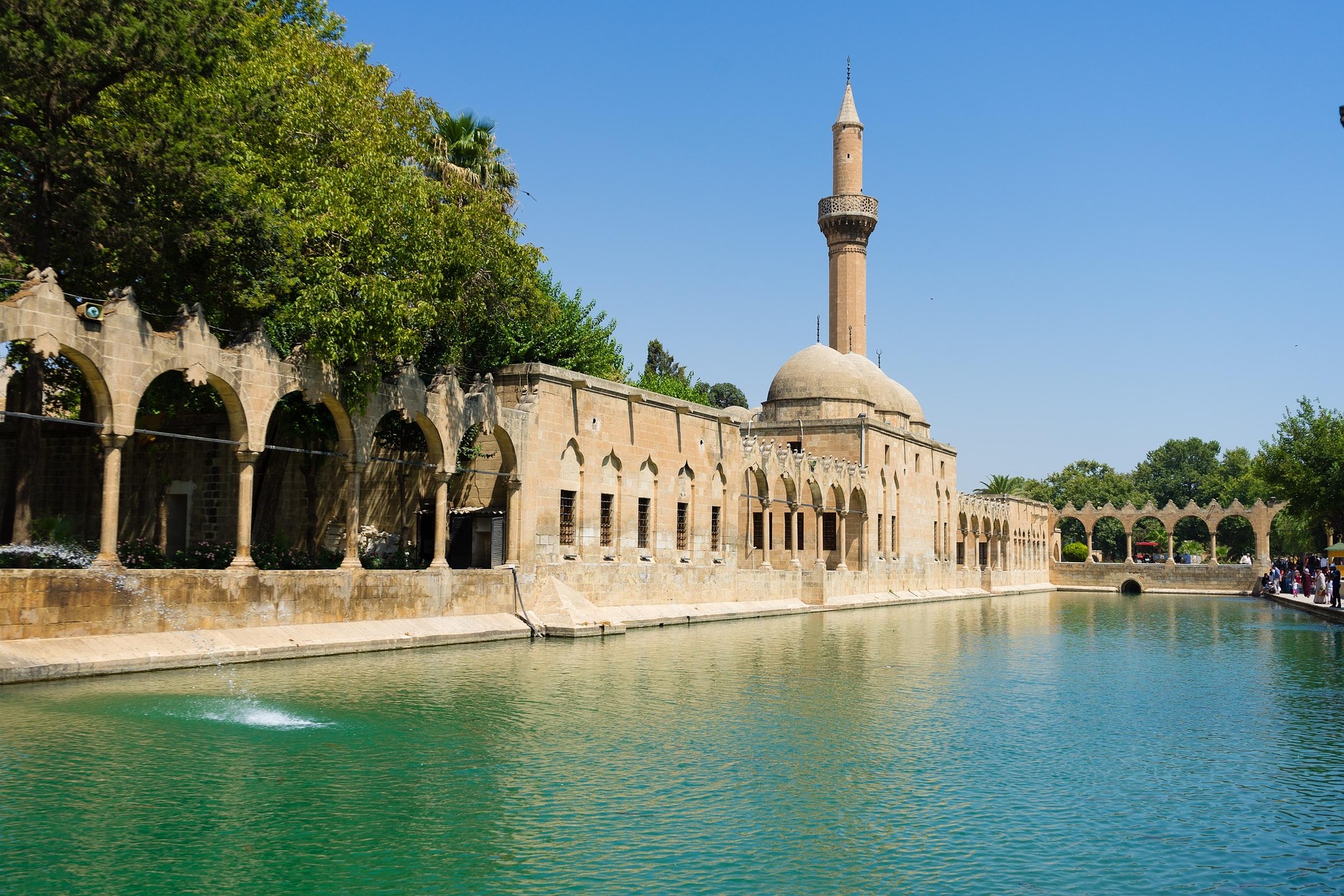
City view of Sanliurfa, Turkey

Sanliurfa

Sanliurfa, often called the “City of Prophets,” rests within sweeping Mesopotamian plains northwest of the Syrian border. According to legend, Abraham’s birthplace lies beneath the reflective pools of Balikligöl, where sacred carp swim in crystalline waters tiled by towering columns. The city’s pointed limestone houses cluster around the 13th-century Ulu Cami, whose endless arched arcade and tranquil courtyard invite contemplation. Nearby, the Harran ruins—famous for beehive mud-brick houses and ancient university foundations—offer an evocative glimpse into early Islamic scholarship. In the covered bazaar, stalls overflow with pistachios, sumac, dried apricots and local flatbreads baked in communal stone ovens. As sunset deepens, the sky over Sanliurfa is pierced by the call to prayer echoing from minarets lit in gold, while Sufi song circles gather in courtyard tea houses to perform mystical verses. Each spring, the International Sanliurfa Festival features folk dancing, camel wrestling and culinary feasts celebrating rural traditions. Between sacred sites, vibrant markets and cultural pageantry, Sanliurfa weaves a tapestry of faith, history and living heritage that resonates across centuries.

Top attractions & things to do in Sanliurfa

If you’re searching for the best things to do in Sanliurfa, this guide brings together the top attractions and must-see places to visit in Sanliurfa. The top picks below highlight the most visited sights for first-time visitors, plus a few local favorites worth adding.

Balikligol (Pool of Sacred Fish) in Sanliurfa, Turkey

Balikligol (Pool of Sacred Fish)

Balikligol, also known as the Pool of Sacred Fish, is one of the most iconic sites in Sanliurfa, steeped in Abrahamic legend. According to tradition, it marks the spot where the Prophet Ibrahim was cast into fire by King Nimrod, only for the flames to turn into water and the burning logs into sacred carp fish. These fish, now considered holy, swim freely in the tranquil waters and are never harmed by locals or visitors. Surrounding the pool is the Halil-ur-Rahman Mosque, built in the 18th century with elegant minarets and domes. The area also features landscaped gardens, colonnaded walkways, shaded courtyards, and tea houses that foster a peaceful atmosphere. A nearby cave, believed to be Ibrahim’s birthplace, adds another layer of sacredness to the site. An interesting fact often overlooked is that the fishpond was once part of a larger irrigation network dating back to Hellenistic times. Historical documents suggest that local rulers preserved the pond through centuries of political upheaval. Balikligol remains a symbol of Sanliurfa’s unique fusion of faith, legend, and urban heritage.
Ads place
Ads place
Ads place
Ads place
Ads place
Gobekli Tepe in Sanliurfa, Turkey

Gobekli Tepe

Gobekli Tepe, located just outside Sanliurfa, is one of the most important archaeological discoveries of the 21st century. Dating back to around 9600 BC, it predates Stonehenge by several millennia and has redefined theories about the origins of civilization. The site consists of massive limestone pillars arranged in circular formations, many adorned with intricate carvings of animals and abstract symbols. These were likely used for ritual purposes, challenging the belief that organized religion followed the development of agriculture. Excavations led by Klaus Schmidt have unearthed tools and remains suggesting a complex hunter-gatherer society capable of large-scale construction. The site’s elevated position offers panoramic views of the Harran Plain and makes it an ideal ceremonial location. A newly built on-site museum and protective roof structure help visitors understand its layout and significance. Lesser known is the presence of buried enclosures yet to be excavated, which may yield even more transformative insights into human prehistory. Some archaeologists believe Gobekli Tepe may represent the earliest known attempt at monumentality in human history.
Ads place
Ads place
Ads place
Ads place
Ads place
Harran Beehive Houses in Sanliurfa, Turkey

Harran Beehive Houses

The Beehive Houses of Harran, located about 40 km southeast of Sanliurfa, are a unique example of ancient vernacular architecture adapted to arid climates. These mudbrick domes, with no windows and a chimney-like top, maintain cool interiors in scorching heat. Their design has remained largely unchanged since pre-Islamic times, reflecting architectural continuity over centuries. The settlement of Harran itself has deep historical roots, once home to the University of Harran, a major center for science and philosophy in the Islamic Golden Age. Nearby ruins include city walls, a 12th-century fortress, and remnants of a Great Mosque commissioned by the Umayyads. The beehive houses today function as cultural centers where visitors can experience traditional furnishings, weaving, and cuisine. Lesser known is that these houses are often built without timber, relying entirely on mud and straw for durability. Scholars have traced similar architectural styles to ancient Mesopotamian models, showing the longevity of the technique. Harran’s beehive houses embody sustainable living and intellectual legacy.
Ads place
Ads place
Ads place
Ads place
Ads place
Sanliurfa Archaeology Museum in Sanliurfa, Turkey

Sanliurfa Archaeology Museum

The Sanliurfa Archaeology Museum houses one of Turkey’s richest collections, featuring artifacts spanning from the Neolithic to the Islamic period. Its centerpiece is the Urfa Man, a 1.80-meter-tall limestone statue considered the oldest known human sculpture, dating back to 9000 BC. The museum offers detailed exhibits on Gobekli Tepe, including pillar fragments, flint tools, symbolic figurines, and ritual objects. Galleries are arranged thematically, guiding visitors through Mesopotamian trade, Hittite influence, and early Islamic art. Touch-screen panels, augmented reality features, and 3D models provide an immersive educational experience. A rarely noted aspect of the museum is its extensive archive of untranslated tablets found in the Harran region, hinting at undiscovered linguistic links. The building’s architectural design, inspired by Mesopotamian motifs, adds to the thematic unity. The museum frequently hosts lectures and temporary exhibitions, fostering ongoing dialogue between local historians and international researchers. With over 5,000 artifacts, this museum is not just a display space but a dynamic center for historical research and cultural dialogue.
Ads place
Ads place
Ads place
Ads place
Ads place
Urfa Castle in Sanliurfa, Turkey

Urfa Castle

Perched on a hill overlooking the city, Urfa Castle is a monumental landmark with roots tracing back to the Hellenistic and Roman eras. Its most visible features today are two tall Corinthian columns dating from the 3rd century AD, believed to have once supported a victory statue. The current fortifications were largely rebuilt by the Abbasids in the 9th century, and later expanded by Zengid and Ottoman rulers. The castle’s elevated position offers sweeping views of Balikligol, the old city, and surrounding plains. Within its walls are remnants of cisterns, tunnels, and stone pavements that reveal its long strategic importance. Restoration work in recent years has aimed to stabilize the structure while uncovering earlier construction layers. A lesser-known feature is the "Watchers’ Platform," from where ancient guards could signal through a system of fire beacons. Some speculate that beneath the fortress lie undiscovered chambers that once stored emergency provisions and military supplies. Urfa Castle stands as a testament to the region’s layered military and urban history.
Ads place
Ads place
Ads place
Ads place
Ads place