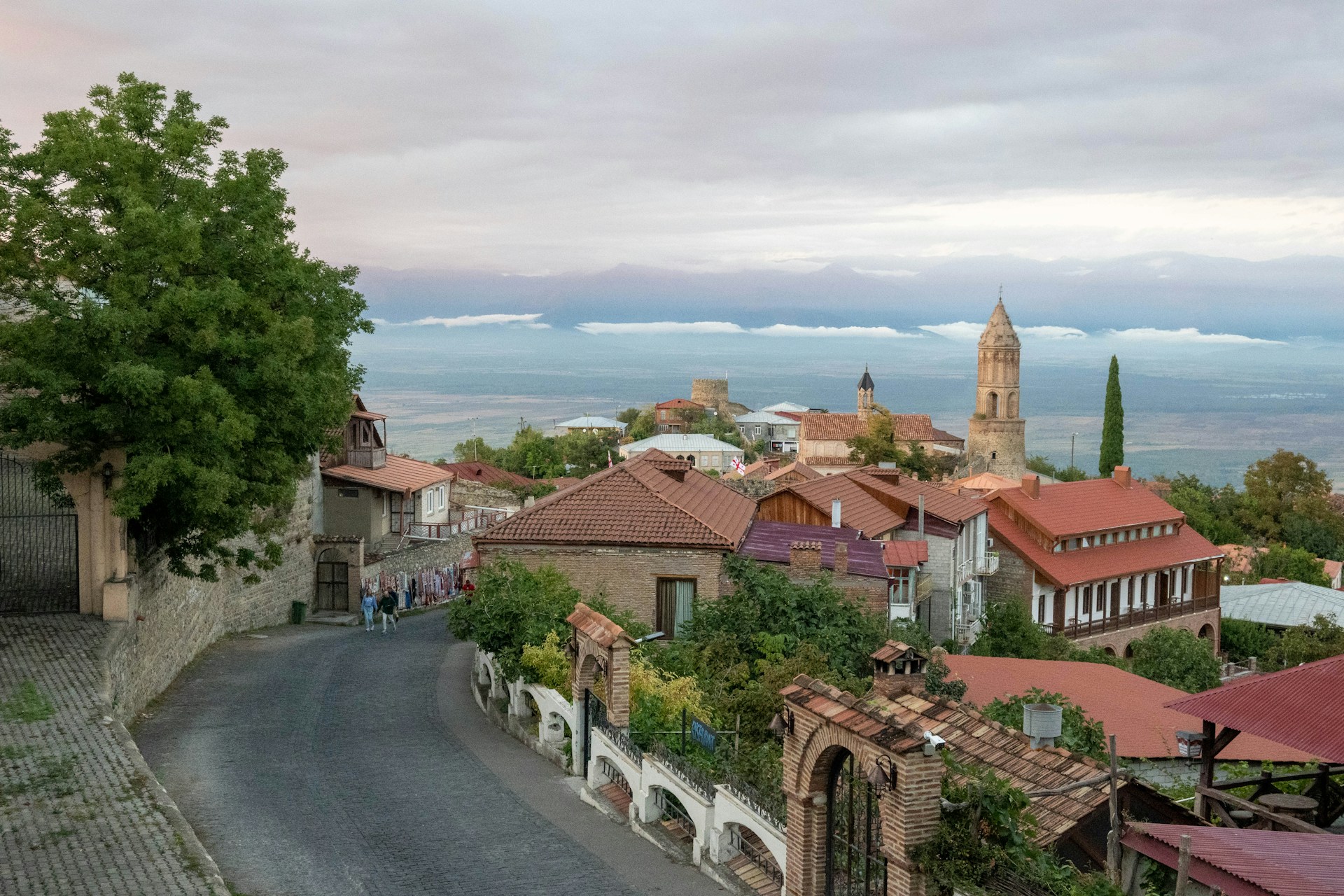

City view of Sighnaghi, Georgia

Sighnaghi

Perched on a hilltop overlooking the vine-striped Alazani Valley, Sighnaghi—dubbed the “City of Love”—charms visitors with its pastel-painted houses, restored 18th-century walls, and lovingly maintained bastions. Strolling along the crenellated ramparts, couples pause to admire panoramic views of rolling vineyards and the distant Caucasus spine. Interior lanes reveal family-run wine cellars, where tastings showcase rich, tannic Saperavi and honeyed Rkatsiteli. Nearby, the tomb of Saint Nino at Bodbe Monastery offers a serene pilgrimage site surrounded by cedar-shaded courtyards. Annual festivals—from grape harvest celebrations to folk dance performances—imbue Sighnaghi with lively local energy. Boutique hotels and artisanal shops occupy restored mansions, blending heritage architecture with modern comforts. As twilight falls, lanterns illuminate the fortifications, and the valley below shimmers in soft gold. Sighnaghi’s romantic ambiance, wine heritage, and commanding vistas make it a must-experience for couples and connoisseurs of culture alike.

Top attractions & things to do in Sighnaghi

If you’re searching for the best things to do in Sighnaghi, this guide brings together the top attractions and must-see places to visit in Sighnaghi. The top picks below highlight the most visited sights for first-time visitors, plus a few local favorites worth adding.

Bodbe Monastery in Sighnaghi, Georgia

Bodbe Monastery

Just 2 km south of Sighnaghi, the Bodbe Monastery has been a pilgrimage site since the 9th century, when Saint Nino—who converted Georgia to Christianity—was buried here. The current basilica, rebuilt in 1834, stands over the saint’s tomb, marked by a marble slab carrying her name in medieval Georgian script. Pilgrims walk three times around the central shrine, touching the marble to receive blessings. In 2012, restoration work uncovered 11th-century fresco fragments depicting early Georgian kings, now displayed behind protective glass. The monastery’s bell tower, added in 1860, houses a donated bell cast in Moscow and inscribed with the names of local benefactors. Cloistered arcades open onto a serene courtyard planted with cypress trees, and a muslin-wrapped spring reputedly channels healing waters from beneath the church floor. Annual commemorations on January 14th draw thousands for liturgies and processions, reinforcing Bodbe’s status as both spiritual heart and historic treasure of Kakheti.
Ads place
Ads place
Ads place
Ads place
Ads place
Nikoladze Wine Cellar in Sighnaghi, Georgia

Nikoladze Wine Cellar

Tucked into a 200-year-old townhouse on the edge of the fortress walls, Nikoladze Wine Cellar has been family-run since 1875. The cellar’s stone vaults maintain constant temperatures ideal for aging qvevri-fermented reds and whites. Proprietor Eka Nikoladze, a descendant of the original founders, continues the traditional Kakhetian practice of foot-treading grapes in clay amphorae sealed with beeswax. Visitors tour the labyrinthine passageways lined with labeled qvevri jars, some dating back to the 19th century, and learn about indigenous varietals such as Kisi and Tavkveri. Tastings are paired with homemade cheeses and spiced honey cakes in a cozy tasting room decorated with family heirlooms. In 2019, the cellar launched a restoration project to preserve antique oak wine presses—visible in a glass-enclosed display. With its blend of personal history and time-honored techniques, Nikoladze Wine Cellar embodies the intimate spirit of Sighnaghi’s wine culture.
Ads place
Ads place
Ads place
Ads place
Ads place
Pheasant’s Tears Winery in Sighnaghi, Georgia

Pheasant’s Tears Winery

Established in 2007, Pheasant’s Tears is a pioneering boutique winery founded by journalist and oenologist John Wurdeman. Nestled just outside Sighnaghi, its cellar sits within a traditional Kakhetian marani (clay wine cellar), where qvevri amphorae rest buried underground as they have been for 8,000 years. The estate cultivates indigenous grape varieties such as Kisi and Khikhvi on 2 hectares of terraced vineyards, practicing biodynamic farming methods introduced in 2010. Tours culminate in a tasting room lined with hand-carved wooden tables and stone floors, where visitors sample amber-hued wines alongside fresh local cheeses and churchkhela. Seasonal harvest festivals invite guests to stomp grapes in open-air pits, experiencing ancient traditions firsthand. Pheasant’s Tears also hosts an annual “Grape Stomping” competition, attracting enthusiasts from across Europe. With its emphasis on authenticity and cultural revival, Pheasant’s Tears has become synonymous with Sighnaghi’s wine renaissance.
Ads place
Ads place
Ads place
Ads place
Ads place
Sighnaghi City Walls in Sighnaghi, Georgia

Sighnaghi City Walls

Encircling the hilltop town like a medieval crown, the Sighnaghi City Walls extend over 4.5 km with 23 restored towers originally built in the 18th century under King Heraclius II to defend against Lezgin incursions. Visitors can traverse a well-preserved 1.2-km section from the eastern gate to the western battlement, pausing at arrow slits for panoramic views of the Alazani Valley’s terraced vineyards and the distant peaks of the Caucasus. Recent conservation work in 2015 uncovered hidden walkways and stone corbels once used to support wooden platforms for sentries. Interpretive plaques detail the defensive strategies of the time and the walls’ role in safeguarding Kakheti’s wine trade. As dusk falls, lanterns line the ramparts, creating an evocative pathway perfect for sunset photography. The Sighnaghi City Walls remain a living monument to Georgia’s military ingenuity and a defining feature of the “City of Love.”
Ads place
Ads place
Ads place
Ads place
Ads place
Sighnaghi Museum of History in Sighnaghi, Georgia

Sighnaghi Museum of History

Housed in a restored 18th-century merchant’s mansion near the main square, the Sighnaghi Museum of History opened in 2002 to celebrate local heritage. Its exhibits include 19th-century domestic utensils, Qvevri wine vessels, and rare maps from the era of the Kakhetian Kingdom. A highlight is a finely embroidered 17th-century royal mantle worn by King Teimuraz I, framed under protective glass. The museum’s upper floor recreates a traditional Sighnaghi household, complete with painted icon corners and a functional qvevri for demonstration. In 2017, digital kiosks were added to trace family lineages and ancient trade routes, linking Sighnaghi to the Silk Road. Seasonal workshops teach Georgian calligraphy and carpet weaving, preserving handcrafted arts. Overlooking the Alazani Valley through tall arched windows, the Sighnaghi Museum of History offers both scholarly insight and a living connection to the region’s storied past.
Ads place
Ads place
Ads place
Ads place
Ads place