
City view of Stepantsminda, Georgia

Stepantsminda

Stepantsminda, more commonly called Kazbegi, occupies a dramatic setting in the shadow of Mount Kazbek, one of the Caucasus’s highest peaks. At its heart, the 14th-century Gergeti Trinity Church perches on a grassy knoll, framed by the mountain’s glacier-clad slopes—a defining image of Georgia’s spiritual and natural grandeur. A steep hike or rugged 4x4 ride leads from town to this iconic landmark, where silence reigns beneath endless skies. Back in town, guesthouses and cafés offer hearty fare—warm lobio (bean stew), freshly baked bread, and tsitsila (cheese pies)—perfect fuel for exploring nearby Juta Valley and Gveleti Waterfall. Adventures range from glacier expeditions to paragliding off the mountain ridges. As daylight fades, the town’s remote location and high altitude produce astonishing starfields. Stepantsminda’s blend of faith, folklore, and alpine adventure makes it an essential pilgrimage for nature lovers and cultural travelers alike.

Top attractions & things to do in Stepantsminda

If you’re searching for the best things to do in Stepantsminda, this guide brings together the top attractions and must-see places to visit in Stepantsminda. The top picks below highlight the most visited sights for first-time visitors, plus a few local favorites worth adding.

Dariali Gorge in Stepantsminda, Georgia

Dariali Gorge

Carved by the Terek River, Dariali Gorge is a narrow 12 km canyon forming the Georgia–Russia border. Its strategic pass has been used since antiquity by the Persian King Darius I—hence the name “Dariali.” The gorge’s rock-cut road was modernized in 1968 but still features original Ottoman-era mile markers along its cliffs. Twenty-seven waterfalls cascade onto the stone highway, the largest being the Gveleti Waterfall (30 m), fed by glacial melt from Mount Shkhara. In 2014, conservationists discovered a medieval guard post half-buried under scree, suggesting the gorge’s role in regional defense. Rock climbers tackle limestone faces rising over 1,000 m above the river, while hydrologists study Dariali’s flash-flood dynamics at narrow choke points. Thermal springs at the gorge’s mouth were once believed to cure rheumatism, with 19th-century British travelogues referencing bathhouses that have since vanished. Accessible by a short drive from Stepantsminda, Dariali Gorge blends natural drama with centuries of Eurasian transit history.
Ads place
Ads place
Ads place
Ads place
Ads place
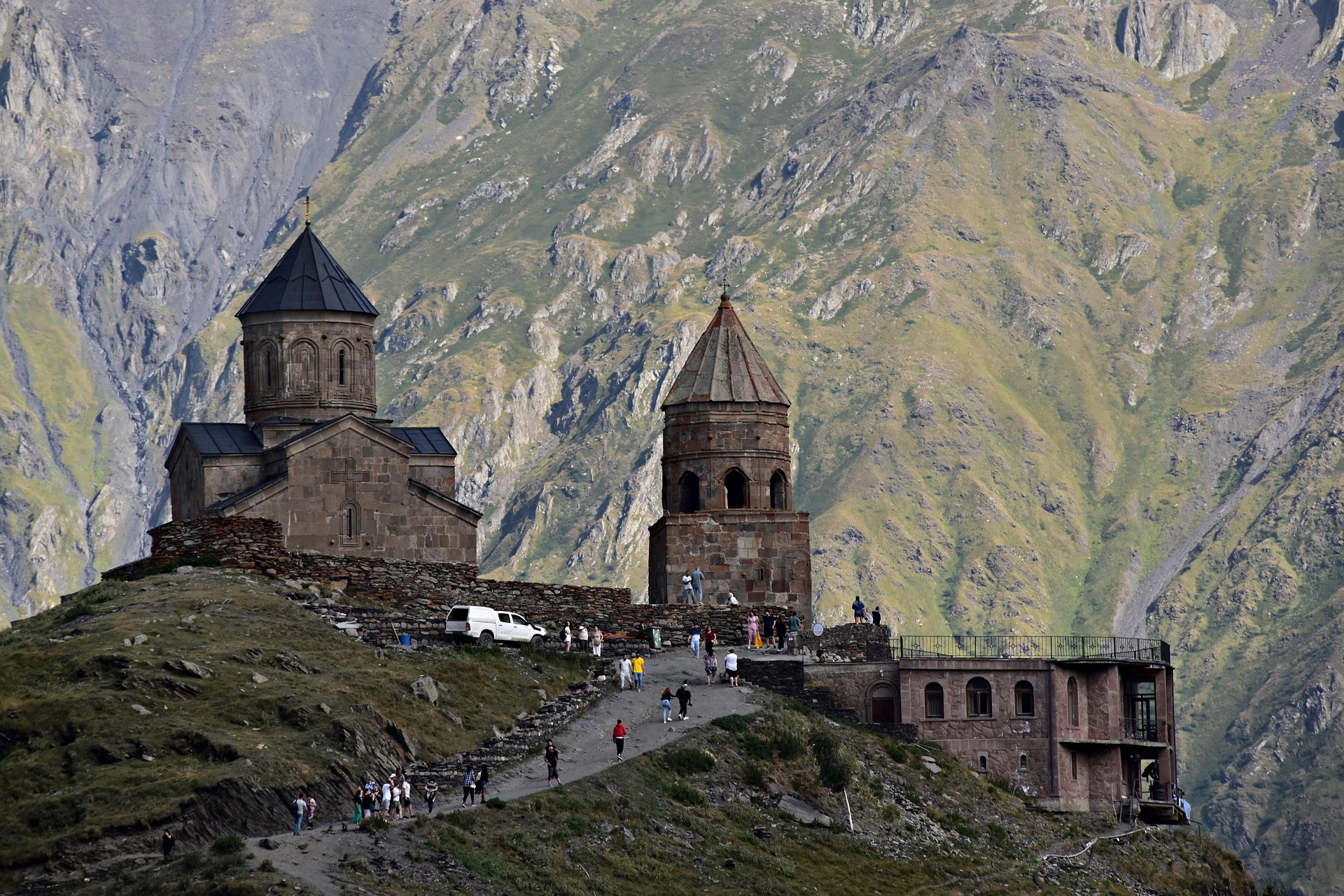
Gergeti Trinity Church in Stepantsminda, Georgia

Gergeti Trinity Church

Perched dramatically at 2,170 m under the peak of Mount Kazbek, Gergeti Trinity Church was constructed in 1348 and remains one of Georgia’s most iconic religious sites. Its cross-dome design features three apses and a central drum, blending Armenian and Georgian architectural motifs. A hidden crypt beneath the nave once housed ancient manuscripts rescued from Mongol invasions in the 13th century. The church’s remote location meant it served as a refuge during Ottoman incursions, evidenced by remains of the walled enclosure uncovered in a 2015 archaeological survey. Visitors approach via a steep 1.5 km trail from the village, passing stone shepherd huts and wildflower meadows. From the terrace, one can see the Terek River gorge carved below and a panorama of snowfields extending into Russia. At dawn, fog often envelops the lower valley, creating a floating-island illusion around the church—a phenomenon captured in meteorological studies for its microclimate effects. Despite its fame, Gergeti remains an active parish, hosting Orthodox services on August 14th for the Feast of the Transfiguration.
Ads place
Ads place
Ads place
Ads place
Ads place
Gveleti Waterfall in Stepantsminda, Georgia

Gveleti Waterfall

Situated on the Gveleti River 14 km north of Stepantsminda, Gveleti Waterfall plunges 30 m over basalt cliffs into a glacial-fed pool. Though visible from the Dariali road, accessing it requires a 45-minute hike through alpine meadows dotted with wild edelweiss. Named after the abandoned village of Gveleti—evacuated after a 1960 landslide—the site retains ruins of osier-woven shepherd huts. In 2017, geologists documented rare tufa formations around the pool’s rim, created by mineral-laden water precipitating calcium carbonate. The waterfall’s mist supports a micro-ecosystem of mosses and ferns rarely found at such high altitude. Local legend claims the pool’s waters grant fertility to childless couples, leading to annual spring pilgrimages. Photographers prize the site for its double-rainbow phenomena on sunny afternoons, a result of high suspended moisture. Though modest compared to larger cascades, Gveleti’s combination of natural beauty, geological significance, and folklore makes it a quintessential Stepantsminda excursion.
Ads place
Ads place
Ads place
Ads place
Ads place
Juta Valley in Stepantsminda, Georgia

Juta Valley

Accessible via a rugged 4×4 track from Stepantsminda, Juta Valley sits at 2,300 m beneath the dramatic spike of Mt. Chaukhi. Though a well-kept secret until the 1990s, it now offers eco-lodges catering to hikers on the famed Khevsureti Trail. In 2010, a conservation initiative reintroduced the endemic Caucasian red deer to the valley’s larch-pine forests. Treks lead to the remote Shkhara Glacier snout and to tranquil Ketrisi Lake, bordered by meadows abundant with wild tulips each May. Archeologists in 2018 uncovered petroglyphs near the valley entrance—cup-and-ring marks dating to the Bronze Age, marking Juta as an ancient pastoral corridor. A hidden hot spring along the eponymous stream provides a secluded bathing spot, framed by rhododendron thickets. With minimal infrastructure beyond solar-powered cabins and goat-cheese producers, Juta Valley embodies sustainable mountain tourism, offering solitude, traditional Svan hospitality, and a front-row seat to the Caucasus’ high-altitude splendour.
Ads place
Ads place
Ads place
Ads place
Ads place
Stepantsminda Ethnographic Museum in Stepantsminda, Georgia

Stepantsminda Ethnographic Museum

Housed in a traditional stone-and-wood Svan tower in central Stepantsminda, the Ethnographic Museum opened in 2005 to preserve local highland culture. Its collection includes bronze-eraSvan textiles woven with symbolic patterns representing mountain deities. A standout exhibit displays the original hand-drawn maps by Vakhushti Bagrationi from 1745, detailing Caucasus topography. Upstairs, life-size dioramas reconstruct a Svan household, complete with a functional qvevri for wine storage. Seasonal workshops teach ancient crafts—carving wooden distaffs or forging shepherd’s axes—led by master artisans whose families have practiced these trades for centuries. The museum’s archive includes oral history recordings from World War II veterans who served in the Caucasus front. Its rooftop terrace offers views of the twin peaks of Ushba and Kazbek, reminding visitors of the symbiotic relationship between Svan lifestyle and the surrounding mountains. A must-visit for cultural enthusiasts, the Stepantsminda Ethnographic Museum bridges past and present in Georgia’s uppermost community.
Ads place
Ads place
Ads place
Ads place
Ads place