
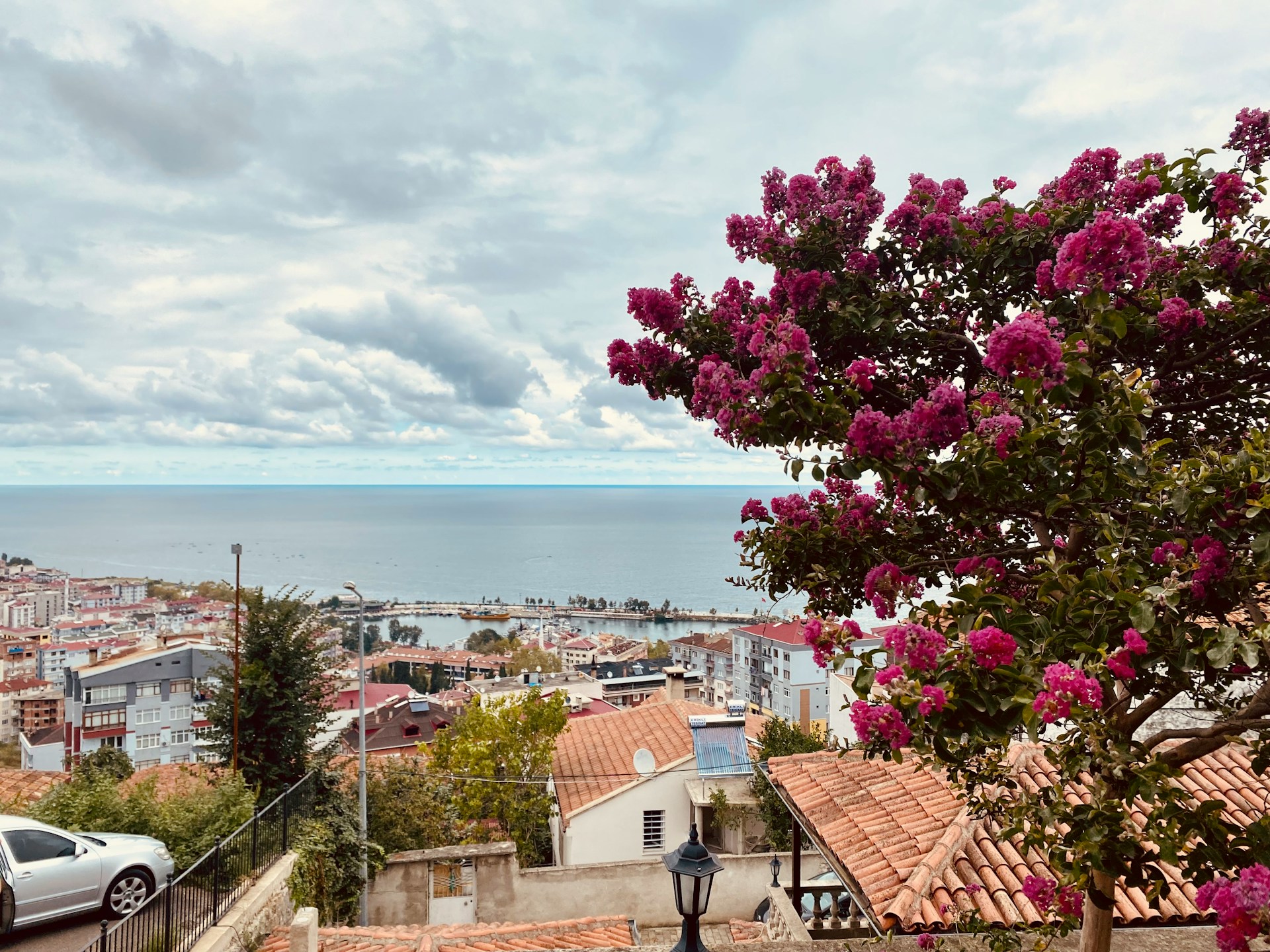
City view of Trabzon, Turkey

Trabzon

Trabzon clings to narrow coastal strips between the Black Sea and the Pontic Mountains, forging a landscape of dramatic slopes carpeted with tea gardens and hazelnut orchards. The city’s Byzantine Hagia Sophia, dating from the 13th century, enchants with surviving frescoes depicting saints and angels, while its central nave echoes with silent reverence. A short drive inland through mist-laden forests leads to the cliffside Sumela Monastery, founded in the 4th century and adorned with frescoes that glow in the filtered daylight. In the bustling Cumhuriyet Square, vendors sell fresh anchovies—hamsi—tossed in cornmeal and fried until crisp, accompanied by steaming cups of Turkish coffee. Local bazaars brim with hand-knitted wool socks and wild mountain herbs prized for their medicinal properties. Each July, the Trabzon International Folklore Festival floods the streets with dancers, musicians and colorful costumes celebrating Black Sea culture. By evening, the sea breeze carries the call to prayer from ancient minarets, mingling with the sound of waves lapping against the harbor breakwater. In Trabzon, untamed nature and centuries of human settlement intertwine to create an indelible Black Sea tapestry.

Top attractions & things to do in Trabzon

If you’re searching for the best things to do in Trabzon, this guide brings together the top attractions and must-see places to visit in Trabzon. The top picks below highlight the most visited sights for first-time visitors, plus a few local favorites worth adding.

Ataturk Pavilion in Trabzon, Turkey

Ataturk Pavilion

The Ataturk Pavilion, originally constructed in 1890 as a Greek merchant's mansion, served as Mustafa Kemal Ataturk's official Black Sea residence during his transformative visits. The structure's design blends Neoclassical and Ottoman Revival styles, with a grand music room featuring perfect acoustics achieved through hollow wall cavities. Ataturk's private study preserves his original writing desk where he drafted educational reforms in 1924. The pavilion's gardens contain century-old magnolia trees planted during his first visit, now standing over 15 meters tall. Rare artifacts include a 1923 hand-drawn map showing Ataturk's vision for modern Turkey's administrative divisions. The building's technological marvels include a German-made hydraulic elevator installed in 1910, one of the first in Anatolia. The tea salon's stained glass windows depict Trabzon's historic landmarks in vibrant detail. Recent restorations uncovered hidden Art Nouveau ceramic tiles beneath later plasterwork, revealing the building's original decorative scheme. The pavilion now serves as a museum showcasing Ataturk's personal effects and documents related to his modernization programs.
Ads place
Ads place
Ads place
Ads place
Ads place
Hagia Sophia of Trabzon in Trabzon, Turkey

Hagia Sophia of Trabzon

The Hagia Sophia of Trabzon, constructed in 1250 under Emperor Manuel I Komnenos, represents a masterpiece of late Byzantine architecture. This former imperial chapel features extraordinary 13th-century frescoes depicting biblical scenes with remarkable color preservation. The building's unique cross-in-square design incorporates Seljuk-inspired geometric patterns in its narthex columns. During its conversion to a mosque in 1584, workers discovered a hidden imperial crypt containing Komnenian-era artifacts. The dome's acoustics demonstrate advanced Byzantine engineering, designed to amplify chants across its 26-meter span. Notable artworks include a rare Deesis mosaic showing Christ flanked by Mary and John the Baptist. Recent restorations revealed fresco underlayers showing earlier iconography beneath the visible paintings. The surrounding garden contains Genoese merchant graves with medieval Latin epitaphs dating to 1347. Archaeologists have identified the remains of a Byzantine scriptorium where manuscripts were copied for imperial use. Today, the site serves as a museum showcasing eight centuries of artistic and religious history in the Black Sea region.
Ads place
Ads place
Ads place
Ads place
Ads place
Sumela Monastery in Trabzon, Turkey

Sumela Monastery

Perched dramatically on a 1,200-meter cliff face, Sumela Monastery was founded in 386 AD and remains one of Christianity's most spectacular rock-cut sanctuaries. The main church houses breathtaking 14th-century fresco cycles depicting the life of Christ and the Virgin Mary, preserved by the site's unique microclimate. Byzantine engineers carved an ingenious hydraulic system into the mountain, including cisterns and aqueducts that still function today. During recent restoration, workers discovered a secret scriptorium containing 11th-century manuscripts and a relic chamber with fragments of the True Cross. The monastery's strategic position along the Silk Road made it a crucial center for theological scholarship. Local tradition claims the site was established after two Athenian monks followed a vision of the Virgin Mary to this remote location. The treacherous ascent via ancient switchback stairs rewards visitors with panoramic views of the Altindere Valley. Conservation efforts have stabilized the fresco pigments using advanced nanotechnology, ensuring their preservation for future generations.
Ads place
Ads place
Ads place
Ads place
Ads place
Trabzon Castle in Trabzon, Turkey

Trabzon Castle

Trabzon Castle's massive walls chronicle over 2,500 years of continuous occupation, from Roman military outpost to Ottoman imperial fortress. The upper citadel preserves a 10th-century Byzantine chapel with rare fresco fragments depicting military saints. Archaeologists have deciphered Genoese merchant graffiti in the sea walls dating to 1340, recording trade deals and ship arrivals. The castle's strategic position controlled the Black Sea trade routes, with its arsenal storing medieval Greek fire projectiles. Recent excavations uncovered a network of escape tunnels leading to the harbor and a secret cistern capable of sustaining 500 defenders during sieges. The panoramic tower offers views of the ancient silk road caravan approach routes that brought goods from Persia and Central Asia. Notable features include the Ottoman-era gunpowder magazine (1461) and a Venetian-designed bastion added during the city's brief occupation by Republic of Genoa forces. The castle's museum displays artifacts from all periods of its history, including a rare Komnenian imperial seal found during 2018 excavations.
Ads place
Ads place
Ads place
Ads place
Ads place
Uzungol Lake in Trabzon, Turkey

Uzungol Lake

Uzungol Lake, nestled in the Pontic Mountains at 1,090 meters altitude, was formed by a catastrophic 1580 landslide documented in Ottoman archives. The lake's unique meromictic layers preserve ancient pollen samples that provide climate records dating back 1,200 years. Traditional Hemsin wooden houses along its shores showcase distinctive Black Sea architecture with their cantilevered balconies and carved eaves. Marine biologists have identified two endemic trout subspecies found nowhere else on Earth. The surrounding primeval temperate rainforest contains 400-year-old sweet chestnut trees and provides habitat for endangered Caucasian lynx populations. A beautifully preserved 16th-century Ottoman stone bridge spans the lake's outlet, bearing inscriptions from Silk Road caravan leaders. Winter transforms the area into a popular skiing destination, while summer reveals alpine meadows with 57 endemic flower species. Conservation efforts focus on protecting the lake's fragile ecosystem from development while allowing sustainable tourism. The area's microclimate produces frequent mists that create ethereal morning light conditions prized by photographers.
Ads place
Ads place
Ads place
Ads place
Ads place