
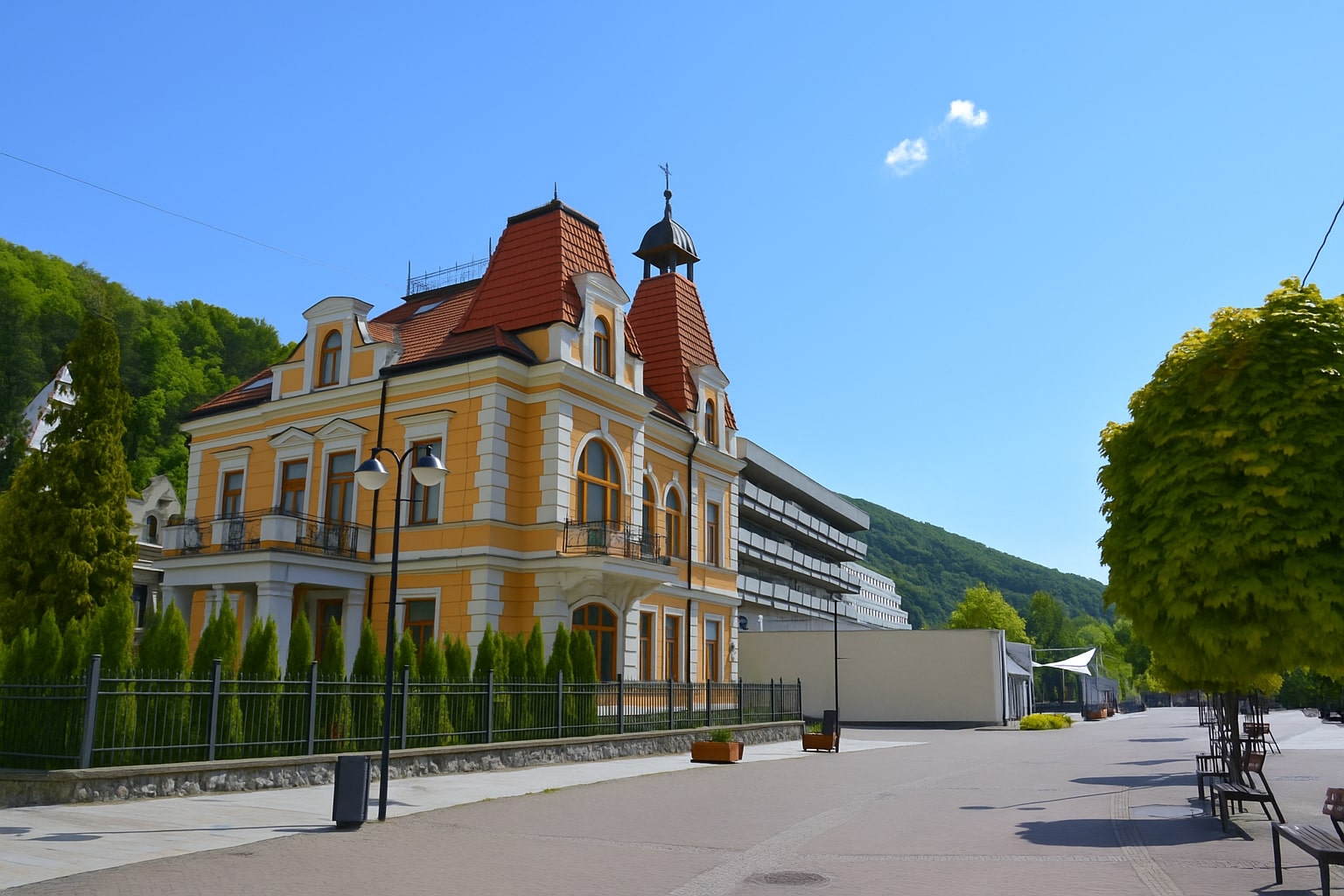
City view of Trencianske Teplice, Slovakia

Trencianske Teplice

Trencianske Teplice learned the art of leisure early and never forgot. Spa architecture lines a valley where promenades are long enough for gossip and short enough for slippers. Thermal pools glow turquoise, and a Moorish style bathhouse adds theatrical flourish to steam that smells faintly of minerals. Film festival banners flutter each summer, bringing directors who argue kindly over ice cream between screenings. Restaurants lean into river fish, dill, and soft dumplings that behave like edible pillows. Pathways head into forested slopes for resets measured in birdsong. A cast iron bridge designed in Vienna provides a photogenic pause before dinner. Quirk worth repeating back home, locals claim the springs relax stubborn houseplants too, and some swear the palms in hotel lobbies perk up after spa season, a story told with a wink and just enough confidence to make you watch the leaves more closely.

Top attractions & things to do in Trencianske Teplice

If you’re searching for the best things to do in Trencianske Teplice, this guide brings together the top attractions and must-see places to visit in Trencianske Teplice. The top picks below highlight the most visited sights for first-time visitors, plus a few local favorites worth adding.

Bridge of Fame in Trencianske Teplice, Slovakia

Bridge of Fame

A modest span near the spa quarter tells a confident story in brass and footsteps. The Bridge of Fame carries plaques that salute actors and filmmakers, a tradition tied for many years to a local festival whose guests left signatures instead of statues. It is a small ritual with good manners: names, dates, and a stroll that turns recognition into a shared walk. The structure itself is practical—reinforced concrete, tidy railings, lights that prefer warmth to glare—and its deck frames the river like a slow camera shot. Panels recall seasons when screenings filled the colonnades and late conversations ran long; curators favor verified film credits over gossip. On quiet mornings, the bridge is simply a pleasant shortcut; by evening, it can feel like a foyer to the whole spa. Stand mid-span and read the plaques out loud, and the town becomes a little more talkative. Cultural memory likes fresh air, and this is a simple, durable way to give it some.
Ads place
Ads place
Ads place
Ads place
Ads place
Klepac Hill Forest Walk in Trencianske Teplice, Slovakia

Klepac Hill Forest Walk

Five minutes from colonnades to trailhead, and shoes trade marble for needles. The walk toward Klepac Hill is a local favorite, a gentle grade that rewards patience rather than gear. Waymarkers outline loops by color and time, while small boards explain habitat care, nesting seasons, and why certain sections rest after storms. In spring the understory rehearses greens; in autumn the ridge learns copper and smoke. Clearings gift measured views back to the spa roofs and the distant Vah corridor, a geography lesson that does not need a classroom. Benches appear where breath naturally pauses, proof that maintenance is the quiet hero of parks. Joggers share the track with families; at intervals, fitness stations add a modest workout without interrupting the calm. On very clear days locals point out peaks by nickname, and the return route carries the comfortable promise of soup. Forest, paths, and town cooperate here with unshowy planning so visitors leave steadier than they arrived.
Ads place
Ads place
Ads place
Ads place
Ads place
Sina Spa House and Hammam in Trencianske Teplice, Slovakia

Sina Spa House and Hammam

Enter by the colonnade and the city quiets; inside, tiled corridors bend toward a jewel of bathing architecture. The Hammam attached to Sina Spa House appeared in the late 19th century, when Central Europe flirted with Moorish Revival forms and spa medicine learned to borrow atmosphere for therapy. A starry ceiling, stucco arabesques, and a compact sequence of warm rooms guide the body from heat to rest with measured grace. Thermal water here typically arrives near 38–40 C, and attendants still follow practical balneotherapy routines that favor timing over slogans. Period brochures mention patrons of rank, while restoration in the 20th century kept the color and the acoustics gentle, so whispers carry better than echoes. Between sessions, a quiet lounge looks toward trees, a reminder that calm is also a technique. Read the small panels about hygiene and flow rates and you will see how beauty and plumbing share the same plan. Come early; the baths reward unhurried arrivals and a willingness to let water do careful work.
Ads place
Ads place
Ads place
Ads place
Ads place
Spa Park and Teplicka Promenade in Trencianske Teplice, Slovakia

Spa Park and Teplicka Promenade

If the baths are the treatment, the park is the timetable. Paths curve under plane trees, benches appear where breath naturally pauses, and the river Teplicka keeps a calm metronome on the edge. Kiosks from the early 20th century survive as gentle punctuation, while a bandstand organizes evenings with small concerts that never overpower conversation. Notice how alleys are set for breeze and shade, a quiet microclimate strategy that keeps summers civil. A drinking pavilion offers mineral water with posted indications; staff remind visitors that dose and rest matter as much as temperature. The planting plan favors seasonal rhythm—bulbs, blossom, deep greens—so return trips feel earned. Plaques sketch the rise of spa culture and its alliance with balneology, proving that public space is also healthcare infrastructure. At dusk, lamps lift slowly and the river edits the day into softer sentences. The promenade rewards walkers who enjoy detail: railings, joints, and vistas placed with the care of a good host. Nothing shouts here, which is exactly the point.
Ads place
Ads place
Ads place
Ads place
Ads place
Zelena Zaba Forest Swimming Pool in Trencianske Teplice, Slovakia

Zelena Zaba Forest Swimming Pool

A footpath slips into pines and suddenly a pool appears, as if a clearing learned geometry. Zelena Zaba is a forest bathing complex opened in 1937, widely linked to architect Bohuslav Fuchs, who translated interwar functionalism into terraces, sun decks, and a water mirror that belongs equally to sport and leisure. After quiet years, a careful renewal in the 2010s returned the gliding lines and added safety and filtration upgrades without bullying the original mood. Families claim steps in the morning; lane swimmers carve shadows at noon; by late day the concrete holds a gentle warmth that invites unplanned conversations. Signage explains gradients, lifeguard zones, and circulation so the place runs on competence, not heroics. The forest sets the soundtrack: wind in needles, laughter on stone. Bring a book and a towel, and take the long way back through trees where light edits itself into stripes. It is architecture that still remembers why clarity, shade, and water make good company.
Ads place
Ads place
Ads place
Ads place
Ads place