
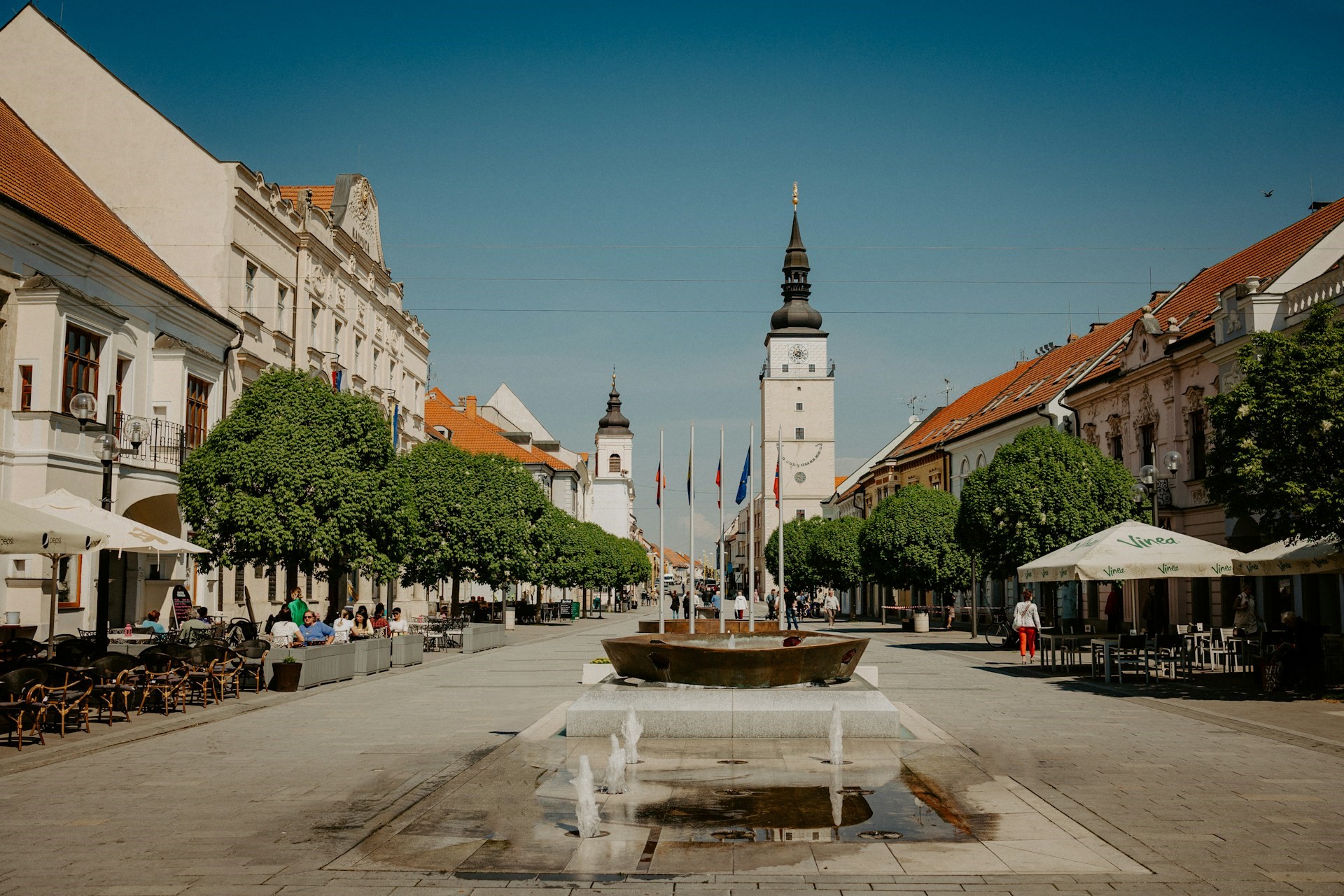
City view of Trnava, Slovakia

Trnava

Trnava has so many towers that even locals use them as a compass for bakery runs. Nicknamed the Slovak Rome for its ecclesiastical density, it hosts churches that span centuries, all within a compact old town stitched by welcoming arcades. Students keep the conversation lively in wine bars that stock small-producer Riesling and Blaufrankisch. The city takes cycling seriously, and a flat network of paths turns errands into fresh air. Food veers comfort side, think goose with red cabbage or potato pancakes crisp enough to echo. Contemporary galleries slip into former workshops, proof that reinvention can be gentle. Day trips launch toward the Little Carpathians for forest loops and picnic views. Surprise detail, a permanent outdoor chessboard in the square attracts grandmasters and toddlers with equal magnetism, and matches sometimes last through sunset, paused only for more pastries from the bakery that always appears when strategy requires sugar.

Top attractions & things to do in Trnava

If you’re searching for the best things to do in Trnava, this guide brings together the top attractions and must-see places to visit in Trnava. The top picks below highlight the most visited sights for first-time visitors, plus a few local favorites worth adding.

Basilica of St Nicholas in Trnava, Slovakia

Basilica of St Nicholas

From the square, the basilica sits slightly aside, content to let its roofline do the talking before you cross the threshold. Inside, a late Gothic skeleton carries later furnishings with unforced grace; ribs settle into clustered piers and the light arrives like good advice. Parish books place major works in the 14th–15th centuries, with chapels refreshed during the Baroque period when donors favored drama with discipline. A venerated image of the Virgin, long associated with local processions, gathers candles and stories; conservators note retouching consistent with the 18th century. Step near the choir and count the bays; the rhythm stays calm even when the organ warms up for rehearsal. Stone portals show mason marks that read as signatures rather than ornament, and a discreet crest recalls an era when families balanced piety with publicity. Outside, the slightly leaning tower—often remarked upon in walking tours—keeps impeccable time for a city that likes punctuality. It is a church that rewards return visits: less spectacle, more conversation.
Ads place
Ads place
Ads place
Ads place
Ads place
St John the Baptist Cathedral in Trnava, Slovakia

St John the Baptist Cathedral

Step through the west door and the space seems to inhale; a long nave leads the eye to a monumental high altar that behaves like architecture inside architecture. The cathedral rose under the Jesuits in the early 17th century, when Trnava briefly served as a spiritual capital, and its confident Baroque language still reads as a manifesto in wood and stucco. Guides often credit Italian-trained craftsmen with the great altar, a layered structure of columns, saints, and cloudwork that reaches toward the vaults. In side chapels, marbled altars and quiet tomb slabs turn theology into furniture a city could live with. A plaque recalls the arrival of the university in 1635, which tied scholarship to daily liturgy and filled the choir with voices. Look for the organ case where gilding meets shadow; even at rest, it suggests movement. Conservation notes mention careful stabilization after the 20th century restorations, letting visitors meet the building at its best. Step outside and the facade keeps its poise in plain daylight—no spotlight required, just proportion and craft.
Ads place
Ads place
Ads place
Ads place
Ads place
Synagogue Center of Contemporary Art in Trnava, Slovakia

Synagogue Center of Contemporary Art

A few streets from the main square, a former synagogue now hosts exhibitions that prefer conversation to spectacle. The building belongs to the wave of 1890s construction and mixes Moorish Revival motifs with a practical plan adapted to community life. Cast-iron columns carry the women's gallery like a balcony in a quiet opera house, while a modest dome gathers daylight in a soft pool. After wartime rupture, careful stewardship returned the hall to cultural use; curators favor shows that speak to place as well as theory. Wall labels keep to verified dates and materials—brick, stucco, pigment—so art meets history on even terms. Listen during a chamber concert as strings circle the space; the room answers with a rounded, generous echo. A small panel explains Hebrew inscriptions and the fate of furnishings removed in the 20th century, letting absence be legible without melodrama. Outside, patterned brick handles light with quiet pride: memory made hospitable.
Ads place
Ads place
Ads place
Ads place
Ads place
Town Walls and Bernolakov Park in Trnava, Slovakia

Town Walls and Bernolakov Park

Walk the green belt and the city explains itself in bricks and trees. Trnava keeps one of Slovakia's most complete fortification circuits, begun in the 13th century and strengthened across the 15th century with towers and angled bastions. Surviving lengths run for kilometers in stitched segments where new brick meets old stone, a textbook of municipal persistence. Bernolakov Park softens the edge with lawns, benches, and shade; in summer, families convert history into picnics and bicycles. Look for arrow slits repurposed as bird homes and for reused blocks stamped with mason marks—economy you can still touch. A discreet board sketches the story of tolls and night watches, including a roster of fines that feels oddly modern. At golden hour, the walls keep a second breath of cool air and the paths turn metronomic. It is a civic classroom: defense as urban planning, maintenance as culture, and public space as a promise kept from one generation to the next.
Ads place
Ads place
Ads place
Ads place
Ads place
Trnava City Tower in Trnava, Slovakia

Trnava City Tower

Look up from Trojicne Square and the tower seems to steady the whole scene, a vertical bookmark you can read from anywhere in the center. Built in the late 16th century—records around 1574 are often cited—it rises to roughly 57 meters, with galleries that wrap the top like a viewing veranda. A later clock, adjusted during the 18th century, taught the town to agree on minutes, while a gilded Madonna keeps watch from the summit. The stair is a measured climb, wide enough for conversation, and the balcony rewards it with a panorama of tiled roofs, university courtyards, and the line of medieval walls. Fire watchers once worked here, turning vigilance into shift work; a small exhibit explains tools, signals, and pay. On clear days you can pick out the cathedral and the basilica as calm anchors in the grid. Sunset is best, but morning belongs to photographers who like clean air and long shadows—precision without crowds.
Ads place
Ads place
Ads place
Ads place
Ads place