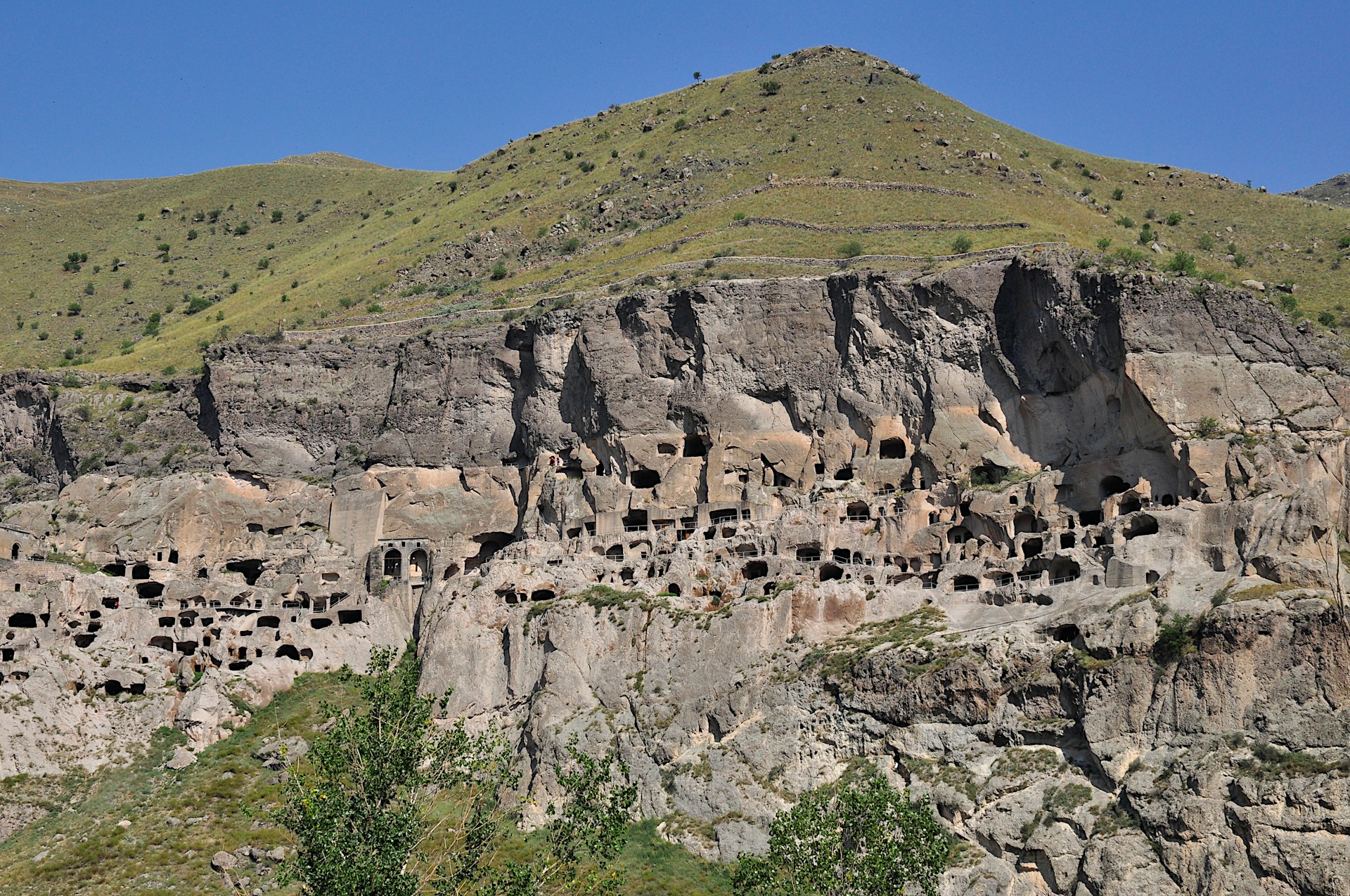

City view of Vardzia, Georgia

Vardzia

Carved into the cliffs above the Kura River in southern Georgia, Vardzia stands as one of the most ambitious monastic complexes of the medieval world. Commissioned by Queen Tamar in the late 12th century, its rock-cut facades conceal a labyrinth of more than 6,000 chambers, including churches adorned with frescoes, wine cellars, dormitories, and hidden tunnels. The principal Church of the Dormition captivates with vibrant murals depicting biblical scenes and regal patrons. Hike the slopes above to discover the Mausoleum of Erusheti and panoramic viewpoints overlooking the Erusheti Valley. Despite seismic damage over centuries, extensive restorations have preserved much of Vardzia’s intricate architecture and sacred atmosphere. Nearby guesthouses host evening presentations on Georgian orthodoxy and monastic traditions, while local guides lead excursions to the nearby Khertvisi Fortress. Vardzia’s fusion of spiritual devotion, rock-hewn engineering, and rugged landscape makes it a singular testament to Georgia’s medieval ingenuity.

Top attractions & things to do in Vardzia

If you’re searching for the best things to do in Vardzia, this guide brings together the top attractions and must-see places to visit in Vardzia. The top picks below highlight the most visited sights for first-time visitors, plus a few local favorites worth adding.

Church of the Dormition in Vardzia, Georgia

Church of the Dormition

As the spiritual nucleus of Vardzia, the Church of the Dormition was consecrated in 1187 and showcases remarkable Georgian-Byzantine artistry. Its interior walls are adorned with vibrant 13th-century frescoes, including the rare portrait of Queen Tamar flanked by bishops, symbolizing the fusion of royal and ecclesiastical power. A recently restored iconostasis features carved cedar wood panels in Mozarabic style—an influence from pilgrims traveling the Iberian route. Beneath the altar lies a crypt where fragments of 12th-century liturgical objects were found buried during a 2005 conservation excavation. The church’s dome, supported by four massive columns hewn from the cliff face, channels acoustics that still resonate Gregorian chants during annual feast day services on August 15th. Exterior niches once served as monastic reading alcoves, and a side chamber houses an engraved stone slab marking the meeting of Georgian and Armenian clerics in 1191. As both an architectural marvel and a living house of worship, the Church of the Dormition remains central to Vardzia’s sacred landscape.
Ads place
Ads place
Ads place
Ads place
Ads place
Hidden Spring Tunnel in Vardzia, Georgia

Hidden Spring Tunnel

One of Vardzia’s most intriguing engineering feats is the Hidden Spring Tunnel, a narrow 100-meter passage built in 1188 to channel fresh water from a perennial mountain spring into the cave city during sieges. Long sealed and forgotten, it was rediscovered by spelunkers in 2001 and partially reopened for guided tours. The tunnel’s interior walls bear chalked inscriptions from medieval builders marking water flow rates—an early example of Georgian hydrology. Visitors must crouch beneath rock overhangs as they follow the trickling stream toward its source, passing small alcoves once used to store ritual oils. At the spring’s emergence point, a reconstructed cistern and basin exhibit the monastics’ sophisticated water distribution network. Seasonal water flow surges during spring melt, reminding modern explorers of the challenges medieval residents faced. The Hidden Spring Tunnel remains a testament to Vardzia’s combination of spiritual devotion and practical ingenuity.
Ads place
Ads place
Ads place
Ads place
Ads place
Main Cave Complex in Vardzia, Georgia

Main Cave Complex

Cut into the soft tuff cliffs of the Erusheti Valley, the Main Cave Complex at Vardzia dates from the reign of Queen Tamar in 1185. Comprising over 6,000 chambers on thirteen levels, it includes churches, monk cells, wine cellars, and a network of 1,500 windows overlooking the Kura River. A highlight is the Church of the Dormition, whose well-preserved frescoes depict biblical scenes alongside regal portraits of Queen Tamar herself. Visitors descend narrow tunnels that once allowed defenders to seal off sections during Mongol invasions in the 13th century. Archaeologists in 2010 rediscovered a hidden stairwell leading to a natural spring, providing fresh water in sieges. Despite a major earthquake in 1283 that collapsed much of the city, the lower tiers remain intact and accessible. At sunset, shafts of light illuminate the honey-colored rock, casting an ethereal glow over ancient niches and arched corridors. A guided tour reveals how scribes produced illuminated manuscripts here, making Vardzia both a spiritual center and a medieval “city of art.”
Ads place
Ads place
Ads place
Ads place
Ads place
Monastic Wine Cellars in Vardzia, Georgia

Monastic Wine Cellars

Hidden beneath the Third Gallery, Vardzia’s Monastic Wine Cellars span over 1,200 m² and housed up to 5,000 qvevri (clay amphorae) used for fermenting sacred sacramental wine. Excavations in 2015 uncovered original 12th-century amphora fragments sealed with beeswax and local resins. The cellars’ vaulted ceilings, carved directly into volcanic tuff, maintained a constant cool temperature ideal for long-term aging. A recently installed glass floor section reveals an ancient drainage system channeling runoff away from the wine stores. Monastic ledger inscriptions, translated in 2018, record donations of “precious lees” from noble patrons, highlighting wine’s spiritual and economic role in Vardzia’s daily life. Visitors to the cellars often encounter the residual scent of fermenting grapes, creating an immersive sensory link to medieval viniculture. A commemorative plaque marks where the head monk would sample the vintage, emphasizing the blend of asceticism and agricultural expertise that sustained this mountaintop monastery.
Ads place
Ads place
Ads place
Ads place
Ads place
Queen Tamar’s Viewpoint in Vardzia, Georgia

Queen Tamar’s Viewpoint

Named in honor of Vardzia’s founder, Queen Tamar’s Viewpoint crowns the highest accessible terrace, offering commanding panoramas of the Erusheti Valley and the distant Javakheti Highlands. According to legend, Queen Tamar would survey her realm from this spot, ensuring the safety of her monastic city. A 2012 restoration revealed carved stone benches—once thought to be prayer ledges—inscribed with Georgian alphabets dating to 1190. The stone railing incorporates reused fragments from an earlier 11th-century church, blending architectural phases. Visitors reaching the viewpoint traverse a narrow spiral corridor that once served as a defense gallery. Seasonal wildflowers—particularly the endemic Vardzia violet—bloom in spring, painting the terraces with purple hues. Birdwatchers prize the vantage point for spotting raptors riding thermal updrafts along the cliff edge. At golden hour, sunlight filters through residual smoke from altar incense, evoking the medieval scenes immortalized in the complex’s frescoes. Queen Tamar’s Viewpoint thus offers both historical resonance and natural splendor.
Ads place
Ads place
Ads place
Ads place
Ads place