
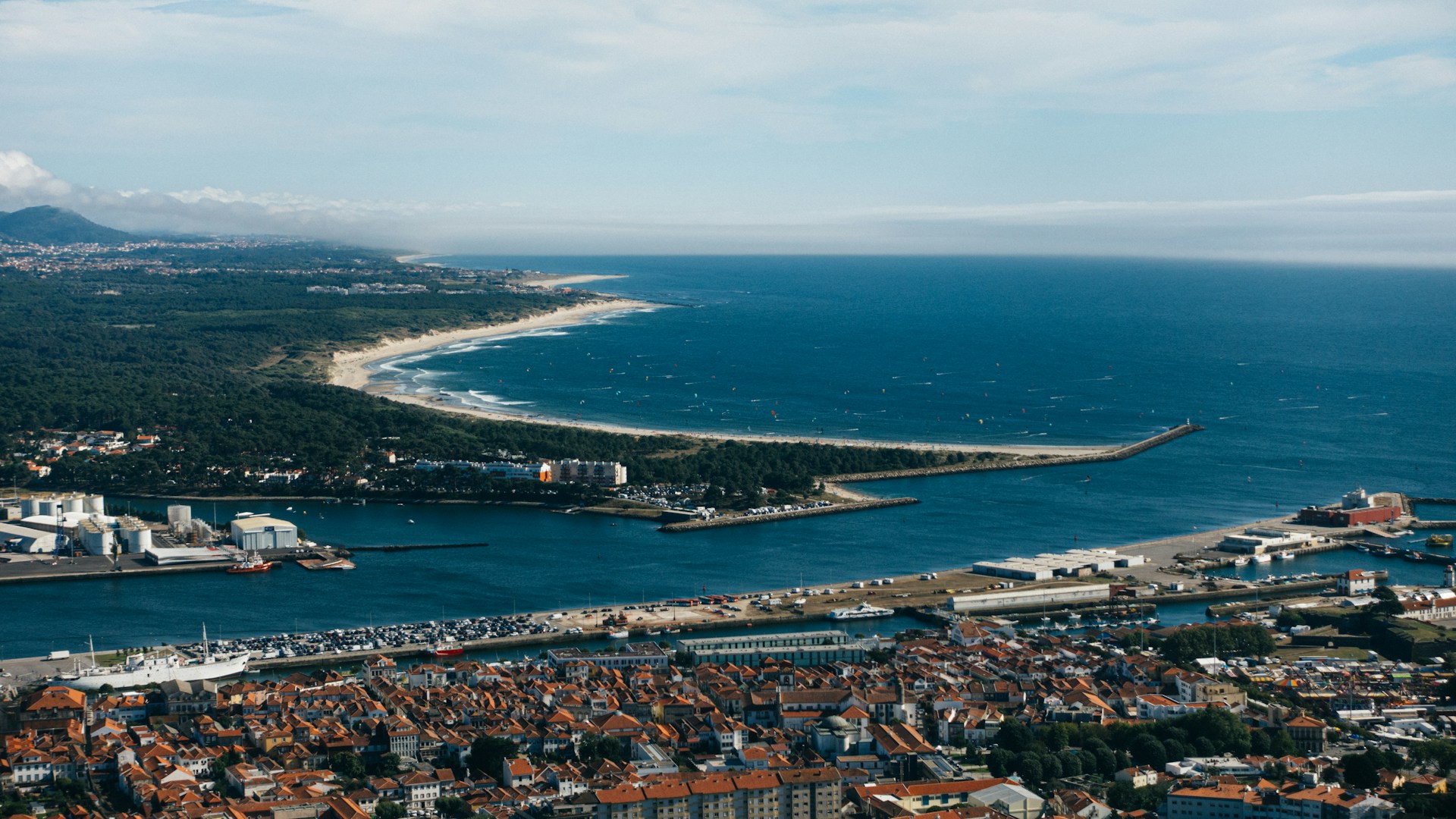
City view of Viana do Castelo, Portugal

Viana do Castelo

Viana do Castelo leans into river and ocean, a shipbuilding town that dresses gladly for festivals. The hilltop sanctuary of Santa Luzia crowns the skyline with a rose window modeled after Sacre Coeur, reached by a funicular that saves knees for later. Down below, filigree goldwork gleams in workshops where patience still outshines fashion cycles. Pilgrims, surfers, and engineers share trains, and all find what they came for. The local cake, bolas de Berlim on the beach, competes with caldo verde in the square for pure comfort. A maritime museum tells how cod fleets met the North Atlantic and came home with stories in salt. For a quirk to file away, the city maintains a festival parade of giant puppets with outrageous eyebrows, a tradition that proves humor floats as reliably as any boat here. Sunset from the iron bridge turns the Lima River into a mirror, and the shipyards into shadow drawings.

Top attractions & things to do in Viana do Castelo

If you’re searching for the best things to do in Viana do Castelo, this guide brings together the top attractions and must-see places to visit in Viana do Castelo. The top picks below highlight the most visited sights for first-time visitors, plus a few local favorites worth adding.

Ads place
Ads place
Ads place
Ads place
Ads place
Ponte Eiffel (Eiffel Bridge) in Viana do Castelo, Portugal

Ponte Eiffel (Eiffel Bridge)

Iron trusses step across the Lima with the calm logic of an equation, a double-deck span attributed to the firm of Gustave Eiffel in the late 19th century. Up top, road traffic once crept between lattice shadows; below, rails stitched Viana to the rest of the coast. The bridge’s riveted joints and slim piers read like a manual on how to make heavy materials feel light, especially when the tide mirrors every triangle. Stand midspan and shipyards, beaches, and Santa Luzia line up as if arranged by a careful hand. Engineers admire the modular rhythm; photographers come for evening when the metal warms to amber. Local memory ties the structure to departures—students, sailors, and cod fishermen—each wave underlining the city’s pact with water. Surviving retrofits and storms, the bridge proves that infrastructure can age into sculpture, its lattice now as much a signature as a solution.
Ads place
Ads place
Ads place
Ads place
Ads place
Praca da Republica and Igreja da Misericordia in Viana do Castelo, Portugal

Praca da Republica and Igreja da Misericordia

Granite arcades draw a rectangle for civic life, with a Renaissance fountain keeping time in the center. On one side, the Igreja da Misericordia presents a facade that marries Renaissance restraint to later Baroque flourish, while its interior unfolds azulejos and gilded wood like a carefully told secret. The old Town Hall watches from the opposite wing, and market stalls sometimes return to remind passersby that commerce built the stones beneath their feet. Sit long enough and you will notice how shadows from the arcades advance like careful brushstrokes across the paving. In festival season, giant heads parade under balconies, a local tradition with eyebrows as expressive as speeches. Cafes tune the square with rattling cups, and conversations echo under vaults that have weathered reform and rain since the 16th century. At dusk, lamps turn the granite honey-warm, and the square becomes a theater where the city plays itself with affectionate discipline.
Ads place
Ads place
Ads place
Ads place
Ads place
Praia do Cabedelo in Viana do Castelo, Portugal

Praia do Cabedelo

Across the river mouth, a crescent of sand faces the open Atlantic and the prevailing Nortada, a daily wind that draws kites and sails like magnets. Dunes stabilized by hardy grasses protect the backshore, and a fringe of pine forest cools the boardwalks that thread to the water. On good days, the bar at the Lima paints tidy lines for surfers; on wilder days, the estuary muscles its own agenda. Beach cafés keep watch with espresso and grilled fish, and rental shacks translate wind charts into friendly advice. The area’s Blue Flag status tells you the basics—clean water, lifeguards, respect for the dune system—are handled with care. Look north and the Santa Luzia sanctuary crowns the skyline, a stone metronome for changing weather. Stay for the blue hour, when sails come down and the beach writes its last lines in ripples and footsteps that the tide politely erases by morning.
Ads place
Ads place
Ads place
Ads place
Ads place
Santuario de Santa Luzia in Viana do Castelo, Portugal

Santuario de Santa Luzia

High above the Lima valley, a hilltop basilica gathers sky, granite, and a viewpoint that resets your internal compass. The design blends neo-Byzantine curves with Portuguese stonecraft, and its vast rose window—among the largest in Iberia—filters daylight into petals. Construction stretched from 1904–1959, so styles converse across decades without quarrel. Ride the funicular from town and the ascent becomes part of the ritual, gliding past terraces where broom and heather take turns perfuming summer. Inside, chapels borrow quiet from the walls, while the dome’s gallery frames surf and shipyards in one slow circle. Architects nodded across the Atlantic to Paris, echoing Sacre Coeur without copying it, and the result feels local even when it gestures abroad. Pilgrims mingle with picnickers, and the breeze edits conversations into fragments. Return at dusk and the sanctuary becomes a lantern for the city, a steady companion to fishermen reading the Atlantic at the river mouth.
Ads place
Ads place
Ads place
Ads place
Ads place