
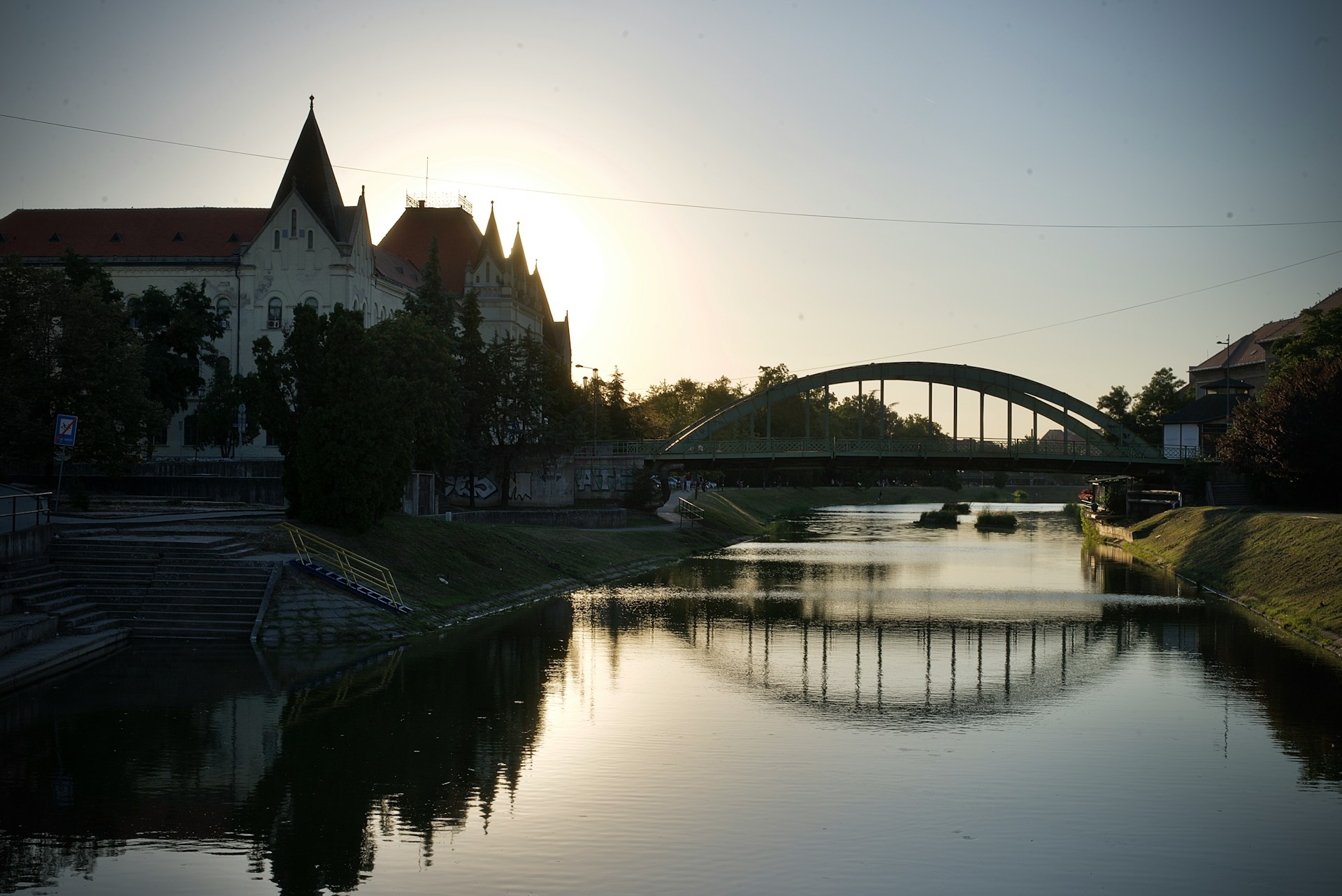
City view of Zrenjanin, Serbia

Zrenjanin

Zrenjanin thinks in canals and rectangles, letting the old Begej bend through squares where Secession curves and neoclassical lines negotiate terms. City Hall blushes in soft color, and the theatre rehearses with a schedule that outpaces most calendars. Langos emerges from oil in a fractal of bubbles, best sprinkled with cheese and a suspicion of garlic. Cyclists drift to Carska Bara, a wetland classroom where herons write long notes over reeds. The museum files local industry into drawers you actually want to open, from enamelware to sugar. Farmers’ markets weigh sunflower seeds by the kilo, and every grandmother has a theory about the correct pot for beans. An eccentric pleasure lives in a bridge whose railings attract padlocks; some are engraved, some are improvised with nail polish. Zrenjanin moves steadily rather than fast, and by day’s end you realize you have matched its pace without trying.

Top attractions & things to do in Zrenjanin

If you’re searching for the best things to do in Zrenjanin, this guide brings together the top attractions and must-see places to visit in Zrenjanin. The top picks below highlight the most visited sights for first-time visitors, plus a few local favorites worth adding.

Carska Bara Special Nature Reserve in Zrenjanin, Serbia

Carska Bara Special Nature Reserve

Willow galleries fold over quiet channels and herons write brief signatures on the air as boats slide through reed corridors. Carska Bara belongs to the Ramsar family of protected wetlands and spreads between the Begej backwaters and the Tisza, a floodplain grammar that rewards patient looking. Rangers keep a light hand so seasonal water can redraw edges and keep biodiversity honest. Visitors learn to spot the elegant flight of the black stork and the sudden punctuation of kingfishers while carp dimple the surface like small weather. Information boards explain how traditional fishing and meadow cutting once synchronized with the river’s moods and how modern care tries to imitate that wisdom. Even the silence feels designed, a soft room where wind becomes the guide. You return to town with slower steps and the conviction that useful landscapes can remain beautiful when respect is part of the management from the start
Ads place
Ads place
Ads place
Ads place
Ads place
Cathedral of St John Nepomuk in Zrenjanin, Serbia

Cathedral of St John Nepomuk

A calm facade faces the boulevard and twin towers lift the eye before the door opens to a nave tuned for measured light. Dedicated to St John Nepomuk, the cathedral carries the clarity of Classicism softened by Baroque memory, a blend that suited a multicultural community under the Austro-Hungarian administration. The organ speaks warmly into a space designed for choral sound and the altars frame saints with local features that make reverence feel close to daily life. Parishes recorded baptisms and repairs across the 19th century, turning ledgers into a patient chronicle of resilience. Outside, schools and courtyards fold the church into the city so sacred and ordinary share the same rhythm without friction. At sunset the towers take on a honeyed tone and bells pass cleanly over rooftops. The cathedral proves that dignity can be welcoming and that architecture can steady a neighborhood simply by keeping its promises day after day.
Ads place
Ads place
Ads place
Ads place
Ads place
City Hall and Liberty Square in Zrenjanin, Serbia

City Hall and Liberty Square

The square opens like a stage and the City Hall sets the tone with brick, tile, and a tower that keeps dependable time over the river town. Zrenjanin grew as a trading node of the Banat, learning administrative confidence under the Austro-Hungarian crown and updating its center through the 19th century. Look closely and you can read a dialogue between late historicism and the floral ease of Secession ornament that arrived with new prosperity. Offices inside still hum with everyday paperwork while the ceremonial hall hosts weddings that turn civic space into family memory. Cafes ring the square and the Begej nearby reminds visitors that the city’s horizon has always been watery and practical. Evening light warms the facade and the tower views arrange streets into a legible map. The ensemble convinces you that a town hall can be both a working machine and a generous invitation to linger, a polite anchor for markets, concerts, and unhurried conversations.
Ads place
Ads place
Ads place
Ads place
Ads place
Ecka Castle Kastel in Zrenjanin, Serbia

Ecka Castle Kastel

Beyond fields of the Banat a pale mansion appears with a portico that seems to hold its breath for arriving carriages. The residence opened in 1820 and drew notables from across the region, including a youthful Franz Liszt whose recital became part of the house lore. Built in a restrained classicist key that suited the Habsburg frontier, the property organized orchards, stables, and salons into a landscape of measured ease. Stories about hunting weekends and diplomatic lunches survive in guest books and the echo of porcelain on wood. Later decades added repairs without bullying the original line so today the rooms still perform graciously for weddings and quiet retreats. The approach road teaches anticipation and the terrace rewards it with big sky and honest light. Ecka proves that hospitality can be architecture and that a country house can hold music, memory, and conversation in a single confident breath
Ads place
Ads place
Ads place
Ads place
Ads place
National Museum Zrenjanin in Zrenjanin, Serbia

National Museum Zrenjanin

Galleries move from prehistory to the present with the assurance of a good editor who trusts objects to speak. The museum’s story is anchored in the Banat plain where migration and rivers braided trades across centuries. Rooms pair Roman fragments with medieval tools, then follow households through the long shadow of the Ottoman era into Habsburg reforms and urban craft. Curators favor context over clutter and invite visitors to read textiles beside maps so technique and geography share the explanation. A sober section treats the 20th century with photographs and documentation that keep dates honest and personal. Temporary shows bring contemporary artists into conversation with the archive which keeps the building alert rather than reverent. You leave with a pocket of well organized time and the sense that Zrenjanin’s identity is a collaboration between fields, workshops, and streets that still remember how to work together
Ads place
Ads place
Ads place
Ads place
Ads place