
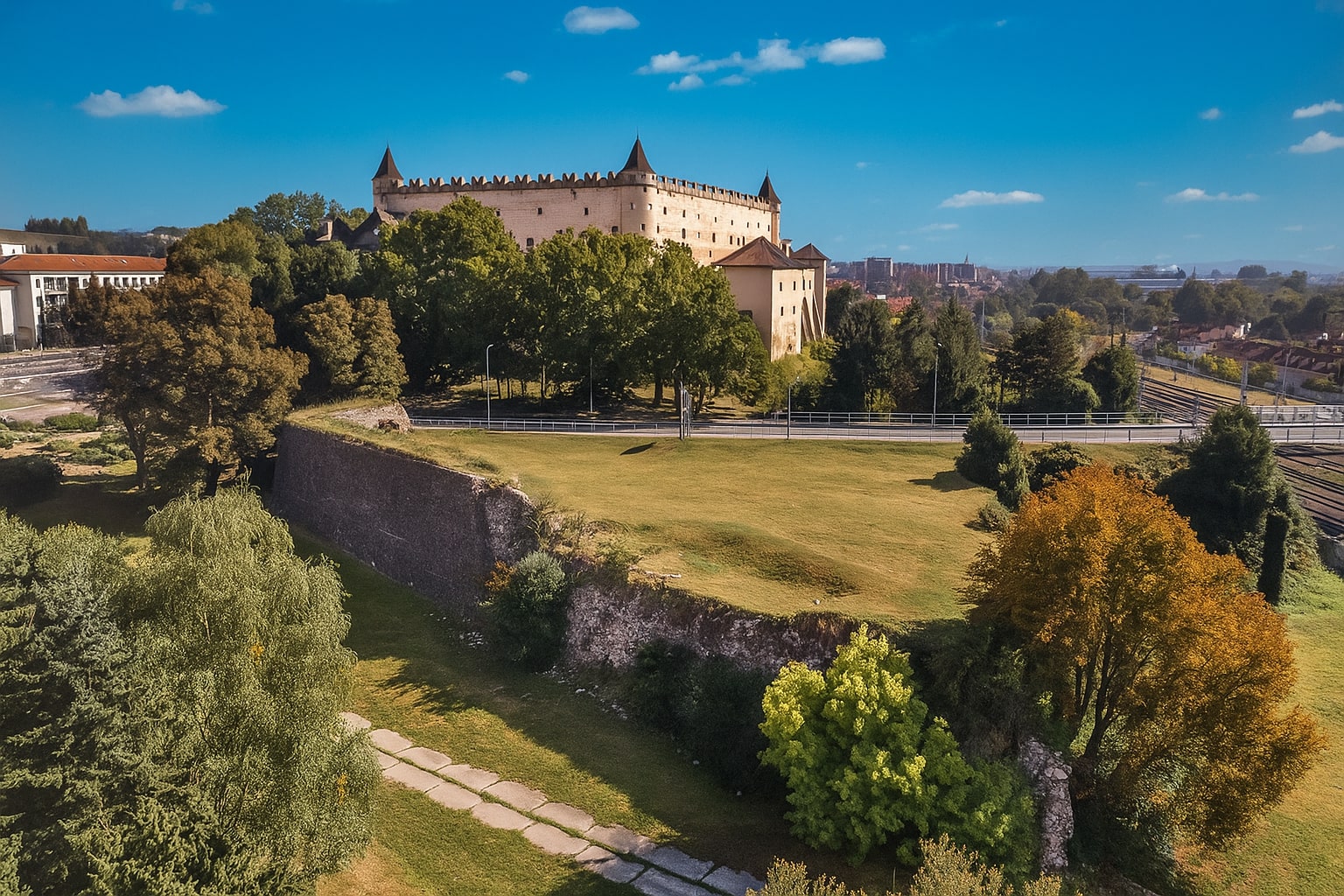
City view of Zvolen, Slovakia

Zvolen

Zvolen sits where forest, rail, and castle shake hands. The square is vast enough for festivals yet cozy when the pastry stalls arrive. Zvolen Castle feels like a furnished time machine, hosting exhibitions that slide from Gothic art to modern printmaking without jolts. Rail buffs love the roundhouse museum where steam engines nap like retired athletes. Order venison in autumn, then walk fifteen minutes to Pusty hrad, the extensive hilltop ruins that deliver views as their ticket price. Students from the forestry faculty give the city an outdoorsy wit, and cafes display botanist sketches next to latte art. Evening conversations often shift from hockey to mushroom seasons and nobody finds the transition odd. Trivia of the lovable sort, an old oak near the river serves as a community noticeboard, covered with small carved messages that locals read like headlines on the way to work.

Top attractions & things to do in Zvolen

If you’re searching for the best things to do in Zvolen, this guide brings together the top attractions and must-see places to visit in Zvolen. The top picks below highlight the most visited sights for first-time visitors, plus a few local favorites worth adding.

Forestry and Timber Museum in Zvolen, Slovakia

Forestry and Timber Museum

On the fairground side of town, a museum turns practical labor into readable history. Founded in the late 19th century—records from the 1890s suggest early collections—it follows wood from seed to beam with tools, models, and field notes that smell faintly of resin. Exhibits explain silviculture as a discipline rather than a slogan: rotation ages, slope logistics, and why mixed stands hedge against weather and pests. A corner on steam-era saws demonstrates belts, flywheels, and guards that kept fingers attached when efficiency was new. Dendrochronology gets a clear table: rings, dates, and climate in polite conversation. Children test grain direction with planes; technicians monitor humidity with the calm of archivists. A small gallery covers timber architecture from cottages to trusses, reminding visitors that joinery is mathematics wearing wood. Outside plots show species lines and windbreak logic, and a panel on seed banks explains how tomorrow’s forests are stored today.
Ads place
Ads place
Ads place
Ads place
Ads place
Pusty Hrad (Deserted Castle) in Zvolen, Slovakia

Pusty Hrad (Deserted Castle)

Take the wooded path above town and the hill opens into one of Central Europe’s largest castle sites. Pusty Hrad spreads across twin plateaus—Upper and Lower—covering roughly 7.6 hectares, a scale that surprises even seasoned hikers. Foundations trace a story from the 12th century through the 13th century, when perimeter walls learned to fold with the terrain and gates turned approach routes into strategy. Archaeological seasons since the 1990s mapped towers, cisterns, and a great courtyard where supply met command; on calm days you can picture carts negotiating gradients with quiet stubbornness. Panels explain how masons balanced weight, lime, and quarry distances, while a diagram of fortification phases makes the ruins legible to non-specialists. The view stitches river, roads, and Zvolen Castle into one frame, a geography lesson delivered without chalk. Bring water and a respectful pace: the site rewards patience, and the wind edits modern noise into something closer to medieval time.
Ads place
Ads place
Ads place
Ads place
Ads place
SNP Square and Town Hall in Zvolen, Slovakia

SNP Square and Town Hall

If Zvolen has a living room, this is it: a long rectangle where errands become promenades and history prefers conversations to speeches. Facades carry Renaissance and later rhythms over older plots, while cafes keep doors ajar like friendly stage wings. A Marian column—often dated to the early 18th century—anchors the center, and plaques fold the 1944 Slovak National Uprising into everyday routes so memory shares the pavement. The Town Hall manages dignity without theatrics; inside, council rooms display seals and bylaws that once synchronized markets and manners. Street trees cool summer heat, and benches make excellent observation posts for local choreography: cyclists, strollers, punctual buses. Look for faint sgraffito and a portal with a Gothic profile reused during rebuilding, proof that thrift can also be preservation. Evenings bring a second light to stucco, and the square turns reflective in every sense. It is urbanism at human scale—public space that edits noise, rewards loitering, and makes punctuality feel like courtesy.
Ads place
Ads place
Ads place
Ads place
Ads place
Zvolen Castle in Zvolen, Slovakia

Zvolen Castle

Walk across the lawn and the castle looks more like a residence that learned self-defense than a fortress itching for trouble. Raised in the later 14th century under the patronage of Louis I of Hungary, the ensemble blends Gothic bones with later Renaissance comforts: a square courtyard, arcades that collect light, and rooms planned for ceremony as much as security. Today a branch of the Slovak National Gallery fills the interiors with paintings and furniture that make the walls conversational rather than mute. Guides point out fireplaces designed as micro-theatres and a banquet hall whose proportions flatter human voices. Conservation campaigns in the 20th century stabilized vaults without sanding away character, and small placards explain tools, limes, and patient scaffolding. From the parapet you read river and road like an old logistics diagram; from the courtyard you hear the city in a softer key. Come late afternoon—stone turns honey-colored and the arcades behave like a sundial for visitors who linger.
Ads place
Ads place
Ads place
Ads place
Ads place
Zvolen Railway Depot Open-Air Collection in Zvolen, Slovakia

Zvolen Railway Depot Open-Air Collection

Follow the rails to the depot and you enter a classroom built of iron, grease, and schedules. An open-air line-up of rolling stock traces technology from coal breath to diesel hum, with a working turntable that still teaches geometry by example. Yard notes place key sheds to the early 20th century, while the station area grew after the 1870s as trunk routes stitched the region to budgets and timetables. Docents translate gauges, brakes, and couplers into human terms; children learn why buffers matter and why whistles were once safety, not romance. A diagram of signaling logic sits beside levers whose paint keeps the memory of hands. On event days a steam demonstration perfumes the air; on quiet mornings you hear metal cool and tick as if the yard were thinking. The collection argues that railways invented modern punctuality—and that maintenance is a civic virtue. Bring a camera and time; both will be rewarded.
Ads place
Ads place
Ads place
Ads place
Ads place